
Choosing to drive a Tesla in 2026 means owning one of the most advanced energy storage systems on the planet. But let’s be real—the Tesla Battery is also the most scrutinized (and expensive) part of your car.
Think of me as your personal EV wellness coach. Today, we’re moving past “range anxiety” and diving into the hard numbers: what does a tesla battery replacement cost in 2026? How does the tesla battery warranty actually protect you? And most importantly, how do you make this “heart of the machine” last for a half-million miles?
1. The 2026 Reality Check: How long do tesla batteries last?
For years, skeptics predicted EVs would need new batteries every few winters. The 2026 real-world data proves them wrong.
The 500,000-Mile Engineering Goal
Tesla batteries are designed to outlast the chassis. According to a March 2026 study of over 50,000 high-mileage vehicles, the average Tesla retains 88% to 92% of its capacity even after crossing the 150,000-mile mark.
The “Settling” Period vs. Long-Term Health
Don’t panic during your first year! It is perfectly normal to see a 3% to 5% drop in range during the first 20,000 miles. This isn’t damage; it’s the lithium-ion chemistry stabilizing.
- Real-World Case: Mark, a ride-share driver from Chicago, has a 2023 Model 3 with 180,000 miles. “I lost about 4% in the first 10 months,” Mark says, “but since then, it’s been rock solid. I’m still at 90% health after nearly 200,000 miles of daily driving.”
2. Protection Plan: Decoding the Tesla Battery Warranty
In early 2026, Tesla officially expanded its Extended Service Agreement (Battery ESA) for Model 3 and Model Y, providing a much-needed safety net for second-hand buyers and long-term owners.
2026 Warranty Coverage at a Glance
Tesla guarantees that your battery will retain at least 70% of its capacity over the warranty period. If it dips to 69% within the window, they will repair or replace the pack at $0 cost to you.
| Model | Warranty Period | Mileage Limit |
| Model S & Model X | 8 Years | 150,000 Miles |
| Model 3 & Y (Long Range) | 8 Years | 120,000 Miles |
| Model 3 & Y (RWD/LFP) | 8 Years | 100,000 Miles |
| Cybertruck | 8 Years | 150,000 Miles |
Pro Tip: In 2026, you can now purchase a “Battery Top-Up” warranty via the Tesla App for an extra 2 years or 30,000 miles (costing roughly $1,800 – $2,200). If you plan to keep your car past the 10-year mark, it’s a brilliant investment.
3. The Big Question: Tesla Battery Replacement Cost
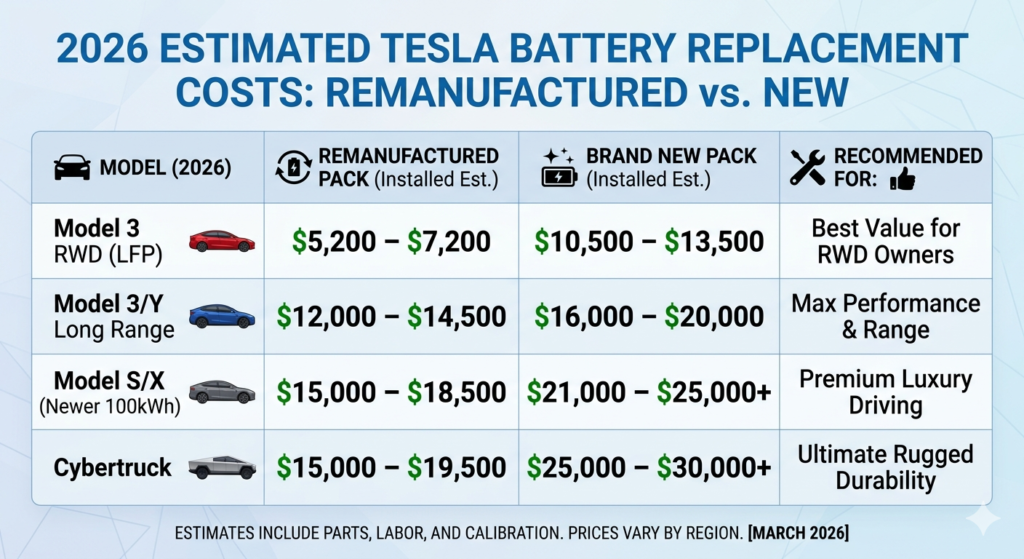
What if you’re out of warranty and the worst happens? In 2026, the tesla battery replacement cost has actually stabilized due to better recycling tech and a surplus of “remanufactured” packs.
| Model (2026 Est.) | Remanufactured Pack (Installed) | Brand New Pack (Installed) |
| Model 3 RWD (LFP) | $5,200 – $7,200 | $10,500+ |
| Model Y / 3 Long Range | $12,000 – $14,500 | $16,000+ |
| Model S / X (100 kWh) | $15,000 – $18,500 | $21,000+ |
Labor Insight: Expect to pay between $600 and $2,200 in labor. A seasoned Tesla technician can swap a Model Y pack in about 3.5 hours, while older Model S cars might take up to 12 hours due to their complex cooling lines.
4. Pro Tips: 8 Habits for a Healthy Battery
Treating your Tesla Battery like an athlete involves specific “nutrition” and “recovery” routines.
NCA vs. LFP: Different Rules Apply
- Identify Your Pack: Go to Controls > Software > Additional Vehicle Information.
- LFP Batteries (Model 3 RWD): Charge to 100% at least once a week. This keeps the “brain” (BMS) calibrated.
- NCA/NCM Batteries (Long Range/Performance): Set your daily limit to 80%. Only go to 100% right before a long road trip.
Extreme Weather Survival
- Heat is the Enemy: Temperatures above 100°F (38°C) can stress the cells. Always park in the shade or a garage on blistering days.
- The “Precondition” Ritual: In winter (below 32°F), use the Tesla App to warm the battery 15 minutes before leaving. This uses grid power to “thaw” the chemistry, increasing efficiency by up to 15%.
- Avoid the “Red Zone”: Never let your Tesla sit below 10% for more than a few hours. Deep depletion is the leading cause of “bricked” packs.
- ABC (Always Be Charging): If you’re at home, plug it in! The car’s computer prefers grid power for its background “vitals” rather than draining its own reserves.
- Smooth is Fast: Aggressive acceleration generates heat. Using “Chill Mode” during hot summer months can actually extend your battery’s chemical lifespan.
5. FAQ: Everything You’re Itching to Ask
Q: How long do tesla batteries last in total years? A: Most 2026 data points to 18–25 years of road-capable service. Even after retirement, these packs are often sold for “second-life” home energy storage (like a DIY Powerwall).
Q: Does Supercharging damage the battery? A: Occasional road trips are fine. However, cars that use Superchargers for 80% or more of their total energy see about 1.2% extra degradation per year compared to home-charged cars.
Q: Can I check my own battery health? A: Yes! In 2026, you can run a Battery Health Test through the in-car Service Mode or the Tesla App. It takes about 24 hours to complete while plugged in.
Conclusion: Drive More, Worry Less
The Tesla Battery is a marvel of 2026 engineering. While the potential tesla battery replacement cost might seem like a scary number, the reality is that the tesla battery warranty and the sheer longevity of these cells make it one of the most reliable parts of the car.
My warm advice? Stop obsessing over the percentage. Set your limit, plug in at night, and enjoy the drive. Your Tesla is built for the long haul—and now, you have the expertise to make sure it stays that way.