
Key Takeaways
- Electronic Blind Spot Monitoring (BSM) has real limitations — it struggles with stationary objects, cyclists at certain angles, and fast-approaching vehicles; a physical mirror fills these gaps
- Placement matters more than the mirror itself — the most common mistake is sticking it in the wrong corner, which blocks either the BSM warning light or the mirror heating element
- Glass outperforms plastic in every category except price — clarity, scratch resistance, and how it handles glare at night are all noticeably better
- The Post-it Test before installing — tape a piece of paper where you think the mirror should go, drive for a day, and confirm the position works before applying the permanent adhesive
- Convex mirrors make objects look farther away than they are — understanding this distortion is the single most important thing to know before relying on a blind spot mirror
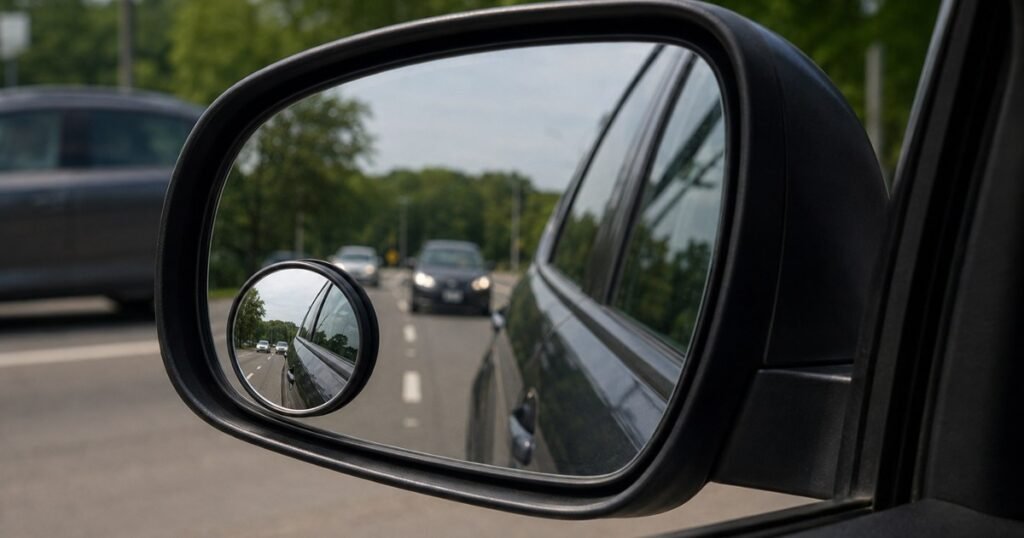
Why Modern Cars Still Need Blind Spot Mirrors
Many newer cars already come with Blind Spot Monitoring (BSM), lane assist, and warning alerts — so adding a small stick-on mirror might seem unnecessary.
But many drivers notice the same problem after switching to a new car: the technology helps, but it does not completely remove every blind spot.
A BSM light can warn you when a vehicle enters its detection zone, but it cannot always give you a clear view of what is actually beside your car — especially during quick lane changes, heavy traffic, parking, or situations involving cyclists and smaller vehicles.
That is where a physical blind spot mirror still helps. It is not a replacement for modern safety systems. It simply gives you another layer of visibility before you make a move.
There are three scenarios where physical blind spot mirrors consistently earn their place:
Highway merging: The angle and speed required to check a mirror while maintaining lane position is precisely the scenario where a wide-angle convex view is most useful.
City driving and parking: Cyclists, pedestrians, and narrow gaps — BSM isn’t tuned for these distances, and a wide-view mirror catches what a standard side mirror misses.
Larger vehicles: SUVs and trucks have larger blind zones than sedans. The rear pillars are wider, the side mirrors are further from your eye, and the whole geometry means more is hidden. A wide-angle convex mirror on a truck does more than the same mirror on a compact sedan.
Best Blind Spot Mirrors for Different Drivers
We focused on the factors that matter most in everyday driving: visibility, glass clarity, placement flexibility, adhesive reliability, and compatibility with modern features like heated mirrors and BSM indicators.
Best Overall: Frameless HD Glass Blind Spot Mirror
For daily drivers who want clean aesthetics and reliable performance, a frameless HD glass mirror in the 2-inch range is the default recommendation. The frameless design sits flush against the side mirror glass and looks close to OEM — from a distance, it’s barely visible. HD glass provides genuine clarity in both daylight and nighttime driving, and the harder surface resists the micro-scratches that degrade plastic mirrors within a few months.
Best for: Sedan and crossover drivers who want a clean look and reliable performance.
What Matters Most:
For larger vehicles, prioritize wider coverage without excessive distortion. The best mirrors provide extra visibility around rear corners while still allowing accurate judgment with your main side mirrors.
Best Adjustable Mirror for Beginners and Multi-Driver Households
Adjustable blind spot mirrors have a small ball joint between the mirror and the adhesive base, allowing the viewing angle to be changed without removing and reapplying the mirror. For new drivers still learning their preferred angles, or households where multiple people drive the same car, this flexibility is genuinely useful.
The trade-off is real: adjustable mirrors can shift during car washes, especially touchless washes with high-pressure jets. They’re also slightly more prone to vibration at highway speeds. If you choose adjustable, check the angle after every car wash and periodically during long drives.
Best for: New drivers, families with multiple drivers, anyone who isn’t sure yet where they want the angle set.
What Matters Most: A ball joint with genuine resistance (not loose out of the box), locking mechanism if available, quality adhesive pad.
Best Wide-View Mirror for SUVs and Trucks
Larger vehicles need larger coverage. A 3-inch wide-angle convex mirror — or a rectangular wide-view design — provides substantially more coverage of the rear quarter than a standard 2-inch round mirror.
One important note specific to trucks: the side mirrors are already significantly larger and further outboard than sedan mirrors. The blind spot mirror needs to be positioned in the upper or outer corner where it extends the view beyond the standard mirror’s coverage, not duplicating what the main glass already shows.
Best for: SUVs, pickup trucks, vans, or anyone towing.
What Matters Most: Minimum 3-inch diameter or equivalent rectangular area, distortion-minimized glass rather than maximum-curvature plastic.
Quick Comparison: Which Blind Spot Mirror Should You Choose?
| Type | Best For | Pros | Cons |
|---|---|---|---|
| Frameless HD Glass (2″) | Daily drivers, sedans | Clean look, durable, clear | Fixed angle |
| Adjustable Ball-Joint | Beginners, multi-driver | Angle flexibility | Can shift in car wash |
| Wide-Angle (3″+) | SUV, trucks | Maximum coverage | More visible on mirror |
| Wedge/Fan-Shaped | OEM-look preference | Low profile | Smaller view area |
Round vs Wedge vs Adjustable: Which Shape Works for Your Car
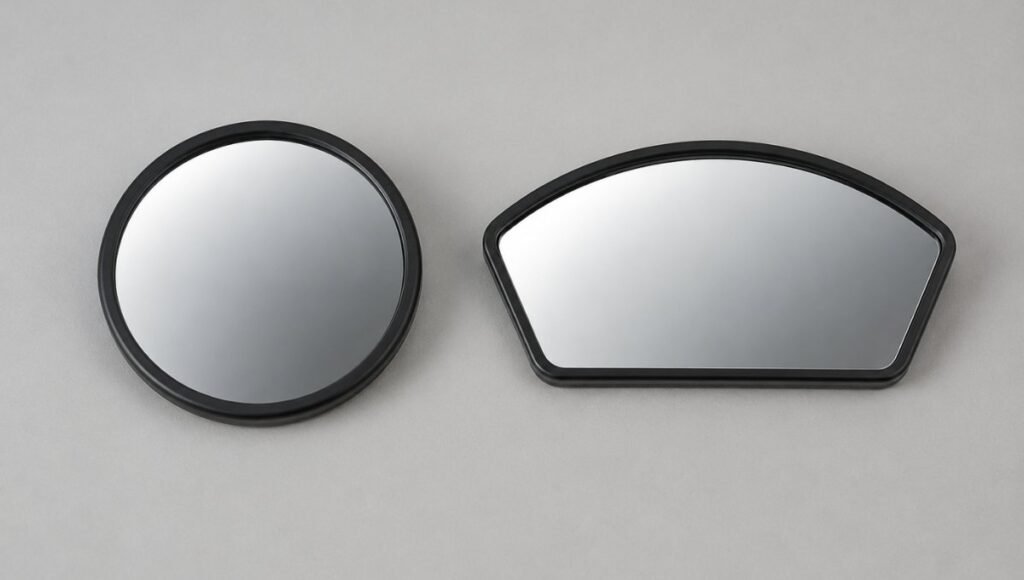
Round Blind Spot Mirrors
The classic shape. A circular convex mirror provides the widest viewing angle relative to its size. A 2-inch round mirror covers more area than a 2-inch wedge. The trade-off is that it sits on the mirror glass as a visible disc — more noticeable than the wedge design.
Round mirrors work best in the lower outer corner of the side mirror, where they extend the view downward and outward into the lane beside you.
Wedge-Shaped (Fan) Mirrors
A fan or wedge shape fits along the bottom or side edge of the mirror glass, creating a lower profile that blends more naturally with the mirror housing. Less field of view than a round mirror of equivalent size, but visually cleaner and less likely to feel like an afterthought.
For drivers who want the blind spot mirror to look intentional rather than stuck-on, the wedge shape is the better aesthetic choice.
Adjustable vs Fixed
The honest assessment after real-world use: fixed mirrors are more reliable and adjustable mirrors are more convenient. If you know where you want the mirror, fixed is the better long-term choice. If you’re still figuring it out, adjustable lets you experiment before committing.
Glass vs Plastic: Does Material Actually Matter?
Short answer: yes, more than most product listings suggest.
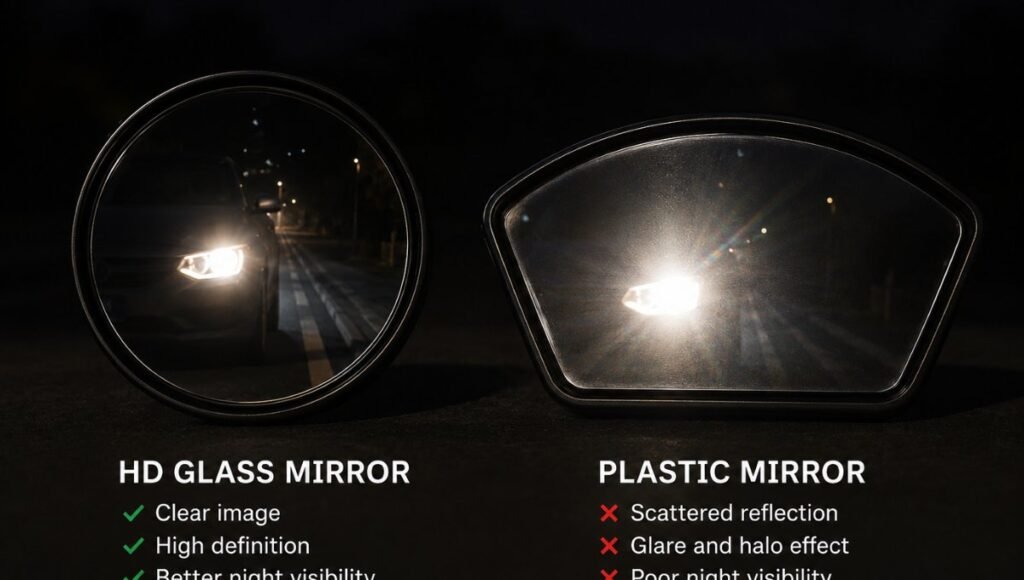
HD Glass mirrors are clearer at all lighting conditions, maintain their surface quality over time, and handle glare significantly better at night — the coating on quality glass mirrors reduces the halo effect that makes nighttime driving with plastic mirrors uncomfortable. They’re also harder to scratch, which matters because side mirrors get contacted by brushes, branches, and car wash equipment.
Plastic mirrors are cheaper and lighter, but degrade noticeably within 6–18 months of regular use. Micro-scratches accumulate from cleaning and environmental debris, reducing clarity. At night, plastic mirrors can create significant glare from headlights behind you — the scattered light from a scratched plastic surface is more disruptive than the point-source reflection from glass.
The price difference between glass and plastic blind spot mirrors is typically $5–15 per pair. Given the clarity difference and the longevity difference, glass is worth it for most drivers.
Where to Place a Blind Spot Mirror — The Decision That Determines Everything
Placement is where most blind spot mirror purchases either succeed or fail. A correctly placed mirror in the right position on a clear side mirror provides useful information every lane change. A poorly placed mirror — blocking the BSM light, covering the heated mirror element, or positioned where it shows the sky rather than the adjacent lane — provides nothing.
Placement for Cars Without BSM
The standard recommendation for non-BSM vehicles is the outer lower corner of the side mirror glass. This position extends the view into the lane beside and slightly behind you — precisely the blind spot zone that the standard mirror doesn’t cover.
The specific position varies by car and driver. The mirror should show the lane beside you from approximately the door handle of an adjacent car back to just past the rear corner of your own car. Adjust until you can see a bicycle-width gap between your car and the adjacent lane throughout that range.
The testing method: Set your side mirrors correctly first (positioned so you can barely see the edge of your own car in the inside edge of the mirror — not showing your car, just the edge). Then adjust the blind spot mirror until it picks up where the side mirror leaves off. There should be a smooth transition of coverage with no significant gap.
Placement for Cars With BSM Warning Lights
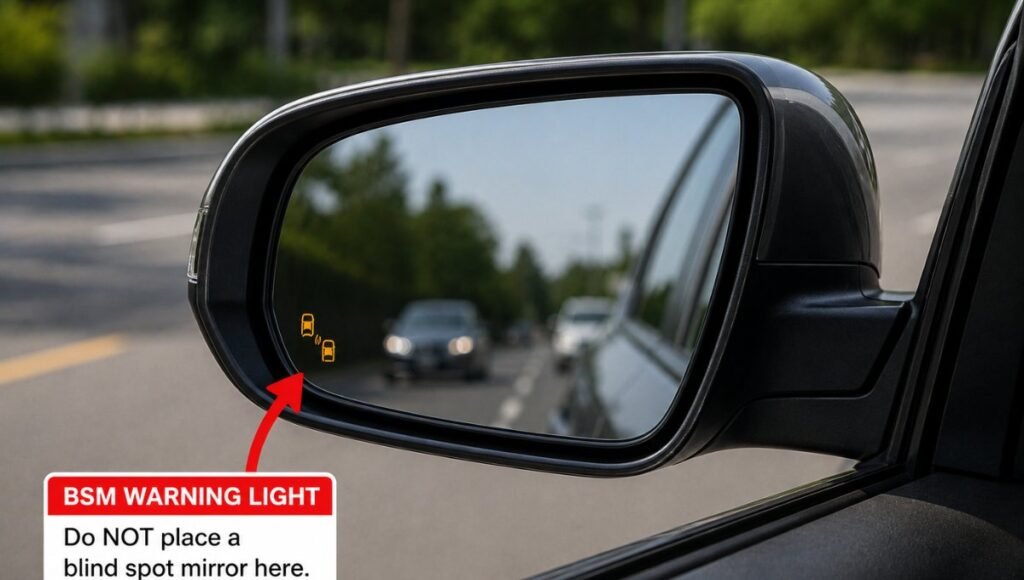
This requires more attention. The BSM warning light is embedded in the mirror housing — either in the inner edge of the mirror glass or in the housing itself near the outer edge. Identify exactly where the light appears before placing any mirror.
The blind spot mirror must not:
- Cover the BSM warning light in any position
- Rest on the mirror heating grid lines (the fine lines visible on the glass in some vehicles — covering them reduces heating effectiveness and the trapped heat can weaken the adhesive over time)
For most BSM-equipped vehicles, the upper outer corner works better than the lower outer corner, as it typically clears both the warning light position and the heating element area.
The Post-it Test — Do This Before You Open the Adhesive
This technique consistently separates successful installations from regretted ones.
Before applying any adhesive: cut a piece of tape or Post-it note to roughly the size of the blind spot mirror and stick it to your intended position. Drive with it for a day — check lane changes, check whether it obstructs anything, check whether the position of the paper is actually where you needed it to be.
Only after confirming the position works in real driving conditions should you clean the glass and apply the permanent mirror. This 60-second step prevents an adhesive removal job that takes 30 minutes.
How to Install a Blind Spot Mirror Correctly
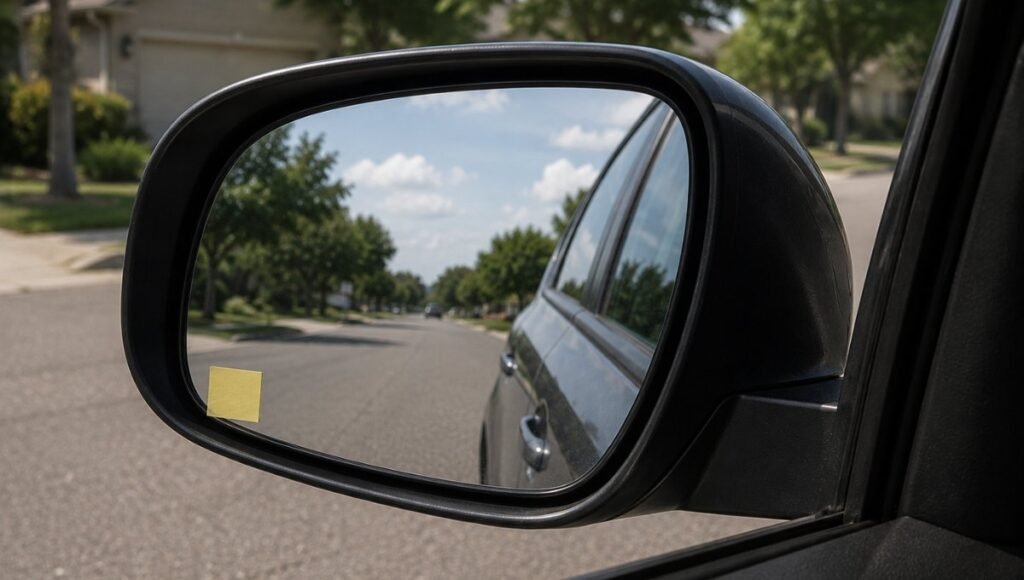
Step-by-Step Installation
Step 1: Clean the glass thoroughly Use isopropyl alcohol (70%+) on a clean microfiber cloth. The adhesive backing is only as strong as the surface it contacts — any oil, wax, or residue from previous products dramatically reduces holding power. Wipe, let dry for 2 minutes, then do not touch the cleaned area with your fingers.
Step 2: Test the position (the Post-it Test above) Confirm the position over at least one day of driving before proceeding.
Step 3: Mark the final position Use a small piece of painter’s tape at the edges of your confirmed position so you know exactly where to place the mirror when the adhesive is exposed.
Step 4: Apply in warm conditions Adhesive bonds significantly better when the mirror glass is at room temperature or above. Do not install in freezing conditions or directly on a cold mirror in winter — the adhesive won’t cure properly and the mirror will fall off within days. If necessary, warm the mirror glass with a heat gun or hair dryer to around 65–70°F before applying.
Step 5: Peel and press Peel the adhesive backing, align to your marked position, and press firmly for 60 seconds. Apply steady pressure across the entire adhesive surface. Allow 24 hours before car washing or significant temperature exposure.
Common Installation Mistakes
Wrong corner: Placing in the inner corner shows more of your own car, not the adjacent lane. Always outer corner for standard applications.
Touching the cleaned glass: One fingerprint contains enough oil to create a bonding failure spot. Clean, don’t touch, apply.
Installing in cold weather without prewarming: The most common reason new mirrors fall off within the first week.
Rushing the cure time: The adhesive needs 24 hours to reach full strength. A car wash the same day is the second most common reason for early failure.
Will Blind Spot Mirrors Stay On Through Rain and Car Washes?
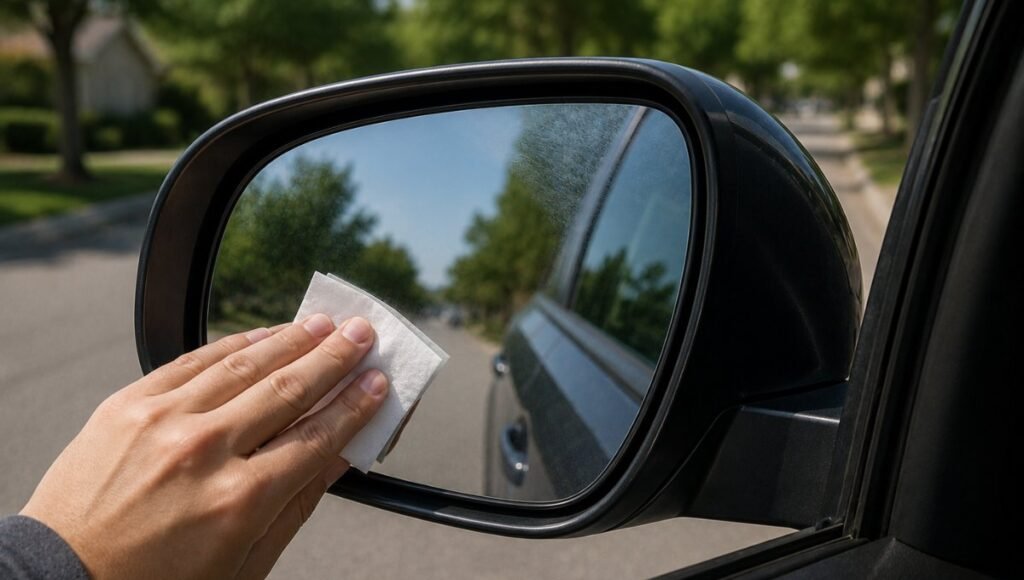
The honest answer: it depends on the adhesive quality, the installation, and the type of car wash.
Touchless car washes (high-pressure water jets only) are generally safe for properly installed blind spot mirrors after the adhesive has fully cured.
Brush car washes create physical contact with the mirror surface. The rotating brushes can catch the edge of a blind spot mirror and pull it off, particularly if the mirror has any edge that protrudes. Frameless, low-profile mirrors survive brush washes better than mirrors with raised edges.
Adjustable mirrors are the most vulnerable — the ball joint creates a surface that high-pressure jets and rotating brushes can push, rotating the mirror even if it doesn’t remove it entirely. Check angle after every automatic wash.
Extending Adhesive Life
After the initial 24-hour cure, the adhesive on quality mirrors with 3M backing holds well in most conditions. What weakens it over time:
- Heat cycles (direct sun in summer expanding and contracting the glass)
- Wax or sealant applied to the mirror glass and getting under the mirror edge
- Cheap generic foam tape rather than actual automotive 3M
If the mirror loosens over time: clean the edge with isopropyl alcohol, add a small amount of automotive adhesive or 3M mounting tape around the edge, and re-press. This typically restores full holding strength.
How to Remove a Blind Spot Mirror Without Damaging the Glass
Eventually, you’ll need to remove a mirror — either to replace it, because you’re selling the car, or because the position was wrong.
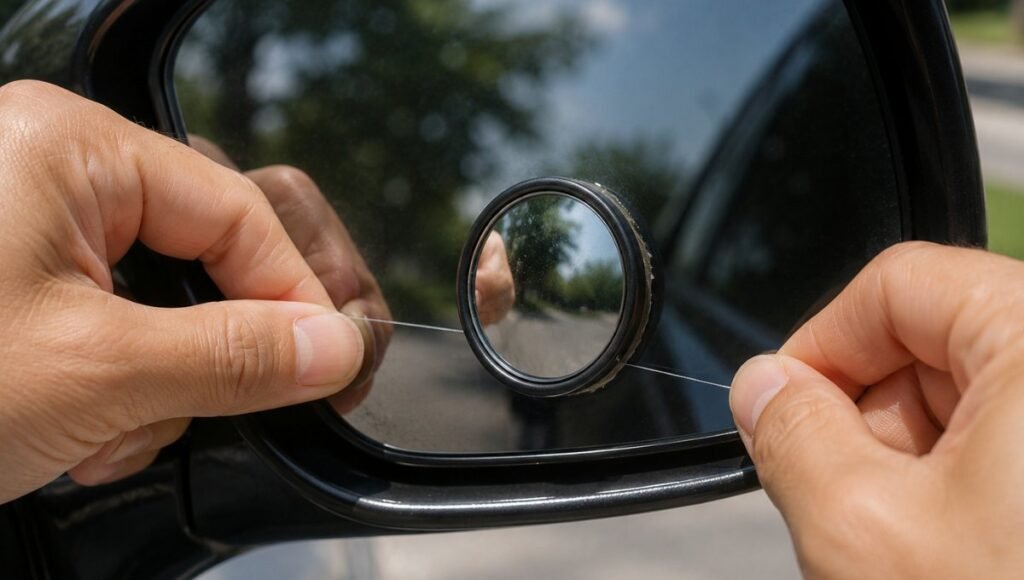
Fishing Line Method
Take a piece of fishing line (or floss, or thin wire) and work it behind the mirror, using a sawing motion to cut through the adhesive from behind. Start at a corner, work slowly, and keep the line parallel to the glass surface. This method cuts the adhesive without applying leverage to the glass and without the heat required by other methods.
Removing Residual Adhesive
After the mirror is removed, adhesive residue remains on the glass. Apply a small amount of adhesive remover (Goo Gone works well) or a dedicated automotive adhesive remover. Let it sit for 2–3 minutes, then wipe with a microfiber cloth. Repeat if needed. Finish with a clean glass cleaner pass to remove any residue from the remover itself.
Do not use a razor blade unless you are very confident in your technique — scratching the mirror glass is not worth saving five minutes.
The Safety Mistake Many Drivers Make With Blind Spot Mirrors
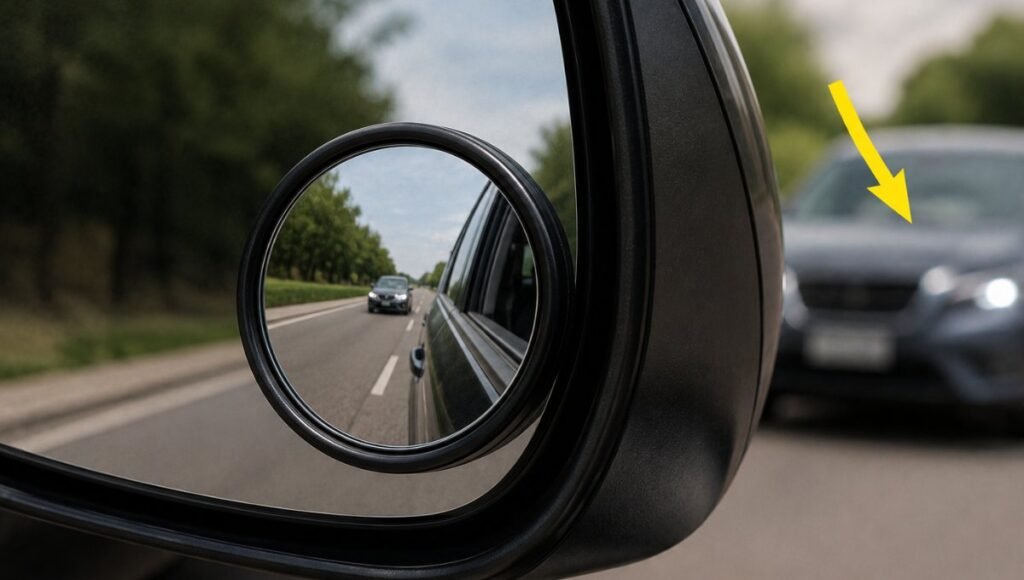
A blind spot mirror gives you a wider view — but it also changes how distance looks.
Because these mirrors use a convex shape, vehicles behind you may appear smaller and farther away than they actually are. This is especially noticeable with smaller, wide-angle mirrors.
That is why a blind spot mirror should answer one question:
“Is there something beside me?”
Not:
“Exactly how far away is that car?”
Use the blind spot mirror to quickly check your blind zone, then confirm distance and movement with your main mirror and a normal shoulder check before changing lanes.
A good blind spot mirror adds information. It should not become the only thing you rely on.
FAQ
Are blind spot mirrors worth it? Yes, for most drivers — particularly those with larger vehicles, those who drive frequently in heavy traffic, or new drivers still building spatial awareness. The $10–25 cost for quality glass mirrors is minor relative to the additional information they provide. Even on BSM-equipped vehicles, they cover scenarios and angles that electronic systems don’t.
Do blind spot mirrors block heated side mirrors? If placed over the heating element grid lines, yes — they can reduce heating effectiveness and the trapped heat can weaken the adhesive over time. Identify the heating element lines on your mirror glass before placing. Most installations in the upper outer corner avoid this area entirely.
Where should I put blind spot mirrors if I have BSM? Identify exactly where the BSM warning light appears in your mirror housing. Place the blind spot mirror in the upper outer corner, confirming it does not cover the warning light in any position. The outer corner clears the typical BSM light location and heating element area on most vehicles.
Are round or wedge blind spot mirrors better? Round mirrors provide more coverage area relative to their size. Wedge mirrors have a lower profile and look more integrated with the mirror. For pure coverage, round wins. For aesthetics and integration, wedge is better. Both work well when properly placed.
Can blind spot mirrors survive automatic car washes? Touchless washes: yes, after 24-hour adhesive cure. Brush washes: adjustable mirrors are vulnerable; flat frameless mirrors are more resistant. Check mirror angle after any automatic wash if you have an adjustable type.
Do blind spot mirrors work at night? Glass mirrors significantly outperform plastic at night — the coating reduces the halo and scatter effect from headlights. If nighttime driving is important to you, glass is not optional. Plastic blind spot mirrors can create distracting glare from vehicles approaching from behind.
How do I remove blind spot mirror glue? Fishing line or dental floss to cut the adhesive from behind without damaging the glass. Adhesive remover (Goo Gone or dedicated automotive adhesive remover) for the residue. Finish with glass cleaner. Do not use a razor blade unless experienced.
What’s Next
Blind spot mirrors connect to the broader picture of driver awareness and vehicle safety:
- Oversteer vs understeer — knowing what’s in your blind spot is part of understanding vehicle dynamics; what you do with that information when changing lanes at speed matters. (→ Oversteer vs Understeer)
- How to check tire pressure — properly inflated tires affect how your car responds during lane changes; a mirror that shows you the lane is clear is only as useful as a car that responds when you move. (→ How to Check Tire Pressure)
- Car essentials every driver should have — the emergency and daily-use items that round out a safe, practical vehicle setup. (→ Car Essentials Every Driver Actually Needs)
A blind spot mirror is a $15 purchase that changes every lane change you make for the life of the car. The placement decision and the installation take 15 minutes. The Post-it Test saves you from the most common mistake. That’s the complete investment required.
🔧 AutoIXPro Field Notes: The Thinking Behind This Guide
Better driving visibility is not only about adding more technology — it is about understanding your vehicle and reducing the risks you cannot easily see.
This guide is based on research and real-world driver concerns covering:
🚗 Blind Spot Safety
How blind spots happen, how driver assistance systems help, and where their limitations remain.
🪞 Mirror Choice & Placement
Why mirror shape, material, and installation position affect real-world visibility.
🌧️ Everyday Durability
Factors like weather, car washes, adhesive quality, glare, and long-term use.
A good blind spot mirror does not replace safe driving habits.
It simply gives you one more layer of awareness.
Blind spot mirror question for your specific vehicle or mirror type? Contact us — we read every message.