
Key Takeaways
- Understeer = the front loses grip; the car goes straight when you’re trying to turn — common in front-wheel drive cars, especially in rain or on ice
- Oversteer = the rear loses grip; the back of the car swings outward — more common in rear-wheel drive cars, and the scarier of the two to experience
- Your instincts are wrong for both — when understeering, turning the wheel harder makes it worse; when oversteering, your instinct to brake makes it worse; both require the opposite of what feels natural
- Almost all modern passenger cars are designed to understeer by default — it’s the safer failure mode, easier to recover from than oversteer
- Electronic Stability Control (ESC) has been mandatory on all new US vehicles since 2012 and handles most everyday skid situations — but it has limits on ice and standing water, and it can’t replace knowing what to do
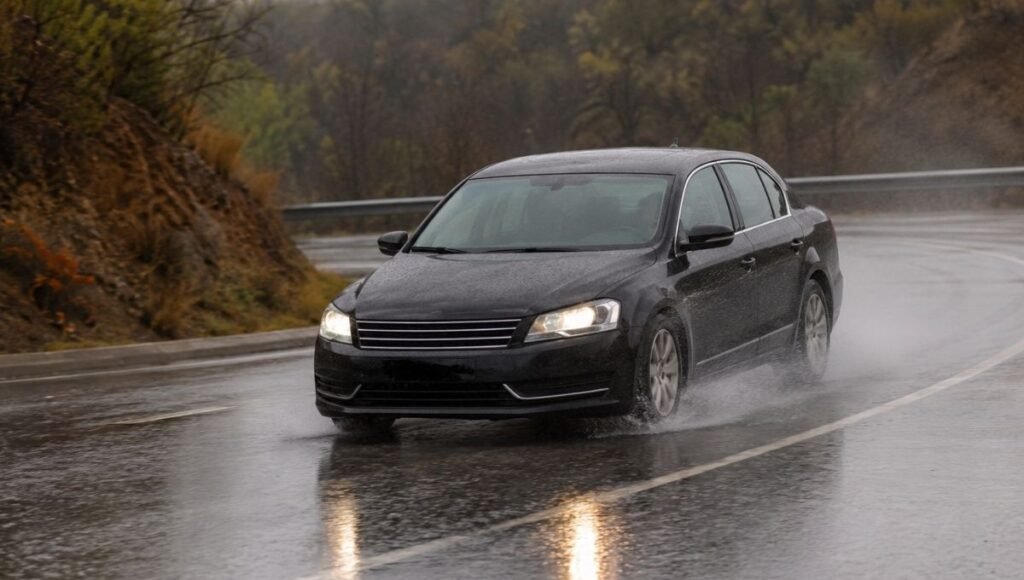
The Moment the Car Stops Listening
You’re making a turn — maybe coming off a highway ramp, maybe rounding a corner on a rainy evening, maybe pulling out of a parking lot that’s slightly iced over. You turn the steering wheel. And the car doesn’t turn the way you expected.
Either the front feels like it’s sliding outward, continuing straight despite the wheel being turned — like the steering inputs aren’t getting through. Or worse, you feel the back end shift, a swinging sensation that suggests the rear of the car is going somewhere you didn’t authorize.
Both of these moments produce an immediate adrenaline response. And in that half-second of pure instinct, almost everyone does the wrong thing. More steering input when the front is sliding. Braking when the rear is swinging. Both of these reactions make the situation worse.
This is why understanding oversteer and understeer matters — not because you’re planning to take a car to a race track, but because on a wet road on a Tuesday afternoon, your car can slip traction faster than your conscious mind can formulate a response. The correct reaction has to be pre-loaded. It has to be something you already know.
This guide gives you that understanding, in plain language, with the actual reasons behind each correction.
Understeer: When the Front Wheels Stop Cooperating
What It Feels Like
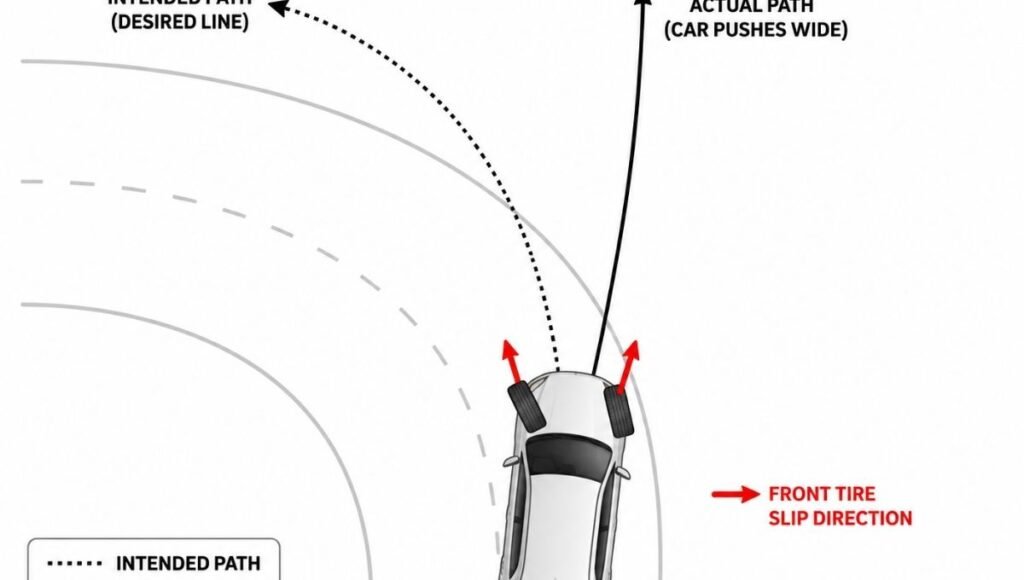
You’re in a turn. The steering wheel is turned. But the car is not following the arc you intended — it’s pushing straight, toward the outside of the curve. The front of the car is going where the front wheels are pointed, but the front wheels aren’t gripping the road enough to actually change direction. They’re sliding across the surface instead of biting into it.
In mild understeer, it feels like the car is being resistant, like it’s taking a wider line than you wanted. In severe understeer, the steering wheel almost feels disconnected — you’re turning it and nothing meaningful is happening.
What’s Actually Happening
The front tires have exceeded their maximum grip for the situation. Grip is finite — it’s determined by tire tread quality, road surface friction, tire pressure, and the speed at which you’re changing direction. When you demand more cornering force than the front tires can provide, they slide.
<cite index=”30-1″>Understeer occurs when the front tires lose grip, causing the car to push straight even when you turn the wheel.</cite> <cite index=”33-1″>Almost all cars are set up to understeer as it’s the easiest type of skid to correct and the least dangerous.</cite>
The reason most passenger cars are designed this way is deliberate: in a situation where the driver must choose between a front skid or a rear skid, front is safer. A car sliding forward is more predictable than a car spinning. You can steer around an obstacle even with a mild front skid; you cannot steer around it while the rear is swinging.
Front-wheel drive cars are particularly prone to understeer because the front wheels are doing two jobs simultaneously — steering and driving. Under acceleration in a corner, the additional load from the drivetrain reduces the grip available for steering.
What Triggers It in Normal Driving
Understeer is most commonly triggered by:
- Entering a corner too fast for the available grip
- Accelerating too early and too hard while still in a turn (especially in front-wheel drive cars)
- Cold or wet tires that haven’t built up temperature yet
- Ice, snow, wet leaves, or any surface with significantly reduced friction
The first rain after a long dry spell deserves a specific mention. Roads accumulate tire rubber and oil residue over dry periods. When rain first hits, it lifts this layer rather than washing it away — creating a brief window where the road is more slippery than it will be after sustained rain. <cite index=”34-1″>The friction of the road is lessened by water, ice, gravel and the oily film that forms as it first rains after a period of dry weather.</cite>
How to Correct Understeer — What Actually Works
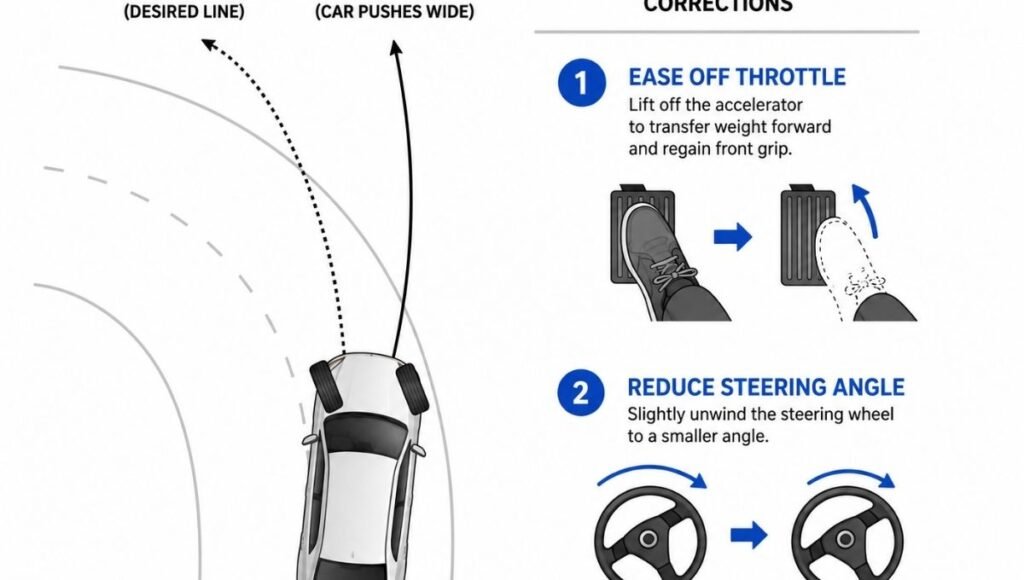
Here’s the counter-intuitive part: do not turn the wheel further. The front wheels are already asking for more grip than the road can give. Adding more steering angle increases the demand on those tires and makes the sliding worse.
What to do instead:
Ease off the accelerator smoothly. This is the primary correction. Releasing throttle shifts weight forward slightly, increasing the load on the front tires and improving their grip. It also reduces the demand being placed on them from the drivetrain in front-wheel drive cars.
Reduce steering angle slightly. Paradoxically, unwinding the steering wheel a small amount often allows the front tires to regain grip, after which you can reapply steering input. Pointing tires that are sliding reduces their sideways friction demand.
Brake gently if needed. Light, progressive braking can transfer more weight to the front axle, improving front grip. <cite index=”30-1″>For understeer, gently lift off the accelerator and ease the steering; avoid turning the wheel harder.</cite> Do not brake sharply — this can trigger a separate skid or cause the rear to step out.
Eyes forward. Look where you want the car to go, not at the obstacle you’re approaching. This sounds psychological but it’s also mechanical — your hands follow your eyes, and fixing your gaze on where you want to be guides your steering inputs.
Oversteer: When the Back Decides to Go Its Own Way
What It Feels Like
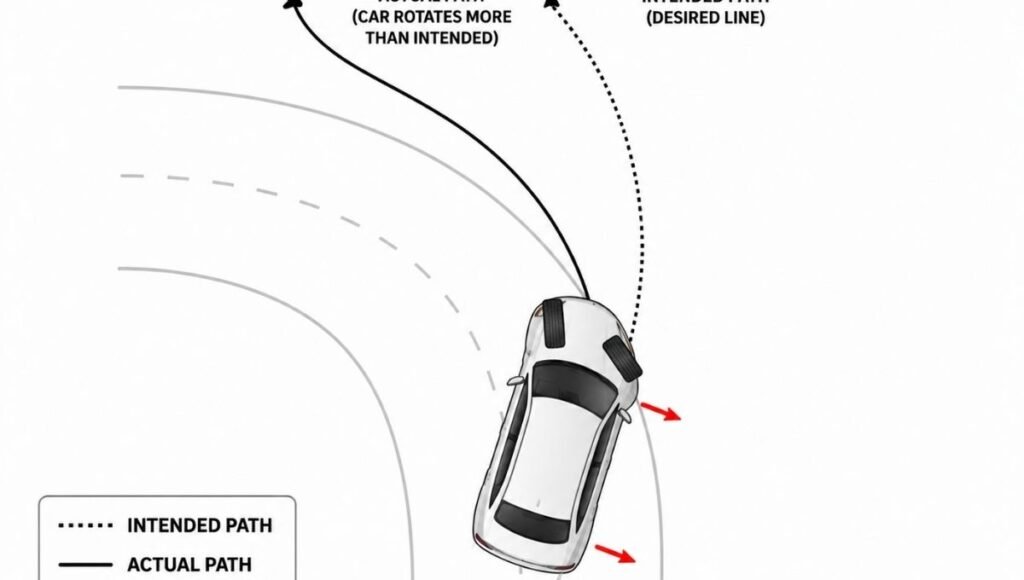
You’re in a corner and the rear of the car suddenly feels loose — like the back is swinging outward, trying to overtake the front. The car is rotating more than you wanted. In mild oversteer, it’s a brief shimmy that resolves itself. In severe oversteer, the rear continues swinging until the car is fully sideways, or spins.
This is the sensation that most drivers find genuinely frightening. Understeer feels like the car isn’t responding. Oversteer feels like the car has taken over.
What’s Actually Happening
The rear tires have lost grip while the front tires still have traction. <cite index=”30-1″>Oversteer occurs when the rear tires lose traction, causing the back of the car to slide or swing out.</cite> Because the front is still gripping and the rear is sliding sideways, the car rotates — the front stays on its arc while the rear swings to the outside.
<cite index=”29-1″>To correct oversteer you must turn towards the direction of the skid — opposite lock. It’s easy to over-correct and end up spinning the other way.</cite>
Rear-wheel drive cars are more prone to oversteer because the rear wheels, which provide the driving force, can exceed grip under hard acceleration. However, all cars — including front-wheel drive — can oversteer in specific situations.
Lift-off oversteer is particularly important for everyday drivers to know about. It happens when you lift off the throttle abruptly in the middle of a corner — the sudden weight shift forward unloads the rear tires, causing them to lose grip. This catches many drivers by surprise because they did exactly what instinct suggested (ease off the gas) and the car responded by getting worse. It can happen at speeds that feel completely normal. Wet roads make it significantly more likely.
What Triggers Oversteer in Normal Driving
- Rear-wheel drive car, too much power in a corner
- Any car: abrupt throttle lift in a corner (lift-off oversteer)
- Any car: sharp braking while already in a turn (weight shifts sharply forward, rear becomes light)
- Ice or very wet roads where rear grip is dramatically reduced
- Panic braking in a corner
How to Correct Oversteer — The Counter-Intuitive Response
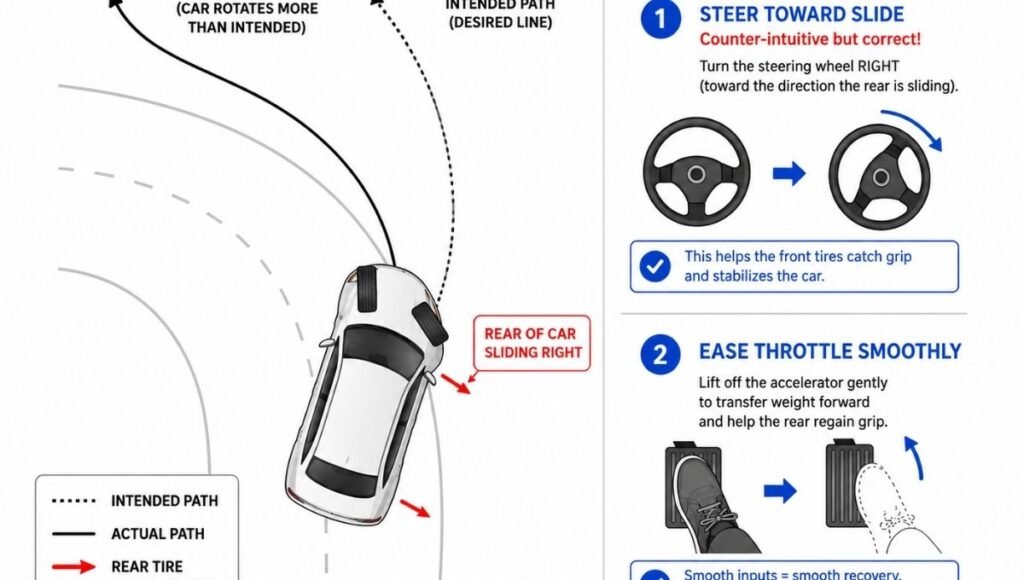
<cite index=”36-1″>The key to correcting both types of oversteer is to remain calm. Panicking or slamming on the brakes will only cause more issues.</cite>
The correction for oversteer is called counter-steering or “steering into the skid” — turning the wheel in the direction the rear is sliding. If the rear is sliding to the right, you steer right. This points the front wheels in the direction of the slide, allowing the car to track the rear rather than rotate further.
This is deeply counter-intuitive. When the back of the car is sliding right, every instinct says “steer left to go straight.” But steering left while the rear is sliding right just accelerates the rotation and leads to a spin.
The correct sequence:
- Ease off the throttle smoothly — do not brake sharply
- Steer in the direction the rear is sliding (counter-steer)
- Use gentle inputs — the amount of counter-steer needed is often less than instinct suggests
- As the slide corrects, gradually ease the counter-steer back to center — the car will want to snap back the other way as grip is restored, and you need to be ready for this
- Once stable, gently reapply throttle to continue
The snap-back after oversteer correction is where many drivers get into secondary trouble. The car overcorrects, swings the other direction, and the driver over-corrects again — producing the fishtail effect called a tank-slapper. Smooth, progressive inputs at each stage are what prevents this.
The Memory Aid That Actually Sticks
If you take away one thing from this guide:
Understeer = front slides = ease off gas + less steering Oversteer = rear slides = ease off gas + steer toward the slide
In both cases, the first action is the same: ease off the throttle smoothly. This shifts weight forward, adds load to the front tires, and removes drivetrain-induced stress from the rear. It’s the universal first response to any skid situation.
The second action is where they differ. Understeer: reduce steering demand. Oversteer: steer toward the slide.
What Your Car Already Does for You: ESC Explained
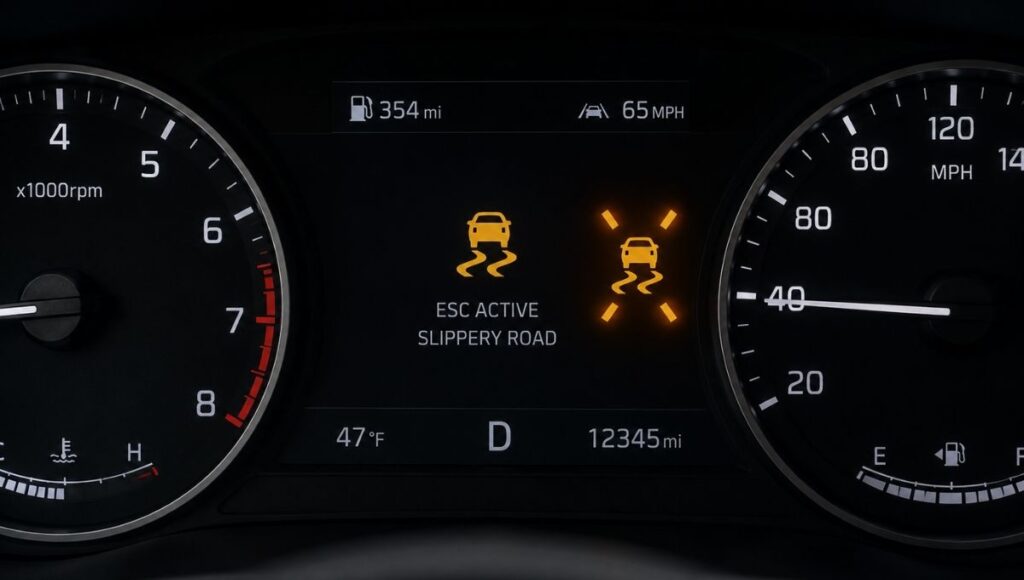
Most drivers will never need to manually correct a significant oversteer or understeer because their car’s Electronic Stability Control (ESC) will intervene before the situation develops.
<cite index=”36-1″>Electronic stability control (ESC) constantly monitors steering angle, wheel speed and the movement of the car, and if it senses something is wrong, it can automatically apply the brakes or reduce engine power to help keep the car on the road.</cite>
ESC has been mandatory on all new passenger vehicles sold in the United States since the 2012 model year (per NHTSA’s FMVSS No. 126). Research by the Insurance Institute for Highway Safety (IIHS) found that ESC reduces fatal single-vehicle crashes by approximately 49% and fatal rollovers by 59%.
How ESC feels when it activates: you may feel or hear a pulsing sensation from the brakes, the engine may briefly lose power, and a dashboard light typically flashes to indicate the system is working. This is normal — it means the system caught something before it became dangerous.
The important limitation: ESC has boundaries. On pure ice or standing water deep enough to cause hydroplaning, there may be no grip for the system to work with. <cite index=”36-1″>On ice, snow or standing water, grip can be lost more quickly than some of these systems can react and there may simply be no grip available. For this reason, no driver should ever rely solely on electronics to save them.</cite>
Understanding oversteer and understeer is what you need when ESC can’t fully save you.
The Tire Connection: What’s Under You Matters
Oversteer and understeer aren’t just about driver inputs — they’re also about what’s at the four contact patches where your tires meet the road.
Worn tires lose grip significantly before the tread wear indicators appear visible. A tire with 2/32″ of tread (the legal minimum in most states) has dramatically less wet-weather grip than a tire at 6/32″ or more. The situations that cause understeer and oversteer — wet roads, cold temperatures, sudden inputs — all become more dangerous and more likely with worn tires.
Tire pressure also matters. Underinflated tires have a larger contact patch but reduced rigidity, which affects how they respond at the limit of grip. The relationship isn’t simple — underinflation can increase grip at low speeds and reduce it at high speeds — but maintaining correct tire pressure is the baseline for everything else.
Cold tires grip significantly less than warmed-up tires. On cold mornings or after a car has been parked, the first few minutes of driving require more caution than normal — tires haven’t yet reached their operating temperature and grip is below what the same tire will provide after a few miles.
→ Full guide: How to Check Tire Pressure
What to Do If You Skid on Ice
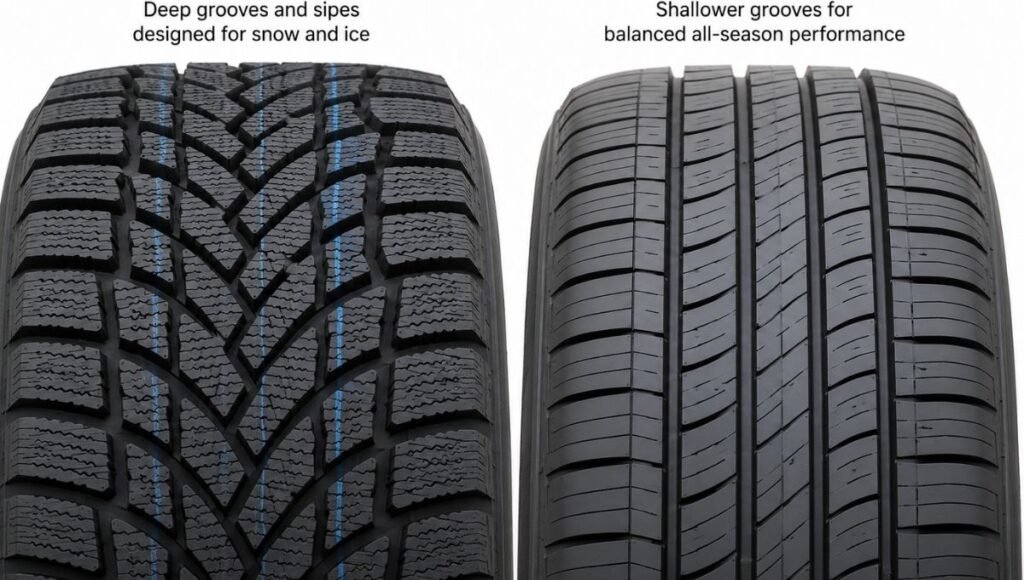
Ice is the extreme version of the low-traction environment that produces both understeer and oversteer. The corrections are the same but the margins are much smaller and the consequences of over-correcting are greater.
The most important single change for icy conditions: slow down before the corner, not during it. Braking while turning on ice triggers both understeer (if you brake and turn simultaneously with front-wheel drive) and lift-off oversteer (if you release brakes abruptly mid-turn with rear-wheel drive). Get to your turning speed before you reach the corner, then use minimal throttle and minimal braking through the turn itself.
If a skid occurs on ice regardless:
- Ease off everything — throttle, brakes, and steering input
- Let the car settle before applying corrections
- Small, smooth inputs only — ice removes the self-correcting behavior that normal roads provide
Winter tires are genuinely transformative for icy conditions. The tread compound in winter tires remains pliable below 45°F (7°C), where all-season compounds harden and lose grip. The performance difference in emergency situations is not marginal — it’s the difference between a skid that the system can manage and one that isn’t correctable.
FAQ
What is the difference between oversteer and understeer? Understeer is when the front tires lose grip and the car pushes straight instead of turning — the car turns less than the driver intended. Oversteer is when the rear tires lose grip and the back of the car slides outward — the car turns more than intended, often creating a swinging sensation. Understeer is more common in everyday driving because most passenger cars are designed to understeer by default.
Is oversteer or understeer more dangerous? Oversteer is generally considered more dangerous for inexperienced drivers because the correction (steering toward the slide) is counter-intuitive, the situation develops faster, and the consequences of over-correction (a spin) can be severe. Understeer, while alarming, is more predictable and the corrections are more forgiving.
What causes oversteer in front-wheel drive cars? Front-wheel drive cars are prone to understeer, not power oversteer (which requires rear-wheel drive). However, FWD cars can experience lift-off oversteer — if you release the throttle abruptly in a corner, the weight shift forward can unload the rear tires and cause the back to step out. It’s less dramatic than RWD oversteer but can still occur.
How do I correct oversteer? Ease off the throttle smoothly (not suddenly), and steer in the direction the rear is sliding — this is called counter-steering or “steering into the skid.” Apply gentle, progressive inputs. As the car corrects, gradually ease the counter-steer back toward center to prevent the car from overcorrecting the other way.
How do I correct understeer? Ease off the accelerator to shift weight forward and increase front grip. Slightly reduce the steering angle — paradoxically, turning less allows the tires to regain grip. Avoid braking sharply. Allow the car to settle before adding more steering input.
Does ESC prevent oversteer and understeer? In most everyday driving situations, yes — ESC intervenes before oversteer or understeer becomes severe. However, ESC has limits on pure ice or deep water where there may not be enough grip for the system to work with. Understanding the manual corrections remains important for situations where ESC can’t fully compensate.
Why do front-wheel drive cars understeer more? Front-wheel drive cars ask the front tires to do two jobs simultaneously: steering and providing driving force. Under acceleration in a corner, the additional traction demand from the drivetrain reduces the grip available for steering. This makes front-wheel drive cars inherently more prone to understeer, which is why manufacturers design them this way — it’s the safer failure mode for typical drivers.
What’s Next
Understanding how a car loses control in corners connects directly to safe driving in specific conditions:
- How to check tire pressure — proper tire pressure is the foundation of grip in cornering; underinflated tires change how understeer and oversteer develop. (→ How to Check Tire Pressure)
- Car maintenance checklist — tire condition, tread depth, and brake system health all affect how your car responds at the limits of grip. (→ Car Maintenance Checklist)
- How to park on a hill — the parking brake and transmission choices that prevent a parked car from rolling. (→ How to Park on a Hill)
- Car essentials every driver should have — the emergency kit items that matter when a skid leads to an incident. (→ Car Essentials Every Driver Actually Needs)
The best skid correction is the one you never need to use. Speed appropriate to conditions, smooth inputs, properly maintained tires, and the awareness that your instincts will be wrong — these four things reduce your exposure to both understeer and oversteer far more than any correction technique.
References
- National Highway Traffic Safety Administration (NHTSA) — Federal Motor Vehicle Safety Standard No. 126, Electronic Stability Control Systems; mandatory ESC requirement for all light vehicles from model year 2012; performance standards and test methodology
- Insurance Institute for Highway Safety (IIHS) — Electronic Stability Control: Status and Effectiveness, research data showing 49% reduction in fatal single-vehicle crashes and 59% reduction in fatal rollovers for ESC-equipped vehicles vs. non-equipped
- Society of Automotive Engineers (SAE) International — SAE J266: Steady-State Circular Test Procedure for Trucks and Buses, vehicle dynamics testing standards including understeer gradient measurement methodology
- Continental Tires Technical Research — Tire Behavior at the Limit of Adhesion, tire contact patch dynamics and grip degradation patterns relevant to understeer and oversteer onset conditions
Have a question about car handling or a skid situation you experienced? Contact us — we read every message.