
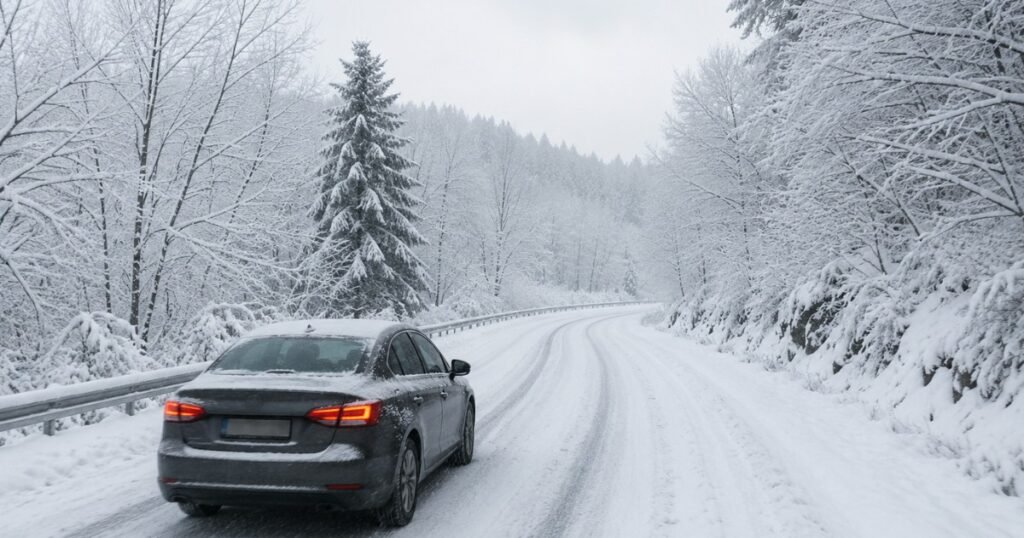
It’s 7:00 a.m. Snow is still falling, you’re already running late for work, and the road outside looks more white than black. Before you’ve even left the driveway, your hands tighten around the steering wheel. You’re not worried about driving—you’re worried about sliding, getting stuck, or making one mistake that ruins your day.
If that sounds familiar, you’re not alone. Every experienced winter driver has been exactly where you are now. The difference isn’t confidence or bravery—it’s knowing how to make calm, predictable decisions when the road offers less grip than you’re used to.
Here’s the most important lesson to remember:
Snow doesn’t reward confidence. It rewards patience.
Safe winter driving comes down to three simple habits: smooth steering, gentle acceleration, and early braking. Master those, and you’ll already be ahead of many drivers who have spent years behind the wheel.
In this guide, you’ll learn how to prepare your vehicle before leaving, test road conditions safely, handle snow and black ice, recover from skids, avoid the mistakes that catch new drivers off guard, and know when the safest decision is simply to stay home.
Quick Answer: How to Drive in Snow Safely
If you only remember five things before driving in snow, remember these:
- Slow down well below the posted speed limit when roads are snowy or icy.
- Accelerate, brake, and steer as smoothly as possible—avoid sudden movements.
- Increase your following distance to at least 8–10 seconds.
- If your car starts to skid, stay calm, ease off the accelerator, and steer gently in the direction you want the car to go.
- If conditions become too dangerous, the safest decision is not to drive at all.
Think of it this way: smooth driving beats fast driving every single time in winter.
Before You Leave: 8 Things to Check Before Driving in Snow
Driving safely in snow starts long before you shift into Drive. A few minutes spent checking your tires, visibility, and emergency supplies can significantly reduce your chances of getting stuck or losing control once you’re on the road. Before heading out, make sure both your vehicle and your winter driving kit are ready for the conditions ahead.
Check Tire Pressure and Winter Tire Condition
Cold temperatures drop tire pressure at approximately 1 PSI for every 10°F drop in temperature. A tire properly inflated in October can be 6–8 PSI low by January. Underinflated tires have reduced contact with the road, which directly impacts traction — the one thing you cannot afford to compromise in winter.
Check all four tires against the recommended pressure on your driver’s door jamb sticker before driving in significant snow. Not the tire sidewall — that’s the maximum, not the target.
If you’re running winter tires, check the tread depth. Winter tires below 6/32″ of tread depth lose a significant portion of their snow performance advantage. A worn winter tire performs similarly to a new all-season in many snow conditions.
Clear Snow From More Than Just the Windshield
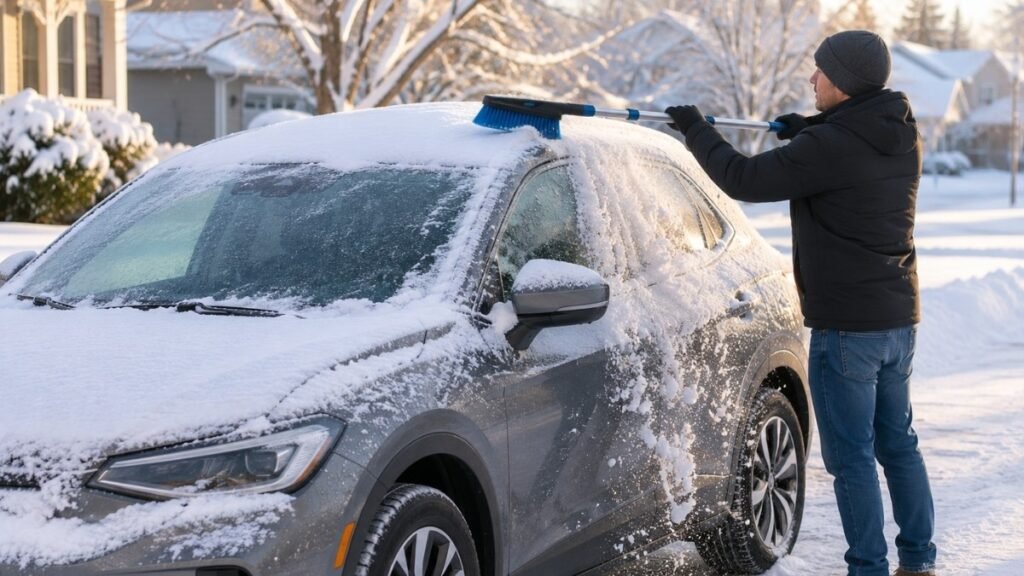
Most drivers clear the windshield, maybe the rear window, and call it done. But snow left on the roof slides forward onto the windshield when you brake, and slides backward onto following drivers when you accelerate. In many states, this is illegal — and the driver behind you experiencing a sudden snow avalanche at 60 mph is a real hazard.
Clear the roof, hood, trunk lid, and all mirrors before driving. Clear around the headlights and taillights too — driving with obscured lights is both dangerous and ticketable.
Use Winter Washer Fluid (Not Summer Fluid)
Summer washer fluid freezes on contact with your windshield in cold temperatures, creating an instant visibility problem at the worst possible moment. Replace it with fluid rated to at least -20°F before the season starts. If you’re already in the middle of winter and your fluid is freezing, dilute it with premixed winter fluid rather than water — adding water makes the problem worse.
Lift Your Wipers Before Heavy Snow (When Appropriate)
When significant overnight snow is forecast and the car will be parked outside, lifting your wiper blades off the windshield prevents them from freezing to the glass. This means you won’t tear the rubber trying to force frozen wipers free in the morning, and the ice scraper can work across the full windshield without the blades in the way.
Don’t leave wipers lifted in conditions with heavy ice or freezing rain — the weight of ice accumulation can stress the wiper arm springs. For light to moderate snowfall, lifting them is a legitimate time-saver.
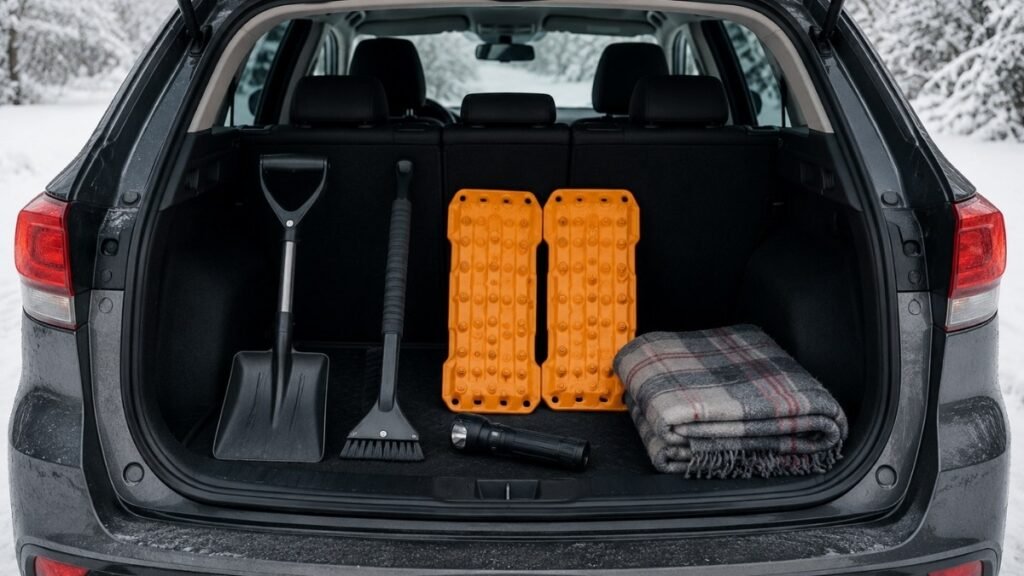
Pack a Small Winter Emergency Kit
This is the affiliate recommendation that’s genuinely not filler: a small winter kit in the trunk changes the outcome of a stuck or stranded situation substantially.
The items that earn their space:
- Ice scraper with long handle — the $5 one from the dollar store fails when you need it most; a quality telescoping scraper with a foam grip is worth the upgrade
- Small folding snow shovel — the collapsible versions take up almost no space and make a real difference when wheels are buried
- Portable tire inflator — cold mornings are the most common time tires are borderline low; having one in the car means you don’t start the winter commute already compromised
- Traction mats — lightweight rubber mats that slide under drive wheels when you’re stuck on ice; more effective than floor mats and don’t sacrifice your car’s interior
- Flashlight (charged) — for when you’re stuck after dark, which winter makes more likely
- Blanket — if you’re stranded and the engine needs to stay off, staying warm is not optional in serious cold
Snow Driving Starts Before You Reach the Main Road
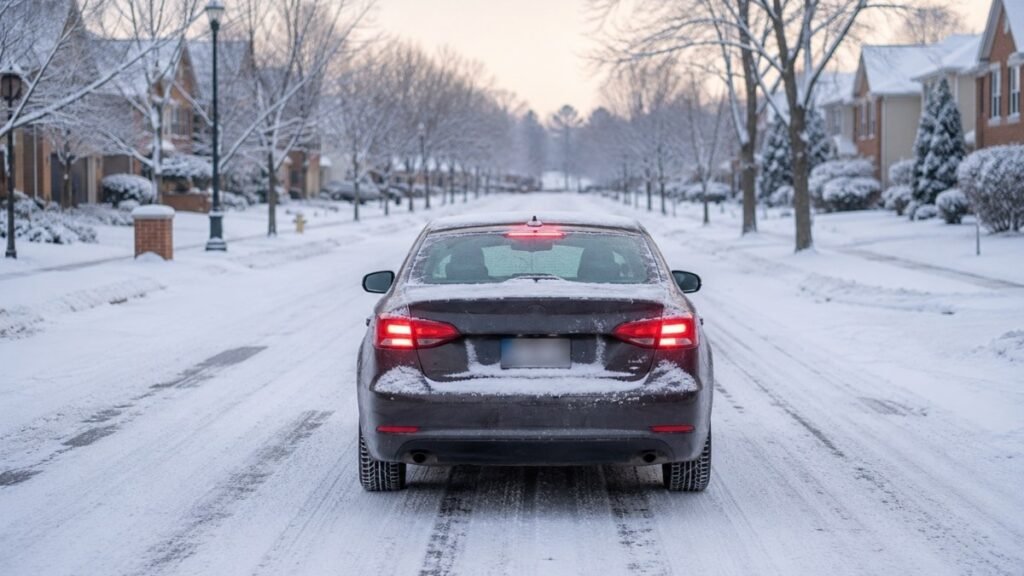
Snow, slush, and ice can vary dramatically from one street to the next, so avoid assuming the roads are safer—or more dangerous—than they appear. Before joining faster traffic, take a moment to understand how your car is responding and adjust your driving to the conditions you actually have.
How to Test Road Grip Safely in the First Few Hundred Feet
This is the piece of advice that almost nobody mentions, and it’s genuinely useful: use the first few hundred feet of every winter drive to calibrate the actual conditions.
Before you get to any intersection or main road, in a stretch of your own neighborhood or parking lot where there’s no consequence if something surprises you:
- Lightly tap the brakes — feel how the car responds. Does it grip and stop progressively, or does the ABS kick in immediately? The answer tells you how much friction is actually available.
- Gently accelerate — do the drive wheels grip immediately, or do they spin briefly before catching? A moment of wheelspin tells you the surface has less friction than it looks.
- Take a slow, easy turn — does the car track your steering input predictably, or does it feel loose and reluctant?
This 30-second calibration replaces assumptions with actual information. Road conditions at 7 a.m. in your neighborhood may be completely different from what they looked like the night before — compacted snow becomes ice overnight, fresh snow can disguise sheet ice underneath, and temperatures vary block to block near drainage areas and shaded sections.
Know Today’s Snow Type Before You Drive
Not all snow is the same, and the type you’re dealing with changes how the car behaves and what techniques are most important.
Fresh powder: Generally offers reasonable grip — the loose crystals create some friction. Heavier cars sink slightly, which can actually help.
Packed snow: More predictable than loose snow but significantly less grip than dry pavement. Braking distances extend considerably. Still manageable with appropriate speed.
Slush: The trickiest of the common types. Slush compresses under tires and can cause the car to track unpredictably — the slush channels can pull you toward edges. Deeper slush also causes drag that feels like resistance through the steering wheel.
Black ice: Clear, nearly invisible ice that forms when moisture freezes on pavement. The road looks wet but behaves like a skating rink. Covered in its own section below because it deserves it.
The Golden Rule: Smooth Steering, Gentle Braking, Slow Acceleration
If there is one sentence that captures everything experienced winter drivers do differently, it’s this: one input at a time.
Braking, steering, and accelerating are all demands on the same four tire contact patches. On dry pavement, these patches can handle all three simultaneously with capacity to spare. On snow or ice, that capacity is dramatically reduced. Asking the tires to do two things at once — turning while braking, accelerating while still in a corner — often exceeds what’s available.
This is why the advice to “brake before the turn, not during it” is the single most practical thing a winter driving guide can give you.
Brake Before the Turn, Not During It
Reduce your speed before you reach the corner. Once you’re turning, the tires are already using friction to change direction — you can’t ask for much more. Braking mid-corner in low-traction conditions is one of the most reliable ways to induce a skid.
On a highway ramp in snow: begin braking before the curve, get to a manageable speed, and then ease through the curve with light, steady throttle. This keeps the rear of the car settled and the tire contact patches doing one job at a time.
Let Your ABS Work — Don’t Fight It
The first time ABS activates under hard winter braking, many drivers assume something is wrong. The pedal pulses. There’s a grinding sound. The instinct is to release the brake.
Don’t.
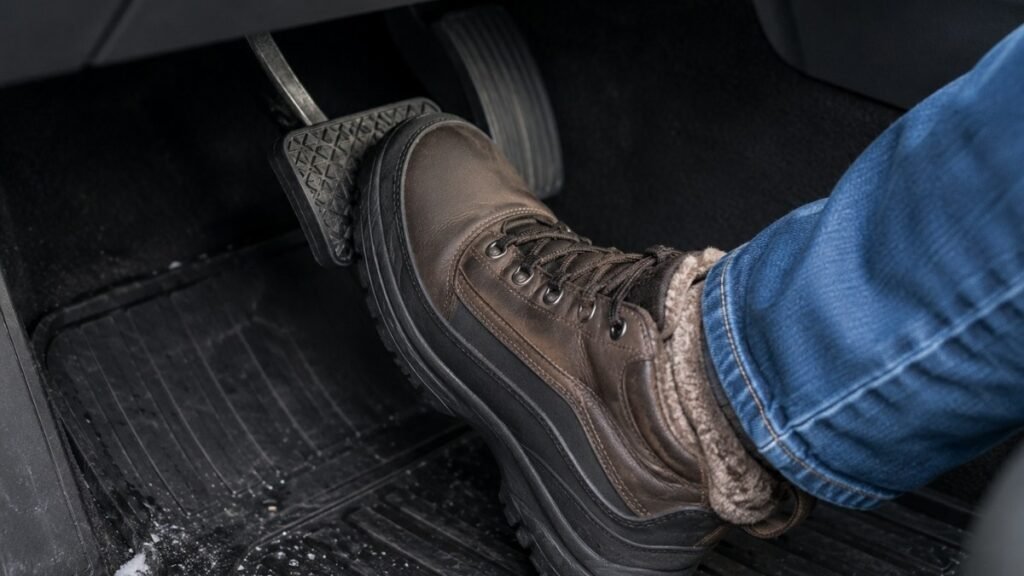
ABS — Anti-lock Braking System — works by rapidly pulsing the brakes dozens of times per second to prevent wheel lockup while maintaining your ability to steer. The pulsing sensation is the system working correctly. Your job is to press the brake pedal firmly and steadily and hold it there. The system does the rest.
Releasing the brake because the pedal feels strange is exactly the wrong response. The pulsing means the system is preventing a skid. Let it.
How to Recover From a Skid Without Overcorrecting
When a skid begins, the panic response is to make a large correction quickly. This is how a minor skid becomes a spin.
The correct approach is the opposite: small, smooth inputs, and remove the cause first.
For a rear skid (oversteer — the back swings out): ease off the throttle gently, and steer toward the direction the rear is sliding. If the rear slides right, steer right. The common mistake is to jerk the wheel hard in the correction direction — this creates a pendulum effect where the car swings through to the other side.
For a front slide (understeer — the front pushes wide): ease off the throttle, reduce the steering angle slightly, and allow the tires a moment to regain grip before reapplying steering input.
In both cases, the first action is the same: ease off the throttle. This shifts weight and removes the cause before correcting the direction.
→ Oversteer vs Understeer — Full Guide
FWD vs RWD vs AWD: Why Your Car Behaves Differently in Snow
This is the topic that most winter driving guides skip or oversimplify, and it matters because the correct technique varies depending on what’s powering your wheels.
Why Front-Wheel Drive Feels More Stable
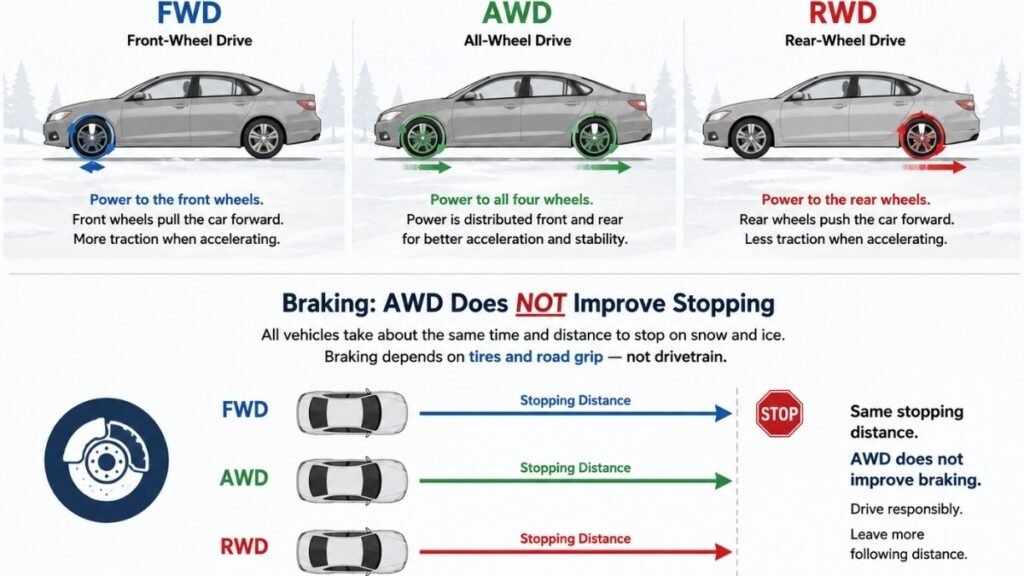
Front-wheel drive cars send power to the front wheels — the same wheels that steer. Under acceleration in snow, FWD cars tend to understeer (push wide) rather than oversteer (rear slides out). Understeer is the safer failure mode because the car continues in a predictable direction.
FWD also provides some natural stability because the weight of the engine is over the drive wheels, improving traction. For everyday drivers in typical winter conditions, FWD is a competent choice.
Rear-Wheel Drive: Avoiding Fishtails
RWD cars push the rear wheels, which carry less weight than the front. Under hard acceleration in snow, the rear can lose traction and step out — the classic fishtail. This happens more easily in RWD than in FWD.
The correction for RWD snow driving: be especially smooth with throttle application, avoid hard acceleration from a stop on low-traction surfaces, and understand that the rear needs gentler treatment than you might expect from the same car in summer.
If the rear does step out: ease off the throttle immediately and steer gently toward the slide. Do not accelerate to “catch” the fishtail.
The AWD Myth: Better Going, Not Better Stopping
All-wheel drive provides traction advantage during acceleration — power is distributed to multiple wheels, so it’s harder to spin the tires. This is real and useful.
What AWD does not improve: braking and cornering grip. The car’s ability to stop is entirely dependent on the tires and the braking system. An AWD vehicle on summer tires stops in more distance on snow than a FWD vehicle on winter tires.
AWD helps you move. Tires help you stop. The most important decision for winter safety is tire choice, not drivetrain.
Common Winter Driving Myths
Winter driving advice is full of myths that sound reasonable but can actually make driving more dangerous. Before moving on, here’s a quick reality check on some of the most common misconceptions new drivers hear every winter.
| Myth | Reality |
|---|---|
| AWD or 4WD helps you stop faster. | False. AWD improves acceleration, but braking depends on your tires and available traction. |
| Lowering tire pressure gives better snow traction. | False. Always use the manufacturer-recommended tire pressure. |
| Pumping the brakes is safer on slippery roads. | False. If your car has ABS, press the brake firmly and let the system do the work. |
| If the speed limit is 55 mph, it’s safe to drive 55 mph in snow. | False. Safe speed depends on road conditions, not the posted limit. |
| All-season tires perform just as well as winter tires in heavy snow. | False. Winter tires provide significantly better grip in cold, snowy, and icy conditions. |
| Cruise control makes highway driving easier in winter. | False. Cruise control can unexpectedly apply throttle when traction is limited, increasing the risk of losing control. |
Black Ice: The Most Dangerous Thing You May Never See
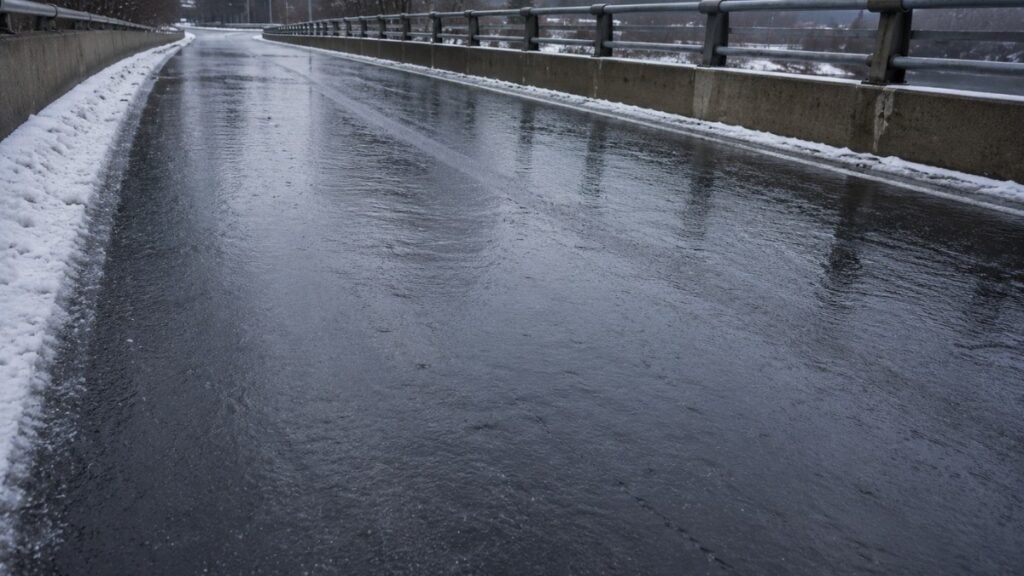
Black ice is ordinary ice on pavement — it appears clear (or black, reflecting the road color beneath it) because it’s thin and transparent. It has almost no visual signature and forms under specific conditions that experienced winter drivers learn to anticipate.
How to Spot Black Ice Before You Hit It
There are rarely visual cues on the ice itself, but there are situational cues:
Temperature: Black ice forms most readily around 32°F (0°C), especially when temperatures drop after a period of melting. If the temperature display reads 30–35°F and the road looks wet, treat every surface as potentially icy.
Location: Bridges and overpasses freeze before the road because air circulates underneath, removing heat from both top and bottom surfaces. Shaded sections under trees or buildings stay colder than sun-exposed sections. Intersections, where cars slow and acceleration condensation can collect, are also higher-risk.
Sound and feel: This one takes experience to recognize — if you notice the tire noise has gotten quieter and the steering suddenly feels lighter, the tires may have transitioned from a grippy surface to ice. The road noise from rubber on pavement is noticeably different from rubber on ice.
Pavement that looks glossy or reflective: Dry pavement has a matte appearance. Wet pavement reflects light clearly. Ice can look similar to wet pavement, but with a slightly different sheen. When in doubt, treat it as ice.
What to Do If You Think You’re Driving on Black Ice
First: don’t do anything sudden. No hard braking, no sharp steering, no sudden acceleration. All of these break the fragile traction available on ice immediately.
Ease off the throttle very gradually. Keep the steering wheel pointed in the direction you want to travel and hold it steady. Allow the car to slow naturally through engine braking and very light, gradual brake application if needed. If ABS activates, let it work — don’t release the brake.
If the car begins to slide despite all of this: steer toward the slide gently, and accept that you may be covering more ground than you’d like before things stabilize. The goal is to not make the situation worse.
How to Handle Tailgaters Without Letting Them Pressure You
This is a Reddit-perennial winter driving topic, and for good reason: being pressured to drive faster than conditions allow by someone behind you is one of the most stressful and genuinely dangerous dynamics on winter roads.
Don’t Let Someone Else Decide Your Speed
Someone flashing their lights, riding your bumper, or clearly impatient behind you in winter conditions is not your problem to solve by going faster. The speed that’s appropriate for the road you’re on is determined by the road, not by the driver behind you.
If you feel pressured and you’re on a multi-lane road: move to the right when it’s safe to do so and let them pass. This is the correct action — not because you need to get out of their way, but because it removes a stressful situation from behind you.
If you’re on a single lane road without passing options: maintain your speed. You are not obligated to endanger yourself because someone else is in a hurry.
Use the Right Lane and Stay Predictable
Staying in the right lane at a consistent, appropriate speed is the winter driving default for most situations. It removes the lane-change dynamic, it positions you for pulling over if needed, and it means you’re visible to faster-moving traffic that can pass on the left.
Being predictable is itself a safety strategy in winter conditions. Other drivers can plan around you if you’re doing consistent, reasonable things. Sudden speed changes, unexpected lane changes, and erratic behavior are all harder for others to accommodate when stopping distances are already extended.
The goal isn’t to win anything. Getting there ten minutes later is worth exactly as much as arriving on time, and worth infinitely more than not arriving.
Driving Downhill, Uphill, and Through Deep Snow
Downhill: This is where most winter accidents happen. The combination of gravity and reduced braking grip is what creates runaway situations. Reduce speed before the descent, use low gear (L, 1, or 2 on automatic transmissions; engine braking in manual), and allow the engine to provide resistance rather than relying entirely on brakes. In automatic vehicles with a CVT or Sport mode, manually selecting a lower ratio before the descent reduces brake heat buildup.
Uphill: The goal is to carry enough momentum through the hill that you don’t lose it, because restarting from a stop on an uphill in snow is difficult and sometimes impossible. If conditions allow, wait for the car ahead to clear the hill before starting your ascent — having to stop mid-hill is significantly harder than never stopping.
Deep snow: Use a measured, steady throttle. Spinning the tires digs the car in; steady pressure helps the car ride up on top of the snow rather than digging channels. If you feel the car sink and start to lose momentum, continuing to spin tires will make it worse.
Driving an EV or Hybrid in Snow? Adjust These Settings First
Electric and hybrid vehicles have winter-specific considerations that combustion-only cars don’t.
Regenerative Braking: EVs typically have high regenerative braking by default — the motor creates resistance when you lift off the throttle, which in winter can feel like sudden braking and cause rear wheel slip in RWD electric vehicles. Reduce regenerative braking to low or disable one-pedal driving in slippery conditions. Most EVs have a snow or low-regen mode specifically for this.
Snow or Winter Mode: Most modern EVs and many hybrids have a specific traction mode for winter. Activating it limits throttle response, adjusts torque distribution (on AWD models), and modifies how aggressively regenerative braking operates. Use it.
Battery in extreme cold: EV range drops significantly in cold weather — sometimes 20–40% below EPA-rated range. Plan for this, especially on longer drives. Preconditioning the battery while still plugged in (warming it before departure) both improves range and reduces the cold-start performance limitations.
Traction Control: Leave it on. The instinct to turn off traction control to “get more power” on snow is counterproductive in winter conditions for most drivers.
Stuck in Snow? Simple Ways to Get Moving Again
It happens to everyone eventually — wheels spinning, the car not moving, that sinking feeling of realizing you may be here for a while.
Rocking the Vehicle Safely
Alternate between Drive and Reverse in gentle, rhythmic movements — forward a few inches, back a few inches, forward again. Each pass compacts the snow slightly and the car builds momentum. Don’t spin the tires; use gentle throttle applications only. The risk of rocking is overheating the transmission with rapid repeated direction changes — don’t rush it.
Using Floor Mats for Temporary Traction
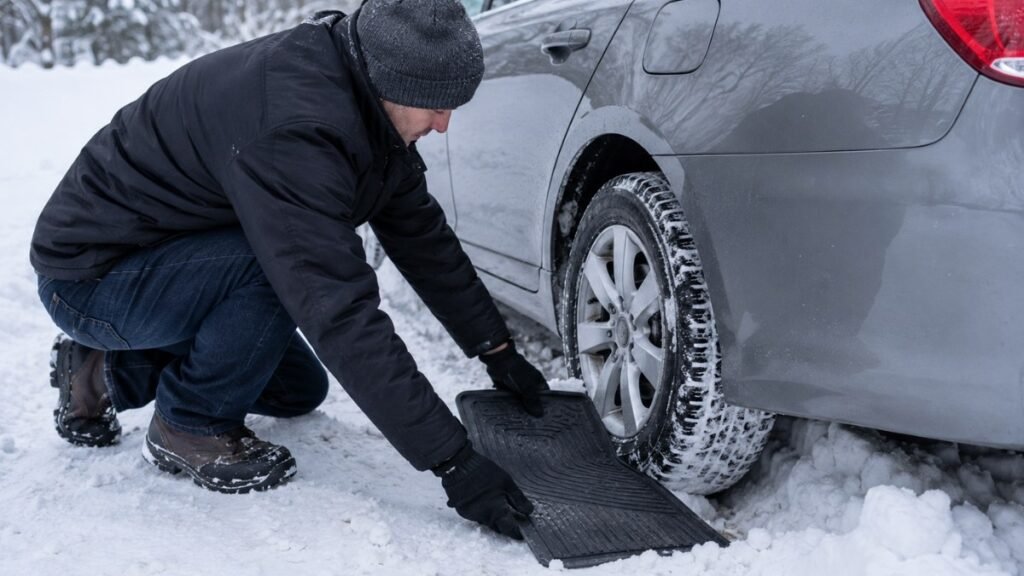
Remove a floor mat from inside the car and slide it under the drive wheel that’s spinning. The rubber surface gives the tire something to grip for the initial movement. This works more often than you’d expect as a temporary measure. It’s hard on the mat, but a replaceable mat is better than being stuck.
Better solution: the traction mats from the winter kit in your trunk, which are designed for exactly this purpose and won’t destroy themselves in the process.
When You Should Stop Spinning the Tires
When wheels spin continuously in place, they melt the snow beneath them and create a polished ice surface that’s harder to get out of than the original snow was. If rocking and traction aids don’t work within a reasonable number of attempts, stop — dig around the drive wheels with the folding shovel, clear a path forward, and try again with clear snow rather than ice beneath the tires.
Clearing Ice and Fog the Right Way
Good visibility is one of the most important parts of winter driving, yet it’s also where many new drivers make costly mistakes. Using hot water on a frozen windshield, running the wrong defogger settings, or ignoring fogged-up windows can quickly turn a routine drive into a dangerous one. The good news is that a few simple habits can keep your view clear without damaging your vehicle.
Never Pour Hot Water on Frozen Glass
It seems logical — hot water melts ice. The problem is that the temperature differential between hot water and frozen glass can cause the glass to crack. Windshield replacement because of a cracked windshield is expensive. Use an ice scraper, the defroster, or a de-icer spray.
De-icer spray (typically an isopropyl alcohol solution) is effective and quick, and won’t damage glass or rubber seals. Commercial de-icer warms rapidly and the ice slides off with minimal scraping. Worth keeping in your emergency kit.
The Correct Defogger Settings Most Drivers Get Wrong
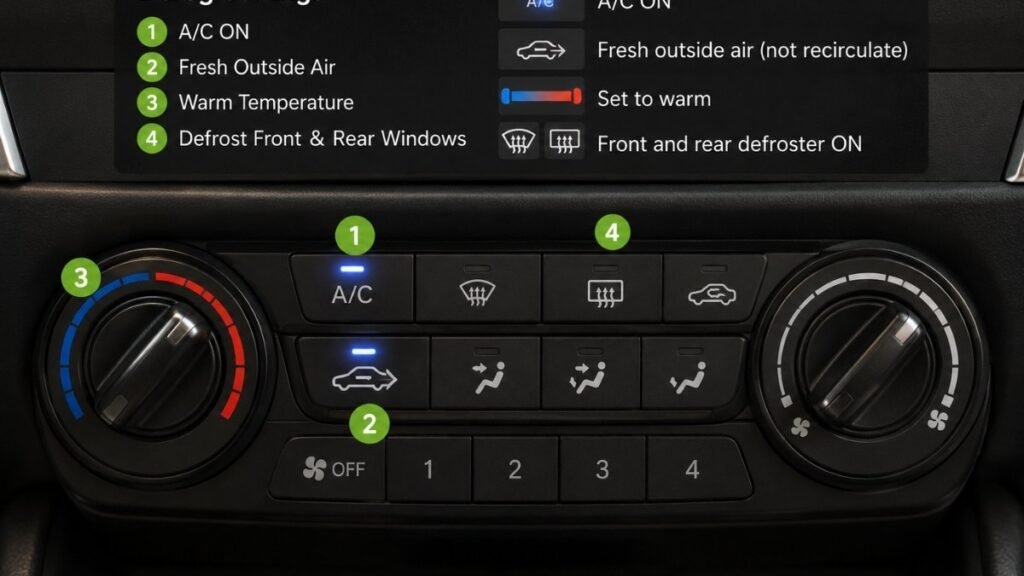
When the windshield fogs up from inside, most people reach for the heat dial. But heat alone on recirculated interior air often makes fogging worse in winter — you’re cycling moist breath and body humidity with no way for it to escape.
The correct winter defog sequence:
- Turn on the A/C — even in winter. A/C removes moisture from the air before it’s heated.
- Switch to fresh outside air — not recirculated interior air. Outside winter air is dry; interior air is humid.
- Set temperature to warm or hot — warm, dry outside air directed at the windshield clears fog quickly.
- Use the rear defogger simultaneously — the heating grid on the rear window is specifically for this.
Most modern cars have a dedicated “defog” button that sets this combination automatically. If yours does, use it — it’s calibrated for this purpose.
When It’s Better Not to Drive at All
This is where experience and judgment matter more than any technique.
There are conditions in which the correct decision — for experienced and inexperienced drivers alike — is to stay home:
Whiteout conditions: Visibility below a few car lengths, blowing snow that makes lanes and road edges invisible. No technique compensates for not being able to see where the road is.
Freezing rain: Rain that freezes on contact with surfaces creates ice faster than any vehicle can adapt to. Freezing rain conditions produce ice coating on roads within minutes. If freezing rain is forecast or occurring, treat the roads as if they’re coated in invisible ice — because they are.
Active blizzard or severe weather warning: Emergency management agencies and transportation departments issue these based on conditions that meet specific danger thresholds. They’re issued for a reason.
If the weather service is telling people to stay home, and your reason for going out is not a genuine emergency, the calculus is simple: the trip can wait.
The most experienced winter drivers know when not to drive. This is not a failure of skill — it’s the exercise of it.
Quick Snow Driving Checklist
Before leaving:
- ☐ Tire pressure checked and correct
- ☐ All snow cleared from roof, hood, windshield, lights, and mirrors
- ☐ Winter washer fluid confirmed
- ☐ Emergency kit in trunk (scraper, shovel, blanket, traction mats, flashlight)
- ☐ Fuel or battery at adequate level for longer-than-expected trip
While driving:
- ☐ Speed reduced for conditions — not just the speed limit, but what the road warrants
- ☐ Following distance tripled from dry-road default
- ☐ Braking before corners, not during
- ☐ One input at a time — brake or steer or accelerate, not combinations
- ☐ ABS — hold pedal if it activates, don’t release
- ☐ Adjusted settings for EV/hybrid if applicable
For specific situations:
- ☐ Bridges and shaded areas treated as potentially icy regardless of appearance
- ☐ Tailgater behind you — right lane when possible, consistent speed otherwise
- ☐ Stuck — try rocking, then floor mat or traction mat, then dig and retry
FAQ
Is it safe to drive in snow with all-season tires? For light to moderate snow, all-season tires are workable with appropriate speed and technique. In heavy snow, packed snow, or repeated winter driving, all-season tires have meaningfully less grip than winter tires below 45°F — the rubber compound hardens in cold temperatures, reducing traction. If you drive in genuine winter conditions regularly, winter tires make a material safety difference.
Should I lower my tire pressure for better traction in snow? No. This is a persistent myth. Lower pressure creates a slightly larger contact patch but reduces the rigidity of the tire, which actually decreases handling precision on snow. Correct pressure for your vehicle (per the door jamb sticker) is the right answer in all conditions.
What should I do if my car starts fishtailing? Ease off the throttle smoothly — not suddenly — and steer gently in the direction the rear is sliding. Use small corrections, not large ones, to avoid the car swinging the other direction. The pendulum effect of overcorrection is how minor fishtails become spins.
Why does my brake pedal shake when I stop on snow? That’s ABS working. The pulsing sensation comes from the system rapidly releasing and reapplying brake pressure to prevent wheel lockup. It means the system is doing its job. Hold the pedal firm and let it work.
Should I turn off regenerative braking in an EV during snow? In most cases, yes — or reduce it significantly. High regenerative braking causes abrupt deceleration when you lift off the throttle, which can trigger rear wheel slip on RWD EVs. Use your vehicle’s snow or eco mode, which typically reduces regen braking automatically.
Why shouldn’t I use cruise control in winter? Cruise control maintains a set speed by applying power when the car slows — exactly when you don’t want unexpected power input on a slippery surface. If a tire loses traction and the car begins to slow, cruise control will attempt to accelerate to compensate, making the situation worse. Turn it off in any winter or wet conditions.
How can I remove ice from my windshield without damaging the glass? Ice scraper, de-icer spray, or your defroster — in that order of speed. Never pour hot water (crack risk) and never use a metal scraper (scratch risk). A quality ice scraper with a foam or rubber blade clears most ice without risk.
Is AWD enough for driving safely in heavy snow? AWD improves traction during acceleration, which reduces wheel spin and improves your ability to get moving from a stop or through deep snow. It does not improve braking distance or cornering grip in the same way. Heavy snow driving still requires appropriate tires, appropriate speed, and the techniques above — AWD is a supplement, not a substitute.
Final Thoughts
Snow driving’s biggest enemy isn’t ice, slush, or poor visibility. It’s impatience and overconfidence — the driver who’s done it before and stopped respecting what can happen, or the driver running late who decides that this time they can make up the time.
Every experienced winter driver you know has been a first-time snow driver at some point. The ones who got through it without incident weren’t doing anything exotic — they left earlier, drove smoother, slowed down more than felt necessary, and made peace with arriving a little later than planned.
Arriving ten minutes late is worth exactly as much as arriving on time. Driving home safely from a winter storm is worth everything. Those two facts should make most of the decisions in this guide feel obvious.
At AutoIXPro, we believe the best winter driving advice isn’t about advanced techniques — it’s about helping everyday drivers avoid preventable mistakes. We focus on practical advice that makes daily driving safer, simpler, and less stressful.
If this guide helped you feel more prepared, explore our other driving resources for emergency gear recommendations, vehicle maintenance guides, and seasonal tips before the next storm arrives.
🚗 AutoIXPro Garage Notes: The Thinking Behind This Guide
Safe winter driving isn’t about confidence—it’s about preparation, patience, and smooth decisions.
That’s why this guide focuses on practical habits that everyday drivers can actually use, from preparing your vehicle before a trip to handling snow, ice, and unexpected situations on the road.
This guide is built around three essentials:
- 🚘 Vehicle Preparation — Tires, visibility, and emergency essentials.
- ❄️ Safe Winter Driving — Practical techniques for snow, ice, and changing road conditions.
- 🛠️ Everyday Driver Safety — Simple habits that help you avoid common winter driving mistakes.
Because the goal isn’t to master winter driving overnight.
It’s to arrive home safely, every time.
Continue Building Your Winter Driving Skills
Winter safety isn’t built from one tip alone. These guides can help you become a more confident driver throughout the season:
- Car essentials every driver should have — the emergency kit items that matter most when winter goes wrong on the road. (→ Car Essentials Every Driver Actually Needs)
- How to check tire pressure — the monthly habit that matters most in winter, when cold temperatures silently reduce pressure while you sleep. (→ How to Check Tire Pressure)
- Car maintenance checklist — where winter preparation fits in a full annual maintenance schedule. (→ Car Maintenance Checklist)
- Oversteer vs understeer — the physics behind winter skids, explained for everyday drivers. (→ Oversteer vs Understeer)
🚗 Drive Smarter with AutoIXPro
Every mile is different, but the goal is always the same—getting home safely.
That’s why AutoIXPro is dedicated to sharing practical driving advice, honest product recommendations, and easy-to-follow maintenance guides for everyday drivers. We believe small habits often make the biggest difference behind the wheel.
Thanks for reading, and we hope to see you again before your next drive.
Drive smarter. Drive safer. Drive with confidence.