
Key Takeaways
- There are two completely different technologies — thermoelectric coolers and compressor coolers — and they serve fundamentally different use cases; buying the wrong type is the most common expensive mistake
- Thermoelectric coolers can only cool 35–40°F below ambient temperature — on a 95°F summer day, the best they can do is 55–60°F, which is not cold enough to safely store dairy or meat
- Compressor coolers work like a real refrigerator and maintain 32–40°F regardless of outside temperature — they cost 3–5x more but are the only option for multi-day trips or food safety
- Leaving a car cooler plugged in with the engine off drains your battery — both types draw continuous power; always run from the engine or a power station, not a parked vehicle
- For a day trip to the beach or a picnic, a quality insulated soft-sided cooler with ice packs is often the smarter choice than an electric cooler under $100
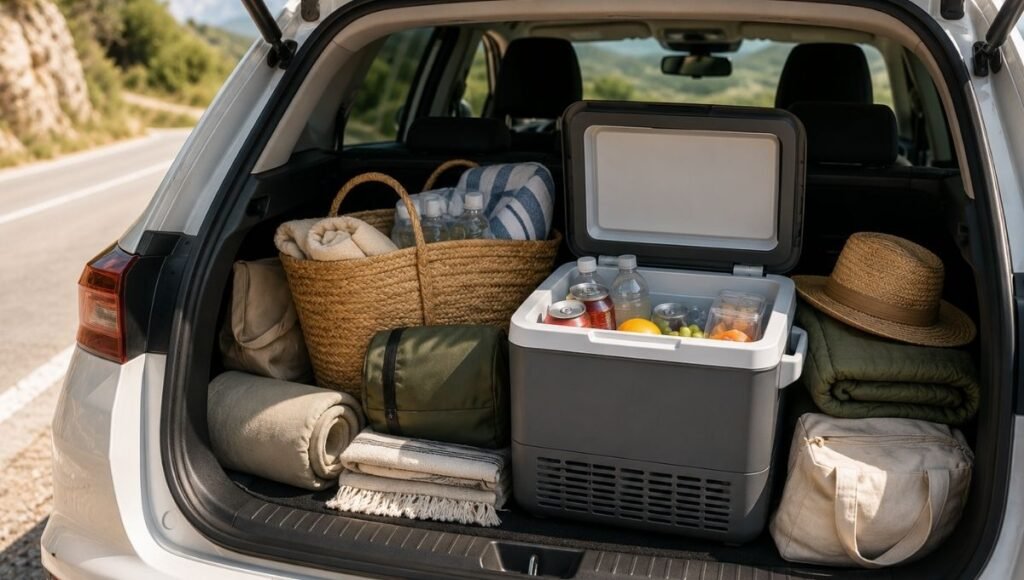
The Warm Soda Situation
It’s three hours into a summer road trip. The temperature outside is 92°F. You reach into the 12V cooler you plugged in when you left — the one with 300+ Amazon reviews and “keeps food cold for hours” in the product description — and pull out a can that’s barely cool to the touch. Maybe 65°F. Not refreshing. Not what you paid for.
This is one of the most consistent complaints across car cooler reviews, and it almost always comes from the same misunderstanding: thermoelectric coolers don’t cool to a fixed temperature. They cool relative to the ambient temperature around them. When it’s hot outside and hot in the car, a thermoelectric cooler is working against physics and losing.
The person who bought a compressor cooler and spent three times as much is pulling out a genuinely cold drink from the same heat. They understood the difference before they bought.
Most car cooler guides bury this distinction in technical specs. This guide puts it front and center, because it determines whether you’ll be happy with your purchase — or whether you’ll be hunting for a gas station ice bag at the next exit.
First: Do You Actually Need an Electric Car Cooler?
Before spending $80–$400 on an electric car cooler, it’s worth asking whether you actually need one.
A quality insulated soft-sided bag with ice packs handles most day-trip scenarios at a fraction of the cost. For a 4–6 hour trip, a well-insulated bag keeps drinks cold without any power, any noise, any space commitment, and any battery drain. The soft sides fold flat when empty. There’s nothing to plug in, nothing to forget to charge, and nothing that requires you to keep the engine running.
An electric car cooler earns its place when:
- You’re traveling for multiple days and need consistent cold without restocking ice
- You need to keep perishable food or medication at specific safe temperatures (below 40°F)
- You’re camping, overlanding, or living out of your vehicle for extended periods
- You’re an EV driver who wants to minimize weight and eliminate ice entirely
If you’re doing the occasional day trip to the lake, taking beach supplies for the afternoon, or carrying drinks and snacks for a few hours — a $25 insulated cooler bag with a couple of ice packs will probably serve you as well or better than an electric unit under $100.
The Two Technologies: What They Actually Do
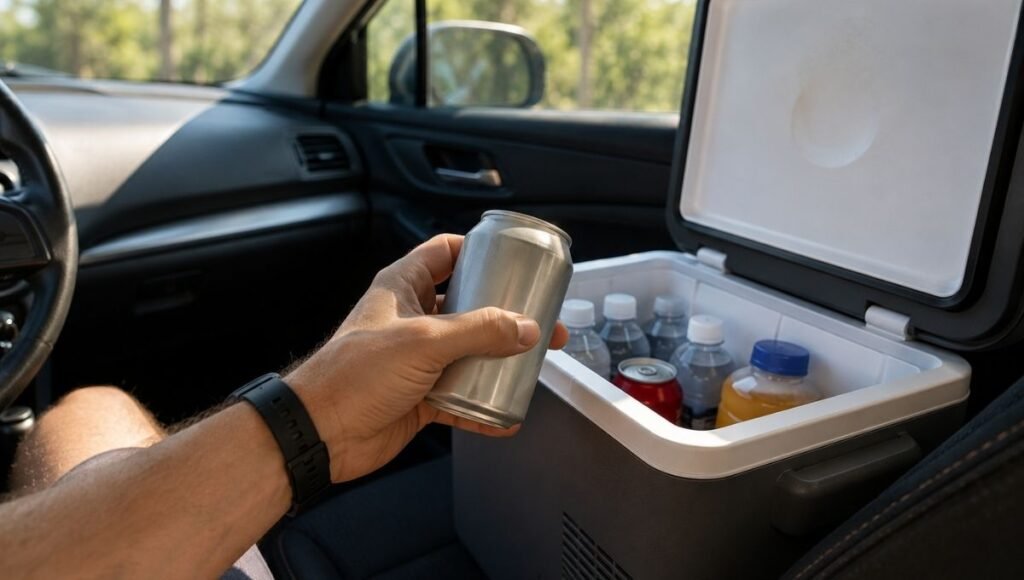
Thermoelectric Coolers ($40–$150)
Thermoelectric coolers use the Peltier effect — electricity flowing through two different semiconductor materials creates a temperature difference, with one side getting cold and the other getting warm. The warm side vents to the outside of the cooler, the cold side faces the interior.
The fundamental limitation: Thermoelectric coolers can only create a temperature difference from ambient — typically 35–40°F below the temperature of the air around the cooler. If the air in your car is 90°F, the cooler interior will reach approximately 50–55°F at best. If it’s 100°F in the car, you’re looking at 60–65°F inside. That’s not food-safe for meat or dairy (USDA guidelines require below 40°F), and it’s not particularly refreshing for drinks.
They work considerably better when:
- The car is air-conditioned and the interior stays below 75°F
- You pre-chill the contents before plugging in (a thermoelectric cooler maintains temperature better than it creates it from warm)
- You’re in a moderate climate where ambient temperatures stay below 80°F
What thermoelectric does well:
- Keeping pre-chilled drinks cold for short drives in moderate temperatures
- Also functions as a warmer (can heat to 120–140°F) — useful for keeping food warm
- Lower cost, lighter weight, quieter operation, simpler maintenance
- Draws less power (30–50W vs 40–80W for compressor models)
Editor’s take: A thermoelectric cooler is a reasonable choice for commuters who want to keep a lunch cold in an air-conditioned car, or for mild-climate drivers doing short trips. In hot climates above 85°F ambient, or for any trip where food safety matters, thermoelectric is the wrong technology regardless of price.
Compressor Coolers ($200–$1,000+)
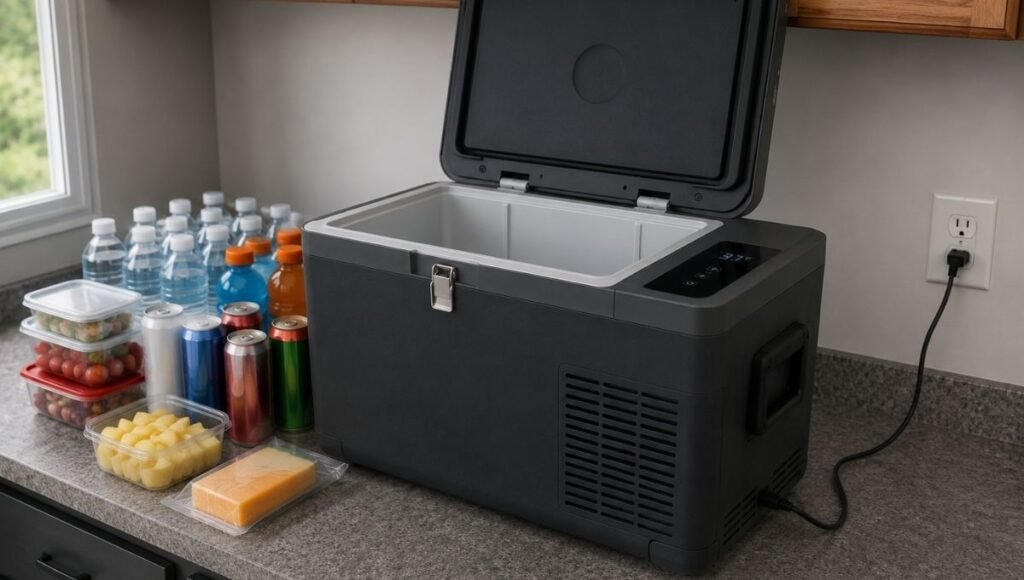
Compressor coolers work on the same principle as your home refrigerator — a refrigerant gas is compressed and cycled through coils, removing heat from the interior and expelling it externally. Temperature is controlled precisely and maintained regardless of outside conditions.
The core advantage: A compressor cooler set to 38°F will maintain 38°F whether you’re in Phoenix in July or Minnesota in October. The outside temperature is essentially irrelevant. This is what makes them suitable for food storage, medical supplies, or any situation where temperature consistency matters.
They can typically cool from 32°F down to -4°F (freezer territory) depending on the model. The Dometic CFX series, Alpicool, and BougeRV models can reach true freezing in under 30 minutes even in high ambient temperatures.
The honest trade-offs:
- Significantly heavier (25–50 lbs for larger models vs 10–15 lbs for thermoelectric)
- More expensive across the board
- Louder during operation (the compressor cycles on and off)
- Higher power draw, though efficient models use surprisingly little in ECO mode (as low as 25–36W steady-state)
Who compressor coolers are actually for: Multi-day travelers, campers, overlanders, road trippers who need reliable cold for 24+ hours, anyone transporting medication that requires specific temperature control, and people who find themselves repeatedly disappointed by thermoelectric performance.
The Battery Drain Issue Nobody Explains Clearly
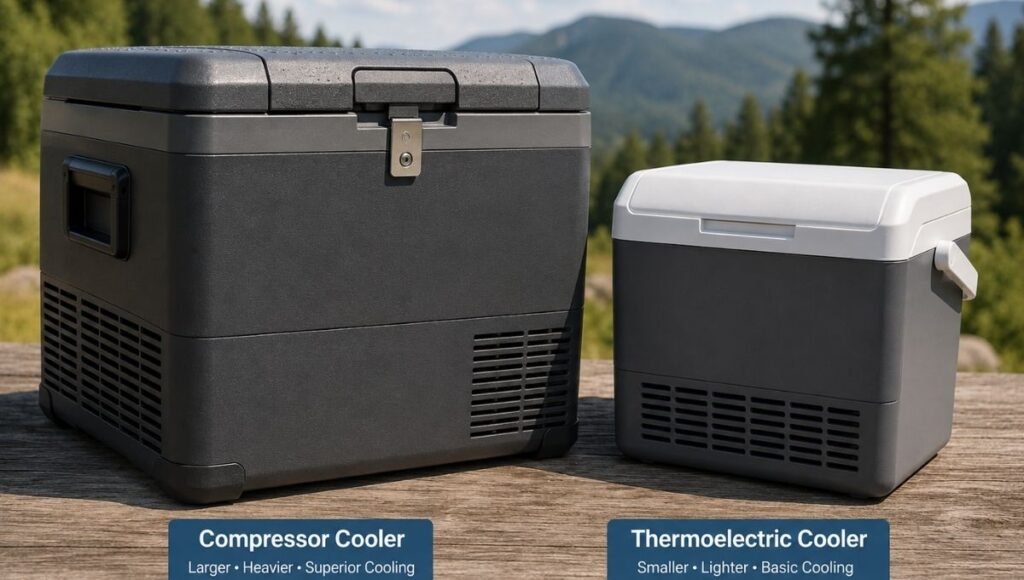
Both types of electric coolers draw continuous power from your car’s 12V system. The implications differ by situation:
While driving: No problem. The alternator is charging the battery continuously, and the cooler’s power draw (30–80W depending on type and model) is well within what the alternator produces. Run the cooler as long as you’re driving.
Parked with engine off: The cooler is now drawing from the battery with no recharging happening. A standard car battery has approximately 50–70 amp-hours of usable capacity. A thermoelectric cooler running at 45W draws about 3.75 amps at 12V — meaning you’d drain a significant portion of the battery within a few hours. A compressor cooler is actually more efficient in ECO mode (sometimes drawing under 3 amps at steady state) but the same principle applies.
The practical rule: Don’t leave the cooler plugged in to a parked car for more than 30–60 minutes without the engine running, unless you have a secondary battery, a power station, or a battery-protect relay that cuts power before the starting battery depletes.
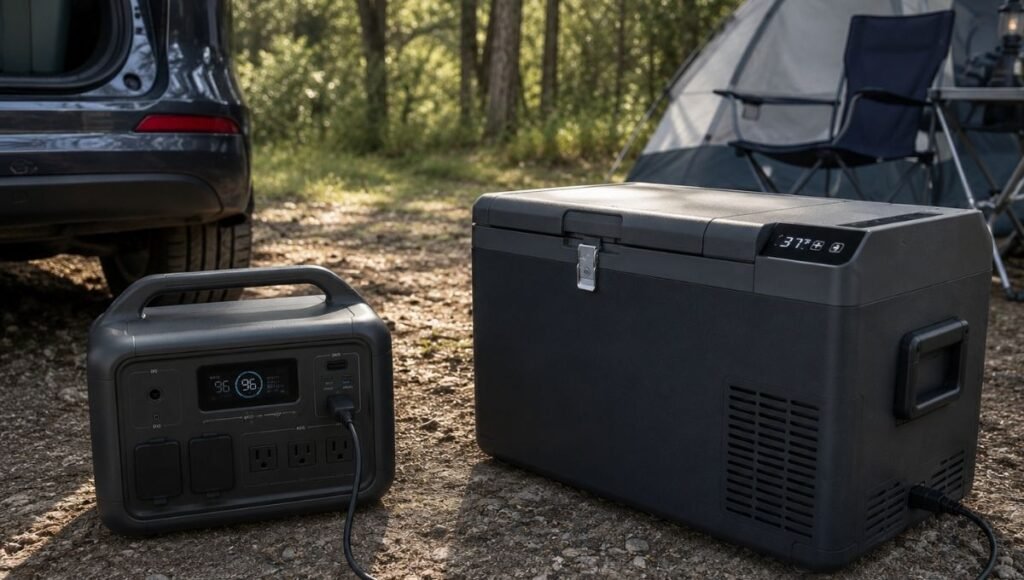
Many compressor cooler owners who use them for camping run them from a portable power station (like a Jackery or EcoFlow) rather than the car battery, which eliminates the battery drain concern entirely.
One exception: The Anker EverFrost and similar models have a built-in battery pack — they can run independently without any external power source for 18–32 hours depending on settings. This solves the parked-car problem completely, at a higher price point.
Choosing by Use Case — The Practical Breakdown
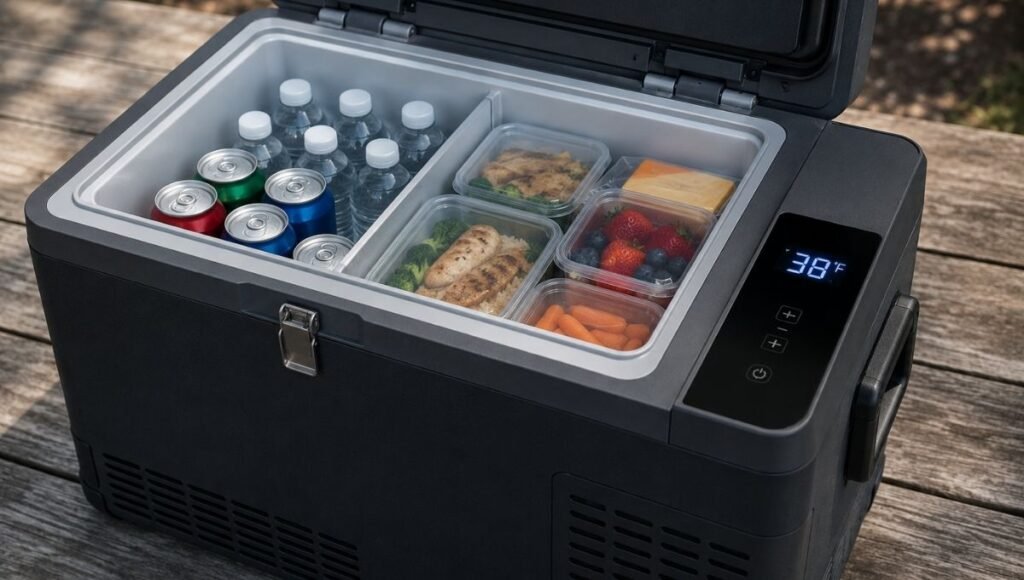
Day Trip (4–8 hours, drinks and snacks)
Best option: Quality insulated soft-sided bag with ice packs ($25–50) Second option: Thermoelectric cooler if the car stays air-conditioned
An electric cooler for this use case is probably over-engineering it. A good insulated bag works without any setup, power management, or engine dependency.
Weekend Road Trip (1–2 days, food and drinks)
Best option: Entry-level compressor cooler like BougeRV 23 Quart ($200–250)
Thermoelectric becomes unreliable for overnight holds in warm climates. A compressor model gives you genuine cold the entire time, and the price difference pays for itself in avoided gas station ice purchases after the first few uses.
Extended Trip or Camping (3+ days)
Best option: Mid-range compressor cooler with dual-zone capability (Dometic CFX3, Alpicool CF45, $300–500)
Dual-zone coolers let you run one section as a fridge and one as a freezer simultaneously — meaning you can freeze meat for later in the trip while keeping drinks and produce at fridge temperature. For multi-day use, this capability is worth the price premium over single-zone models.
Medication Storage (insulin, certain prescriptions)
Only option: Compressor cooler with precise temperature control
Thermoelectric coolers cannot reliably maintain the 36–46°F (2–8°C) range required for insulin storage in hot weather. A compressor cooler with a digital thermostat is the only appropriate choice. Verify specific temperature requirements with your pharmacist and test the cooler before relying on it for medication.
The Features That Actually Matter vs. The Ones That Sound Good
Actually Important
Temperature range and stability: For compressor coolers, verify the minimum temperature it can achieve and how consistently it maintains the set temperature during real-world use. Look for reviews that mention performance in hot conditions, not just spec-sheet numbers.
Power consumption in ECO mode: Most compressor coolers have an ECO or energy-saving mode that cycles the compressor more slowly. This is the relevant number for long-term use — not the peak draw during initial cooling.
Build quality and hinge construction: The lid hinge is the most common failure point on both types. Plastic hinges on budget models crack with repeated use. Look for metal or reinforced hinge construction if you’re planning regular use.
Capacity vs. physical footprint: A 45-quart cooler sounds large until you realize it might not fit in the cargo area of your specific vehicle. Measure the available space before buying. Most manufacturers list external dimensions, not just quart capacity.
Sounds Good, Less Important
App connectivity: Phone apps for temperature monitoring exist on some premium models. Nice, but rarely the deciding factor in actual use.
USB charging ports on the cooler: Convenient, adds minimal real value.
“Whisper quiet” claims: All compressor coolers make noise. The cycling compressor is audible in a quiet car, typically at around 45–50 dB. Fine for road trips where there’s road noise; noticeable in quiet campsites. Thermoelectric coolers are genuinely quieter (no compressor), which is one legitimate advantage.
The 10-Minute Pre-Chill Habit That Changes Everything
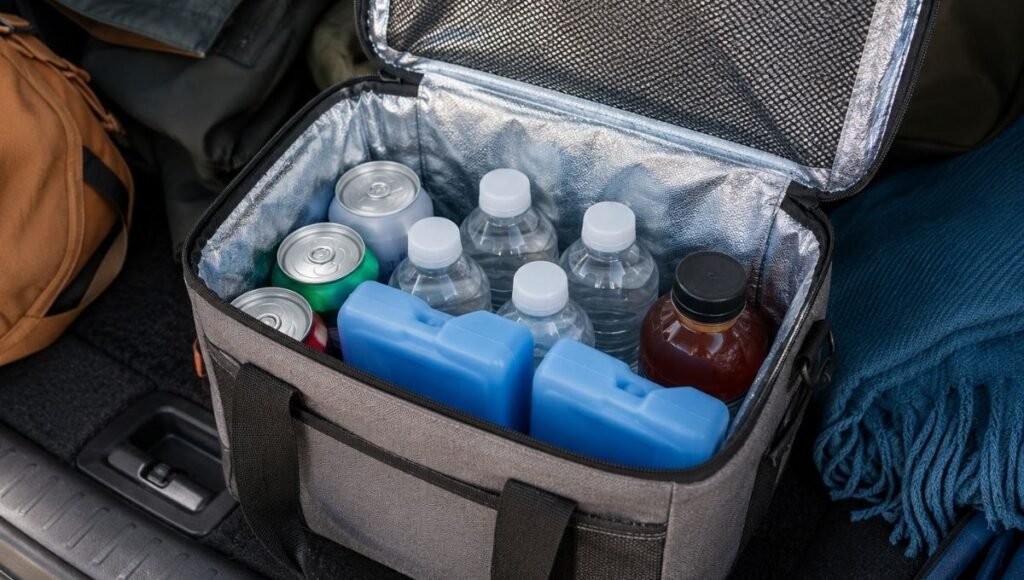
One of the most consistent pieces of advice from people who’ve used car coolers for years: pre-chill before you load.
Both thermoelectric and compressor coolers work significantly better when started cold. Run the cooler for 30–60 minutes at home (plugged into AC power) before loading your food and drinks, and then transfer cold contents into a cold cooler. Starting warm means the cooler spends its first hour working down from ambient rather than maintaining.
Pre-chilling the contents (cold drinks rather than room-temperature drinks, refrigerated food) has an even bigger impact. A thermoelectric cooler loaded with items at 38°F will maintain near that temperature — the same cooler loaded with room-temperature items may never catch up in summer heat.
This one habit, more than any spec on the product listing, determines how satisfied people are with their car cooler.
FAQ
What is the best car cooler? Depends on your use case. For day trips: a quality insulated bag with ice packs. For road trips and camping where you need reliable cold for 24+ hours: a compressor cooler in the $200–350 range (BougeRV, Alpicool, or entry Dometic models). For serious overlanding or extended use: a premium dual-zone compressor unit from Dometic or Engel.
Can you run a car cooler with the engine off? For short periods (30–60 minutes), yes — but leaving it running while parked will drain your car battery. For extended parked cooling, use a portable power station or a model with a built-in battery (Anker EverFrost). Always use battery protection settings if available on the cooler.
What is the difference between thermoelectric and compressor car coolers? Thermoelectric coolers can only cool 35–40°F below ambient temperature — they struggle in heat and cannot guarantee food-safe temperatures above 85°F ambient. Compressor coolers work like real refrigerators and maintain set temperatures (32–40°F) regardless of outside temperature. Compressors cost significantly more but are the only type suitable for food storage in warm weather or multi-day trips.
Do car coolers drain the battery? Yes, if left running with the engine off. While driving, the alternator compensates and the cooler runs without battery impact. Parked with engine off, a cooler can drain the battery significantly within a few hours. Use ECO mode, a power station, or limit parked runtime to under an hour to avoid being stranded.
Are thermoelectric car coolers worth it? For keeping drinks cold in a temperature-controlled car on a short trip in mild weather — yes. For anything requiring consistent food-safe temperatures in hot weather — no. The limitation is physics, not quality: thermoelectric cooling is fundamentally temperature-relative, and no amount of spending overcomes this in hot conditions.
How cold do car coolers get? Thermoelectric: typically 35–40°F below ambient. At 90°F ambient, expect 50–55°F interior maximum. Compressor: typically down to 32°F or below, independent of outside temperature. Freezer-capable models reach -4°F. The difference is significant for food safety and drink temperature.
What size car cooler do I need? A rough guide: 20–25 quarts for 1–2 people on a weekend trip. 35–45 quarts for 2–4 people or longer trips. 50+ quarts for extended camping or overlanding. Measure your cargo area before buying — external dimensions vary significantly even for same-capacity models, and a cooler that doesn’t fit your space is useless regardless of performance.
What’s Next
A car cooler pairs naturally with a complete road trip setup:
- Car organizer — keeping the trunk organized around a cooler requires planning; the zone approach makes the cooler accessible without reorganizing everything. (→ Car Organizer — By Zone and Why Trunk Organization Is a Safety Issue)
- Car essentials every driver should have — the emergency and comfort items that round out any road trip kit. (→ Car Essentials Every Driver Actually Needs)
- Car sun shade — in extreme heat, a sun shade reduces the ambient temperature inside the car, which directly improves thermoelectric cooler performance. (→ Car Sun Shade — Why Your Car Gets So Hot)
The right car cooler for your situation exists — it just requires being honest about what you’re actually doing, not what sounds most impressive in a product description.
References
- U.S. Department of Agriculture (USDA) Food Safety and Inspection Service — Keeping Food Safe During an Emergency, food temperature safety guidelines (below 40°F for refrigerated storage) and travel food safety recommendations
- U.S. Department of Energy — Thermoelectric Power Generation, technical reference on Peltier effect efficiency and temperature differential limitations in thermoelectric systems
- National Institutes of Health (NIH) — Insulin Storage and Traveling with Diabetes, medication temperature requirements (36–46°F / 2–8°C) for insulin storage in travel conditions
- GearJunkie / Outdoor Gear Lab — Electric Cooler Testing Methodology 2025, independently verified performance data for compressor and thermoelectric cooler categories
This article contains affiliate links. AutoIXPro may earn a small commission on purchases through our links at no extra cost to you. All recommendations are based on genuine research and practical testing data. See our Affiliate Disclosure for details.
Car cooler question for your specific situation? Contact us — we read every message.