
Key Takeaways
- The straps matter more than the size or material — a trunk organizer that slides during hard braking is worse than nothing; always verify tie-down straps connect to the cargo anchor hooks in your trunk floor
- Fabric denier rating predicts longevity — 600D Oxford polyester is the minimum worth buying; anything thinner will sag under grocery weight within months; 1680D handles tools and serious loads
- Collapsible wins over rigid for most people — a rigid organizer is better when you can’t fold it, worse when you occasionally need full trunk space; collapsible handles both situations
- Measure before you order — the gap between what an organizer claims to fit and what actually fits in your specific trunk is significant; trunk dimensions vary widely even within the same vehicle class
- An organizer only stays organized if the system is simple — one organizer with three clear categories beats four organizers full of things you’ve forgotten about
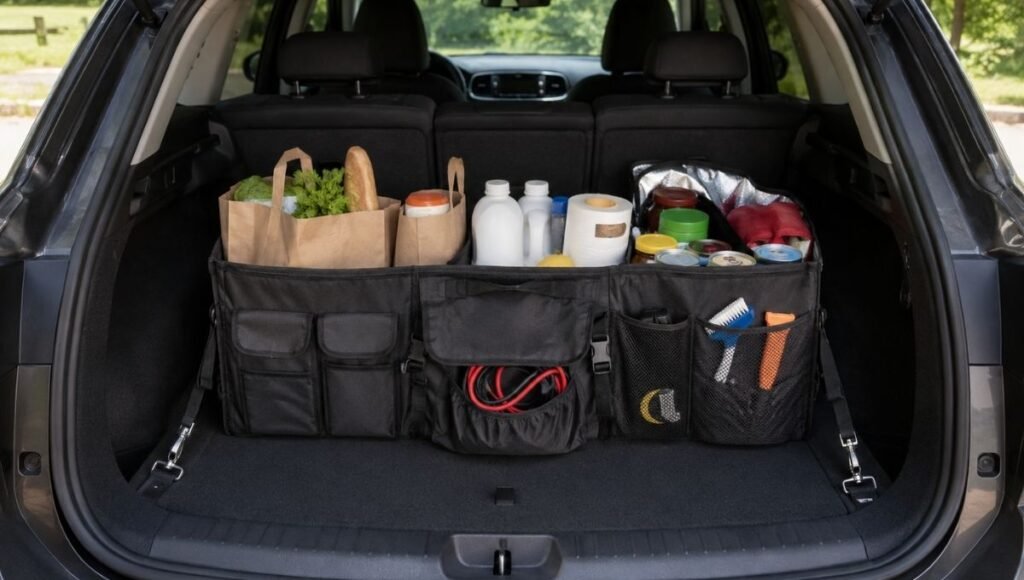
The Grocery Avalanche That Finally Made You Look This Up
You’ve done the mental calculus. It’s a Tuesday evening. You have six bags of groceries in the trunk. The eggs are on the left side, the bread somewhere in the middle, the produce bag is already tipping. You take a gentle right turn into your neighborhood and hear the familiar cascade — the dull thud of something heavy falling over, the softer rustling of produce redistributing itself across the trunk carpet. When you get out, one of the eggs is broken. The bread is under the bag of potatoes.
This is the moment most people look up trunk organizers. Not because they’ve been wanting to optimize their cargo management. Just because they’re tired of the grocery avalanche.
The trunk organizer market is saturated with products making similar promises. Most of them do the basic job adequately. The difference between a good one and a mediocre one comes down to a few specific features that almost none of the product listings explain clearly — and one feature in particular that determines whether your organizer is a convenience or a hazard.
The Safety Feature That Most Listings Barely Mention
In crash testing that simulates a 30 mph sudden deceleration, unsecured trunk organizers — even fully loaded ones — shift forward significantly. A 30-pound organizer full of groceries, tools, or supplies becomes a dangerous moving object in a hard stop or collision. This isn’t theoretical: it’s the same physics that makes any unsecured trunk cargo a concern.
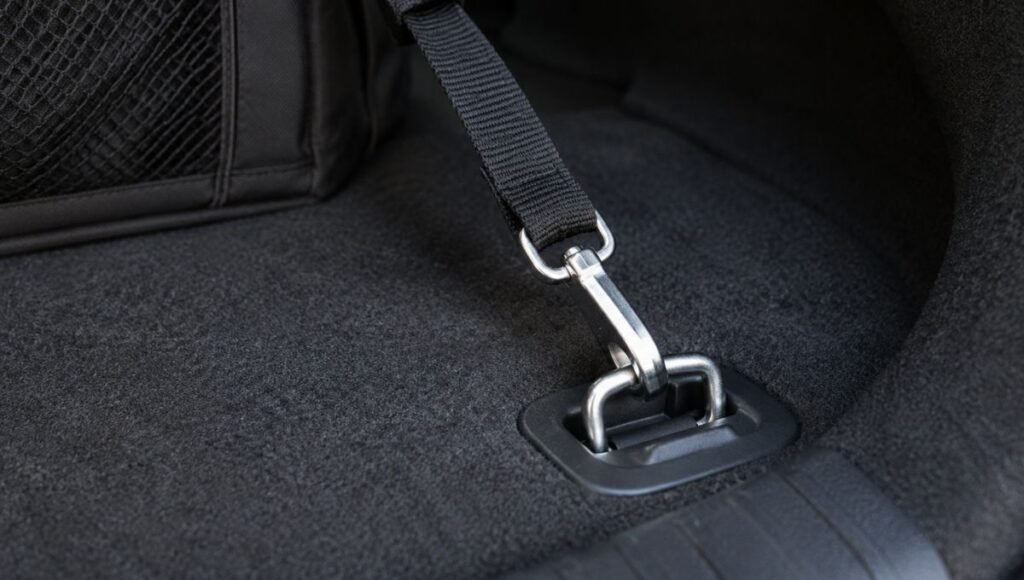
Most cars have cargo tie-down hooks or D-rings embedded in the trunk floor — small metal loops or hooks that are there specifically for securing loads. They’re easy to miss if you’ve never used them. But they’re the correct anchor point for a trunk organizer’s straps.
What to verify before buying any trunk organizer:
Does it include tie-down straps, and do those straps have hooks or clips designed to connect to standard cargo anchor points? Some organizers include decorative straps that don’t actually connect to anything useful. Others have straps with proper J-hooks or snap clips that engage the cargo loops.
Non-slip backing (rubber or mesh material on the bottom) reduces sliding on smooth trunk surfaces. But non-slip alone is not adequate for hard braking — you need the straps engaged. Both together is the correct setup.
If your car’s cargo hooks are in an awkward location relative to where the organizer sits, some organizers include adjustable or extendable straps. This is worth checking before buying for specific vehicles.
The Material Guide: What Denier Actually Means for Real Use
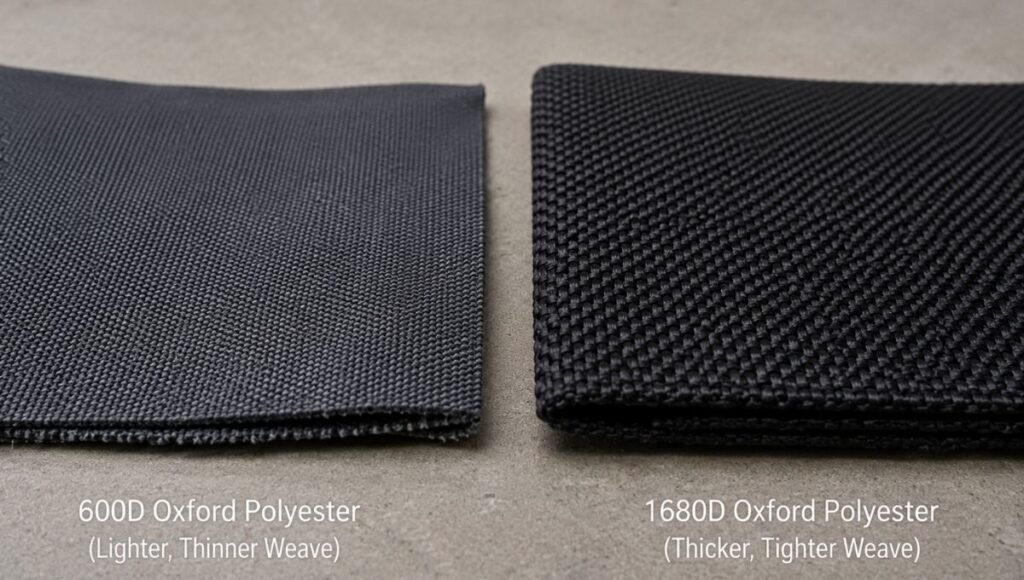
Every trunk organizer listing mentions fabric denier — 600D, 900D, 1680D — but almost none of them explain what these numbers mean in practical terms.
Denier is a measure of fiber thickness. Higher numbers mean thicker fibers, which translates directly to tear resistance, sag resistance, and overall longevity under load.
600D Oxford polyester: The minimum acceptable for trunk use. Handles grocery loads, reusable bags, and light supplies without sagging. Will show wear after a year of heavy use with tools or wet gear. Appropriate for drivers who primarily use the organizer for weekly errands.
900D–1200D Oxford polyester: Noticeably more substantial. The sides hold their shape better when partially filled and handle moderate weight (15–30 lbs) without the sagging that plagues thinner fabrics. Good middle ground for most drivers.
1680D Oxford polyester (ballistic grade): What contractors and overlanders use. Heavy-duty enough to carry tools, recovery gear, and heavy supplies without structural compromise. Overkill for grocery runs; exactly right for anyone who regularly hauls serious weight.
The base panel matters separately from the fabric. The bottom of the organizer takes the most direct weight and is the most common failure point. Quality organizers have reinforced base panels — either a separate rigid board insert or a multi-layer base construction. Test this before buying: set the organizer on the floor and press firmly on the center of the base. Significant flex means it won’t hold heavy loads over time.
Cardboard insert vs. polypropylene (PP) panels: Some organizers use cardboard as the stiffening material for their walls and base. Cardboard softens and deforms when exposed to moisture — a leaky bottle, a wet bag, or even humidity in a warm trunk will compromise it over time. PP (polypropylene) panels maintain their rigidity when wet. If you’re buying for regular use, verify which material is in the walls.
Collapsible vs. Rigid: The Honest Trade-Off
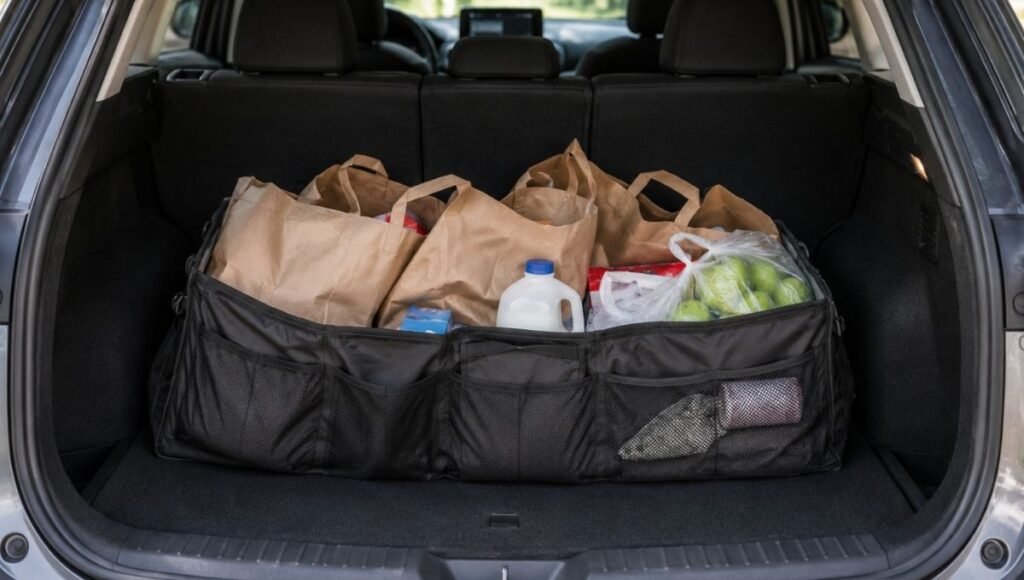
This is the decision that most trunk organizer guides spend too much time on. The practical reality is simpler than most comparisons make it seem.
Collapsible fabric organizers are appropriate for the overwhelming majority of drivers. They can handle anything from grocery runs to moderate outdoor gear when properly sized and constructed. When you need the full trunk space — moving furniture, transporting large items, airport pickups — you fold the organizer flat and stow it. This is the feature that makes collapsible the default right answer.
The failure mode of cheap collapsible organizers is well-documented: they sag. The sides fold inward when loaded because the fabric is too thin or the internal structure is inadequate. The solution isn’t to buy rigid — it’s to buy quality collapsible with proper internal panels. A well-built collapsible organizer with 900D+ fabric and PP wall panels maintains its shape under typical loads.
Rigid organizers (hard plastic or heavy polypropylene construction) hold their shape regardless of load and are easier to clean when contents leak. They’re appropriate for:
- Contractors who transport tools and need the organizer to withstand rough treatment
- Drivers who want a permanent installation they’ll never remove
- Anyone regularly transporting fragile items (wine, glass containers) that benefit from rigid wall support
The trade-off is space. A rigid organizer takes up the same trunk space whether it’s empty or full. In a smaller sedan trunk, a rigid organizer can make the space feel permanently claimed.
Editor’s take: Buy collapsible with good construction unless you have a specific reason to need rigid. The flexibility to reclaim trunk space occasionally is worth more than the marginal structural advantage of rigid for typical use.
Sizing: The Measurement Step Everyone Skips
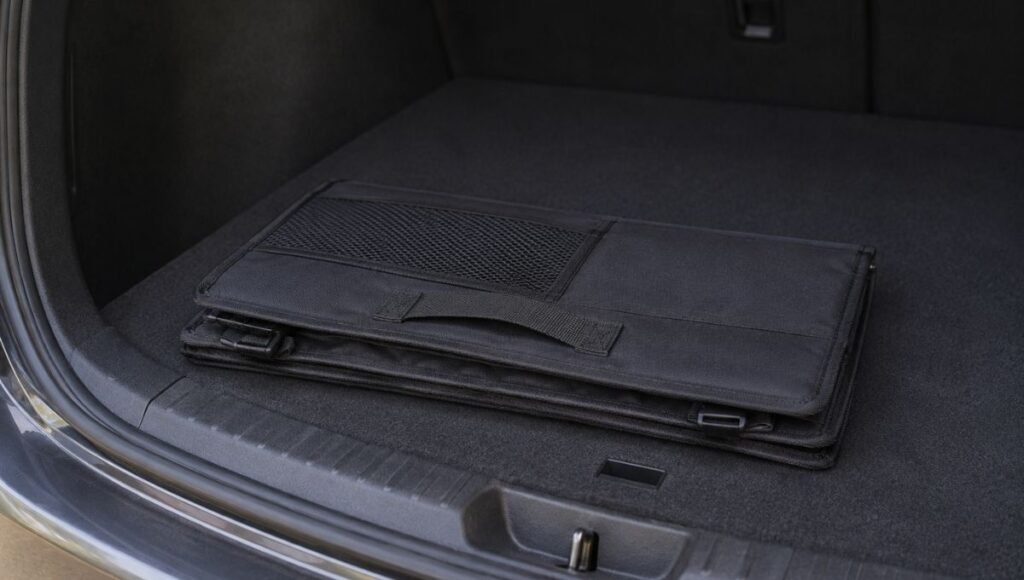
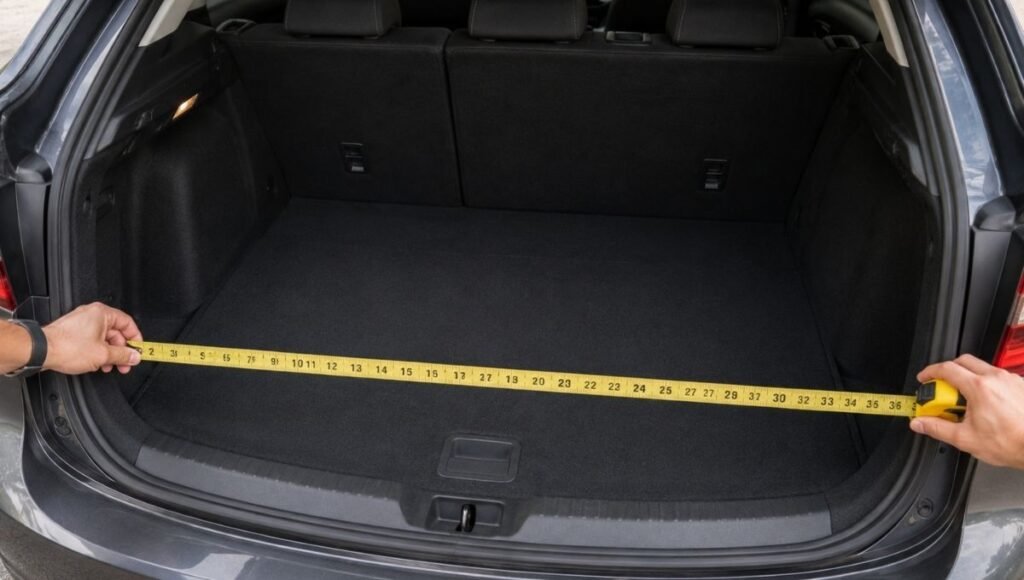
This is where most trunk organizer frustration originates. The product says “fits most vehicles.” It arrives and takes up two-thirds of the trunk, leaving no room for anything alongside it. Or it’s smaller than expected and slides around in a trunk it was supposed to organize.
Before ordering, measure:
- Trunk width at the widest point, and at the narrowest point (some trunks taper significantly front-to-back)
- Trunk depth from the rear of the back seat to the rear hatch opening
- Height clearance — some organizers are tall enough that the trunk lid won’t fully clear them when they’re loaded
The 30–50% rule: An organizer should occupy roughly 30–50% of your trunk’s usable width. This leaves room beside it for bags, a car cooler, sporting equipment, or whatever else you regularly transport. An organizer that claims the entire width of a compact sedan trunk has eliminated the flexibility of the trunk in the process.
Vehicle-specific considerations:
- Sedans: Trunk width typically 36–45 inches. Look for organizers in the 11–16 inch width range.
- SUVs and crossovers: Cargo width typically 42–54 inches. Can accommodate larger organizers without losing flexibility, or use multiple smaller organizers side by side.
- Hatchbacks: The cargo area typically doesn’t have a fixed rear wall like a sedan trunk — organizers slide more freely without the containment of a trunk surround. Non-slip base and strap attachment are even more important here.
- Trucks: Bed organizers are a different category from trunk organizers. A standard trunk organizer placed in a truck bed is exposed to weather and will not last.
The Three-Category System That Makes Organization Stick
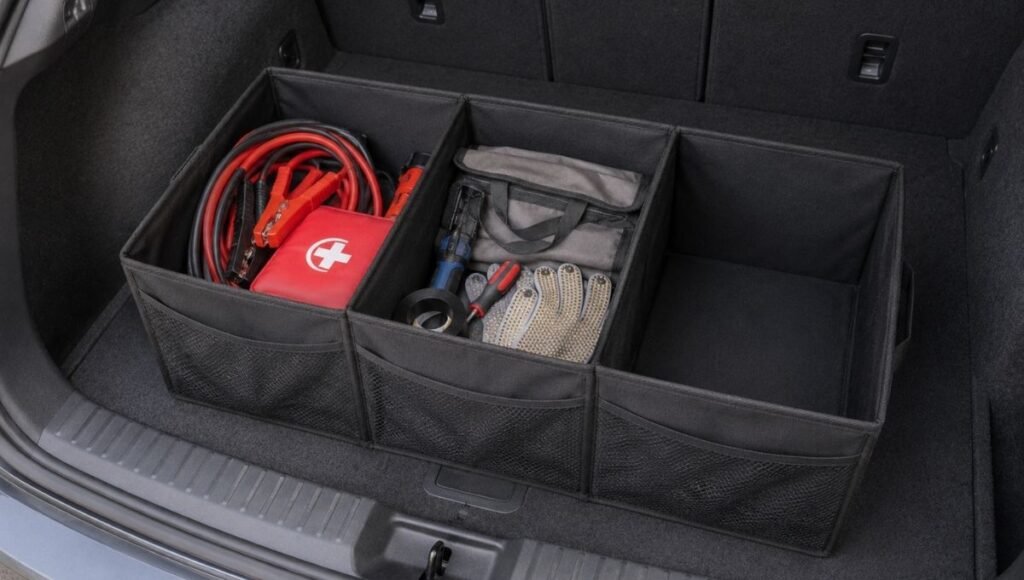
The most organized trunks belong to people who have committed to a specific system — not people who own the most organizers.
The system that works consistently: assign three categories and stick to them.
A typical three-compartment organizer maps naturally to:
- Emergency and maintenance items (jumper cables, tire inflator, first aid kit, tow strap)
- Regular-use items (reusable bags, umbrella, car cleaning supplies, small tool)
- Flexible space (left empty or used for whatever the current week requires — sports gear, groceries, a bag to return)
The flexible space is the critical element. An organizer with all three compartments constantly filled becomes a storage unit you have to unpack every time you need the full trunk. Keeping one compartment clear for variable needs prevents this.
Every three months or so: remove everything from the organizer, put back only what’s still serving a purpose, and evaluate whether the category assignments still make sense. This 10-minute maintenance session is what keeps the system working rather than slowly reverting to chaos.
When Your Organizer Keeps Sliding (The Fix That Actually Works)
If the organizer moves during driving despite having non-slip backing:
Step 1: Locate the cargo tie-down hooks in your trunk floor. These are typically small D-rings or anchor hooks near the corners of the trunk floor, often under a plastic cover or flush with the carpet. Flip up the carpet if needed to find them — they’re there on almost every modern passenger vehicle.
Step 2: Engage the organizer’s straps to these hooks. Thread the strap through the hook and clip or tie it securely. The strap should be taut but not so tight that it distorts the organizer shape.
Step 3: If the organizer’s straps can’t reach the cargo hooks in your specific vehicle, a set of universal cargo anchor extensions (available for $10–15) bridges the gap.
If the organizer has no straps at all and you’re relying solely on non-slip backing: a sheet of non-slip drawer liner ($5–10 from any home store) cut to size and placed under the organizer dramatically reduces movement. Not as reliable as straps for hard braking scenarios, but significantly better than nothing.
FAQ
What is the best car trunk organizer? For most drivers: a collapsible 600D–900D Oxford polyester organizer with tie-down straps, a reinforced base panel (not cardboard), and non-slip backing. Size it to occupy 30–50% of your trunk width, leaving room beside it for other cargo. Brands like FORTEM, Gorilla Grip, and HOTOR consistently appear in long-term positive reviews for construction quality.
How do I keep my trunk organizer from sliding? Connect the tie-down straps to the cargo anchor hooks in your trunk floor — the small D-rings near the corners of the trunk floor, sometimes under the carpet edge. Non-slip backing alone is insufficient for hard braking. Straps to anchor points is the correct solution.
What size trunk organizer do I need? Measure your trunk width and depth before buying. For most sedans, a 12–16 inch wide organizer leaves enough space beside it for regular cargo. For SUVs, 16–20 inches. The organizer should occupy no more than half your trunk’s width to maintain flexibility.
Are collapsible trunk organizers good? Yes, when they’re built with adequate material (600D+ Oxford fabric, reinforced base panels, PP or EVA wall panels rather than cardboard). Cheap collapsible organizers sag under load — the quality difference is in the internal structure, not the fabric alone. Quality collapsible organizers maintain their shape under typical grocery and supply loads.
Can I damage my trunk carpet with an organizer? A rigid organizer with exposed plastic edges can cause wear on trunk carpet over time if it shifts repeatedly. An organizer with rubberized or soft-backed bottom panels is safer for carpet preservation. Strapping it down reduces shifting and therefore reduces carpet wear.
How do I clean a trunk organizer? Most fabric organizers: wipe interior surfaces with a damp cloth for routine cleaning. Spills from liquids (oil, food): remove any removable base panels, wipe thoroughly, allow to dry completely before reinstalling to prevent mold under the panels. Some organizers with water-resistant linings can be rinsed with a hose — check manufacturer guidance. Allow to air dry fully before use.
What should I keep in a trunk organizer? Emergency items (jumper cables, tire inflator, first aid kit, reflective triangles), regular-use items (reusable shopping bags, umbrella, cleaning supplies), and one empty compartment for variable weekly needs. Avoid valuables — trunk organizers are visible and mark the contents as worthwhile to steal. Use the trunk’s own lockable areas or bring valuables inside.
What’s Next
A trunk organizer is one part of a complete trunk management system:
- Car organizer — the full zone-by-zone approach to organizing front, back, and trunk areas together, including the safety case for securing all cargo. (→ Car Organizer — By Zone and Why Loose Trunk Items Are a Safety Risk)
- Car cooler — if you regularly transport food or drinks, pairing an organizer with a car cooler in the trunk creates a functional road trip setup. (→ Car Cooler — Which Type Is Actually Worth It)
- Car essentials every driver should have — the items worth keeping in a dedicated emergency section of your trunk organizer. (→ Car Essentials Every Driver Actually Needs)
The goal is a trunk where you know where things are, nothing becomes a projectile in a hard stop, and getting what you need doesn’t require unpacking everything else first.
References
- National Highway Traffic Safety Administration (NHTSA) — Cargo Securement in Passenger Vehicles, guidance on interior cargo containment and the physics of unsecured loads during sudden deceleration
- AAA Foundation for Traffic Safety — Distracted Driving and Interior Cargo, research on how unsecured interior cargo contributes to driver distraction and collision risk
- American Society for Testing and Materials (ASTM) — ASTM D1388: Standard Test Method for Stiffness of Fabrics, material testing standards relevant to textile denier ratings and load performance
- Consumer Reports — Car Trunk Organizer Testing 2025, long-term durability and performance assessment methodology across fabric, rigid, and hybrid organizer categories
This article contains affiliate links. AutoIXPro may earn a small commission on purchases through our links at no extra cost to you. All recommendations are based on genuine research and practical value. See our Affiliate Disclosure for details.
Trunk organizer question for your specific vehicle? Contact us — we read every message.