
Key Takeaways
- Loose items in your trunk are a real safety hazard — at 35 mph, a 20-pound toolbox becomes a 600-pound projectile in a collision; securing cargo isn’t just organization, it’s physics
- Match the organizer to the zone — a backseat organizer for kids is completely different from a trunk organizer for groceries, which is completely different from a center console organizer for daily items; buying the wrong type solves nothing
- Collapsible fabric organizers are better than rigid boxes for most people — they adapt to irregular loads, fold flat when empty, and don’t rattle
- The most-used items in your car belong in the center console or seat-back pocket, not the trunk — accessibility matters as much as storage capacity
- Don’t over-organize — a single trunk organizer that contains everything you actually need beats three organizers full of things you’ve forgotten about
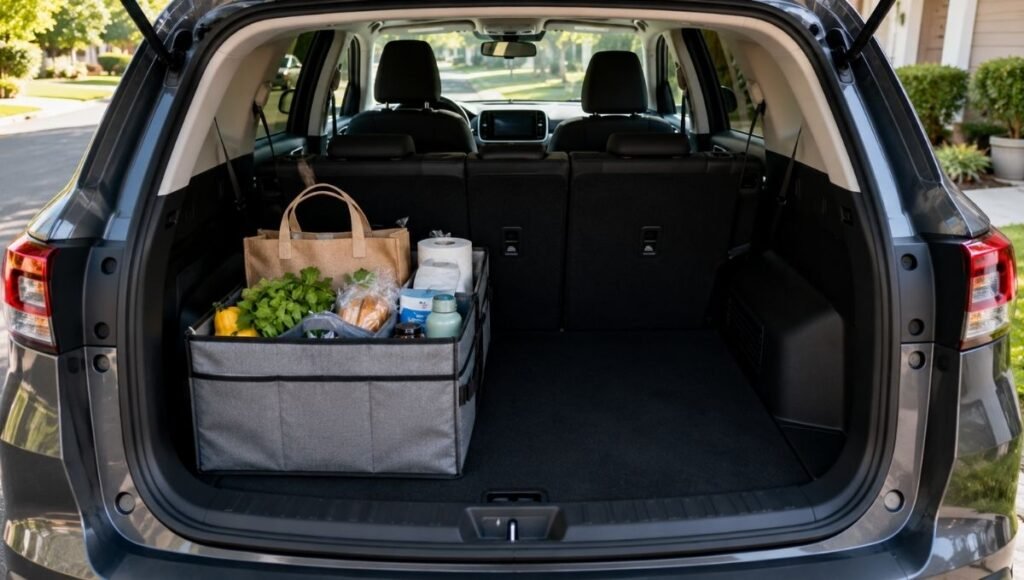
The Moment You Can’t Find Anything
You’re in a parking lot. You need the jumper cables. They’re in the trunk — somewhere under the reusable grocery bags, the gym shoes you keep meaning to bring inside, the emergency kit from two cars ago, and a layer of miscellaneous items that have been accumulating since you bought this car.
You find the cables eight minutes later. You’re going to be late.
Or the other version: you’re on the highway and something slides forward from the backseat floor and makes contact with your ankle during a lane change. It’s a water bottle. No harm done this time.
Car clutter is one of those things that starts slow and then reaches a point where the car feels like it belongs to chaos rather than to you. The frustrating part is that most car organizer buying guides jump straight to product recommendations without answering the actual question: where is your stuff going, and what does it actually need to do?
A car organizer is not a magic fix. But the right organizer in the right location, containing the right things, makes a car feel ten times calmer without requiring much maintenance. This guide works through that by zone — trunk, backseat, and front — and covers the safety angle that almost nobody talks about.
The Safety Case for Organizing Your Car (This Part Is Worth Reading)
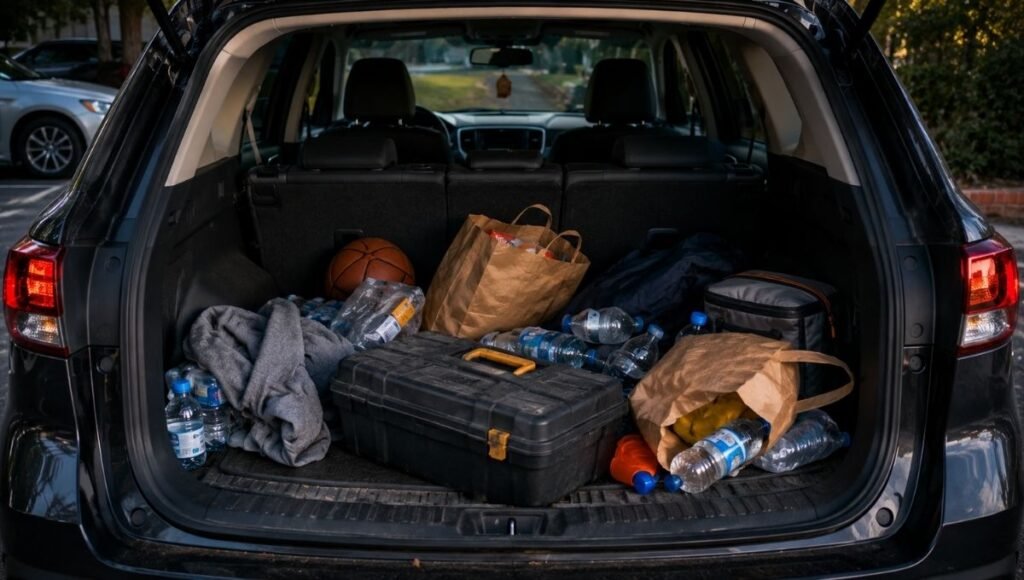
Before getting into products, this matters.
The NHTSA and transportation safety researchers have documented what happens to unsecured cargo in vehicle collisions. The numbers are striking: a 20-pound object traveling at 55 mph has an impact force of approximately 1,000 pounds in a sudden stop. A heavy toolbox, a bag of potting soil, or a case of bottled water in your trunk — unsecured — can come through the rear seat in a frontal collision. In a rollover, unsecured items become projectiles that hit occupants from every direction.
This isn’t theoretical. A 2023 AAA Foundation research report found that in approximately 13% of police-reported crashes with vehicle interiors surveyed, unsecured cargo was identified as a contributing factor to occupant injury.
A trunk organizer that straps to the cargo tie-down hooks (most vehicles have these) doesn’t just keep your groceries from rolling around. It keeps a 30-pound bag of dog food from becoming a dangerous moving object in the event of a sudden stop or collision. The straps are the feature worth paying for.
Zone 1: Trunk / Cargo Area
This is where most car organizer searches start, and for good reason — it’s the highest-chaos zone in most cars.
What Goes in the Trunk Organizer
The trunk organizer’s job is to contain items that would otherwise slide around, prevent groceries from tipping over, and keep your emergency kit, jumper cables, and spare tire tools accessible without excavating through everything else.
What doesn’t belong in the trunk: daily-use items. If you’re going into the trunk three times a week for the same item, it doesn’t belong there — it belongs in the back seat or center console. Trunk = infrequent access.
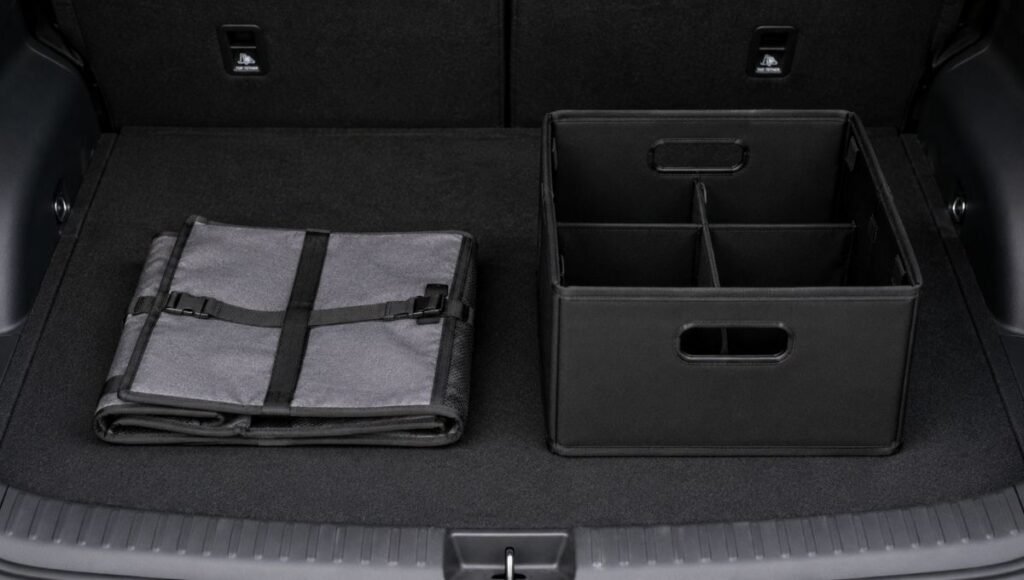
Collapsible Fabric vs. Rigid Box
Collapsible fabric (Oxford cloth or polyester): The default choice for most people, and usually the right one. Adapts to irregular loads, can hold a full set of grocery bags on one trip and be folded flat the next week when you’re moving furniture. The “collapsible” feature isn’t just about storage — it means the organizer doesn’t take up space when you don’t need it.
Look for: double-stitched handles, a reinforced base that keeps the organizer from sagging, and side pockets for flat items. Weight capacity on the label is a useful signal for build quality.
Rigid box (polypropylene or hard-sided): Keeps its shape, which makes it excellent for fragile items, wine bottles, or anything you don’t want crushed. Better at containing spills (a bottle of motor oil that leaks in a fabric organizer is a disaster; in a rigid box it’s contained). The trade-off is that rigid organizers can’t adapt to oversized loads and don’t fold away when empty.
Editor’s take: Unless you’re regularly transporting fragile or liquid items, collapsible fabric wins on flexibility. The rigid box is the better choice if you’re using it as a semi-permanent tool storage solution.
The Tie-Down Strap Detail That Most People Skip
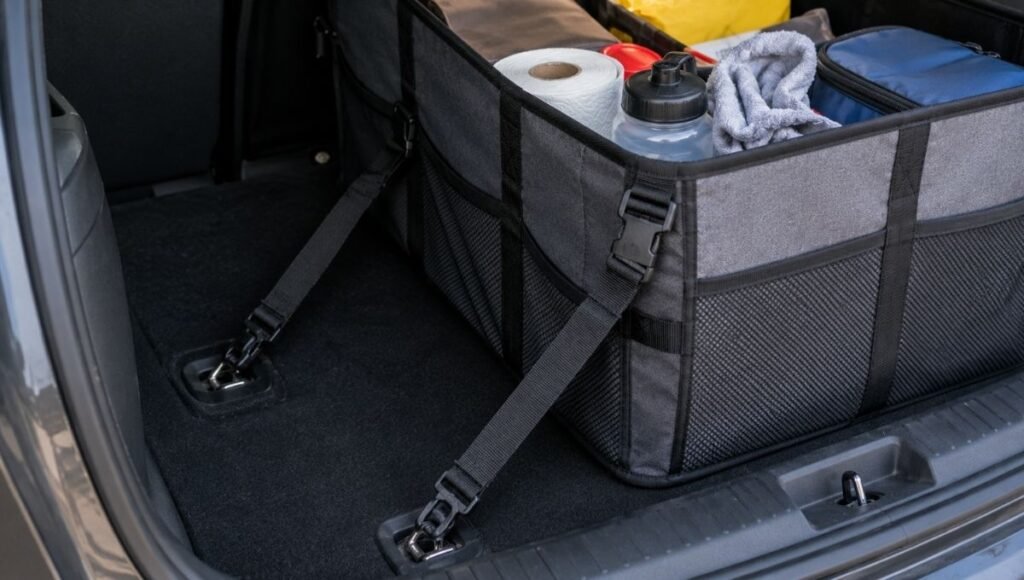
Most trunk organizers come with adjustable straps meant to attach to the cargo tie-down hooks in your trunk floor. These are the small D-rings or anchor points that most car owners have never used.
The straps prevent the organizer — and its contents — from sliding forward during hard braking. Without the straps, you’ve just created a heavier, more dangerous projectile.
Find the cargo hooks, use the straps. This is the difference between an organizer that’s a convenience and one that’s actually safer than what it replaced.
Size Guidance
Measure your trunk before buying. The most common mistake is buying an organizer that either fills the entire trunk (leaving no room for anything larger) or one that’s so small it slides around inside the space it’s supposed to organize.
A good rule: the organizer should occupy 30–50% of the trunk’s usable width, leaving room beside or behind it for bags, luggage, or bulky items. An organizer that takes over the whole trunk isn’t an organizer — it’s just clutter with rigid walls.
Zone 2: Backseat / Rear Passenger Area
Backseat organization is a different problem than trunk organization, and the two are often confused.
The backseat chaos problem is usually one of three situations:
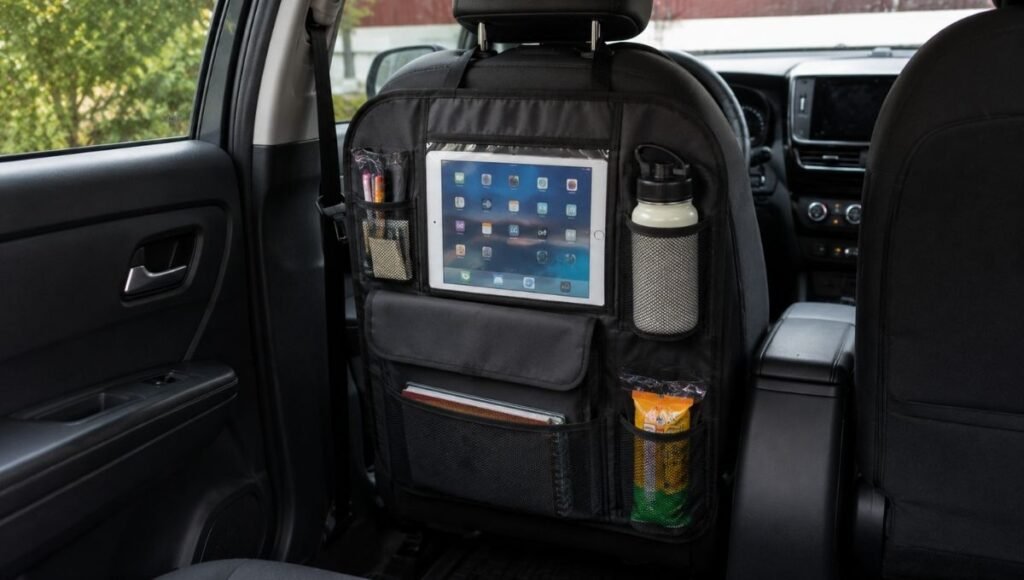
Situation A: You have kids. This is the primary driver of backseat organizer sales. Tablets, water bottles, snacks, activity books, headphone cords — the back seat becomes a storage and living space for small passengers. A back-of-seat organizer with multiple pockets (including one tablet-sized) is designed specifically for this.
Situation B: You use your back seat as a secondary trunk. Bags, shopping, gym clothes, work items — things that get dropped in the back seat because it’s easier than the trunk. This usually requires either behavior change (commit to using the trunk) or a simple back-seat cargo net or barrier that prevents items from sliding around.
Situation C: You’re a rideshare driver or frequently have adult passengers. Back seat organization for adults is actually minimal — a seat-back pocket with a charging cable, a water bottle holder, and maybe a phone holder. Over-organizing an adult passenger space looks busy and slightly off-putting.
Back-of-Seat Organizer (Seat-Back Organizer)
Hangs from the back of the front seat headrest. Creates pockets and compartments accessible to rear passengers. The standard design has several mesh pockets, a large center compartment, and usually a tablet sleeve.
What makes a good one: Headrest attachment straps that don’t slip (look for anti-slip backing on the straps), enough tension to stay flat against the seat back rather than sagging forward, and materials that wipe clean — kids are not careful with liquids.
What makes a bad one: Thin elastic that loses its tension within months, pockets too small to actually hold the stated items, and attachment systems that damage the headrest stitching over time with weight.
The fit issue: Seat-back organizers are sized for standard sedan or SUV front seats. In trucks with bench seats or vehicles with unusual seatback shapes, standard organizers often don’t fit correctly. Check the headrest spacing before buying.
Cargo Net / Back Seat Barrier
For adults who use the back seat as overflow storage, a simple cargo net stretched across the back of the front seats — or a barrier that mounts to the headrests — prevents items from sliding to the floor or becoming a distraction while driving.
Less visually intrusive than a full organizer, more practical for irregular or oversized loads. A good option for drivers who don’t have regular passengers.
Zone 3: Center Console and Front Area
This is the highest-frequency zone — the items you reach for while stopped, while parked, throughout every drive. Organization here has the most daily impact.
What Belongs in the Center Console
Not everything. The center console gets overstuffed because it’s convenient, but a jammed console means you can never find what you need quickly. The items that belong:
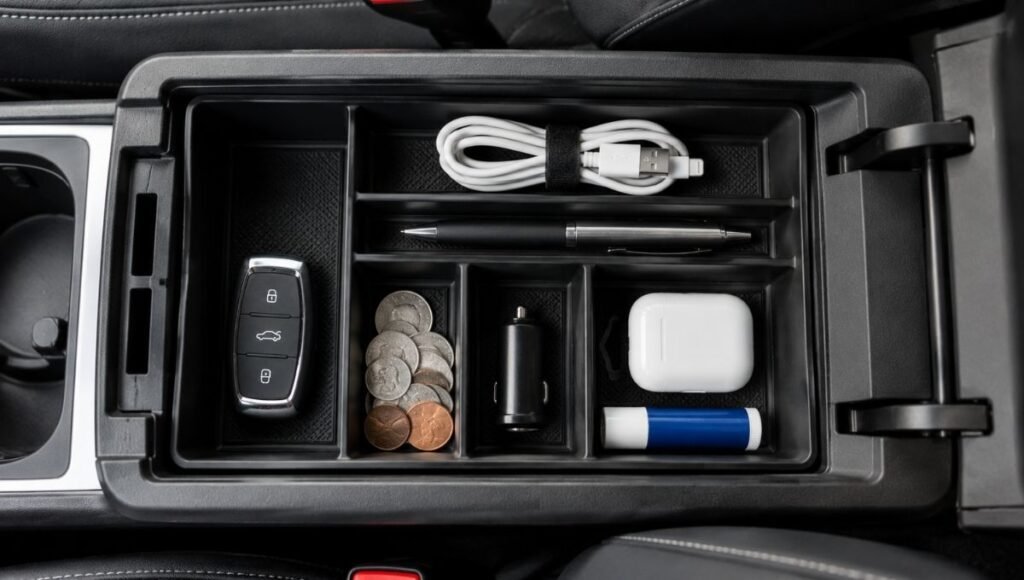
- Documents (registration, insurance card) in a dedicated document wallet or envelope — these should be findable in under 10 seconds
- Phone charger cable
- One or two pens
- A multi-tool or small flashlight
- Lip balm, hand cream, or other daily-use items
- Coins for parking
The items that don’t belong: receipts, expired coupons, old drive-through napkins, multiple USB adapters, cables for devices you no longer own. The console needs a quarterly clear-out just like a junk drawer.
Console Insert / Center Console Organizer
A tray or insert designed to fit inside your center console armrest compartment, creating organized sections for small items. Prevents the common problem of items shuffling around in a single large bin.
Material: a firm but non-scratching plastic insert with felt or silicone lining protects the inside of the console and keeps items from sliding. Measure the interior dimensions of your console before buying — these inserts are not universal.
Cupholder Insert
More useful than it sounds. A cupholder expander or insert organizes the typically oversized cupholder space, holds phones upright, and adds small-item storage (coins, cards) in dead cupholder space. Particularly useful for vehicles with large cup holder openings that don’t grip smaller bottles.
Glove Box Document Organizer
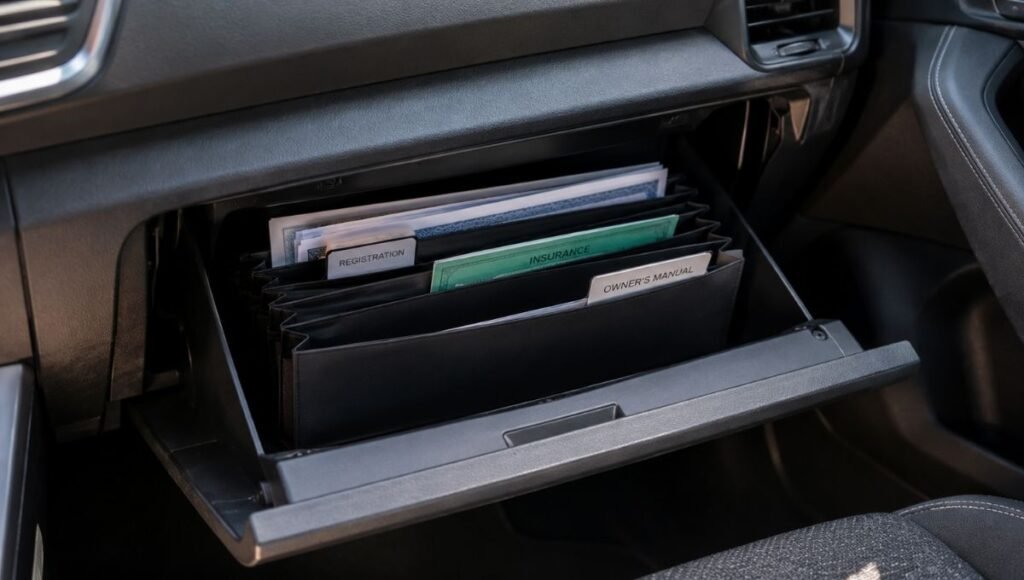
A thin accordion-style document organizer that fits in the glove box holds registration, insurance card, owner’s manual, and emergency contact info in findable order. This is the version of “car organizer” that matters most when you actually need it — at a traffic stop or after an accident — and the one most people don’t have.
The One-Zone Rule for People Who Keep Over-Organizing
Here’s an honest observation about car organizer buying habits: people tend to buy multiple organizers, fill them with things, and then ignore three of them permanently while the fourth stays organized for about a month before reverting to chaos.
The most organized cars belong to people who have committed to one zone at a time.
Start with the trunk. Get that right, get it secured, get it consistent. Then move to the front. Don’t touch the backseat until the other two zones work. And within each zone, resist the urge to fill every pocket — empty pockets are available for things you actually need to put somewhere.
Organization in a car is a habit problem, not a product problem. The organizer is just a container. The habit is deciding what goes where and putting it back there every time.
The 10-Minute Car Declutter Before You Buy Anything
Before spending money on organizers, spend 10 minutes on this:
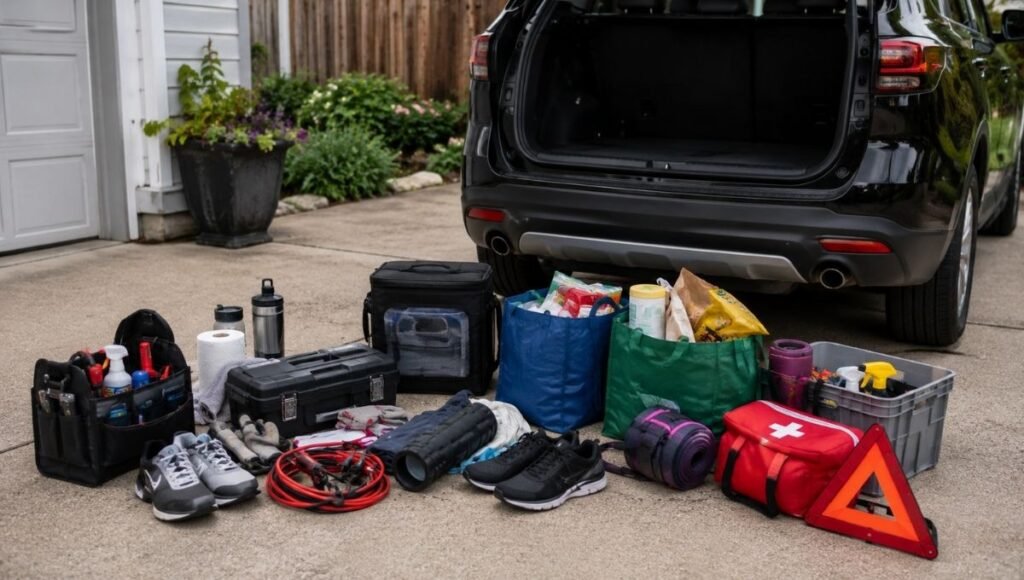
- Remove everything from the trunk. Everything. Set it on the ground.
- Throw away obvious trash. Old receipts, empty bottles, anything with no clear purpose.
- Set aside items that don’t belong in the car. Gym shoes that belong inside, items for donation, tools that live in your garage.
- Put back only what serves a real purpose in the car. Emergency kit, jumper cables, reusable bags, tools you actually use.
Now look at what’s left. That’s what your organizer needs to handle. Buy for what’s actually there, not for a hypothetical perfectly-stocked car.
FAQ
What is the best car organizer? Depends on what you’re organizing and where. For the trunk: a collapsible Oxford cloth organizer with tie-down straps in the 12–14 inch width range works for most sedans and SUVs. For the backseat with kids: a multi-pocket seat-back organizer with a tablet sleeve. For the front: a console insert tray and a document accordion file for the glove box.
Are car trunk organizers worth it? Yes, if you use them. The key word being “use” — an organizer that becomes a storage bin for random items defeats its own purpose. The value is in the commitment to keeping specific categories of items in specific locations, which reduces time spent looking for things and reduces the safety risk of unsecured cargo.
How do I keep my car trunk organized? Use an organizer with tie-down straps connected to the cargo hooks in your trunk floor. Assign categories to sections (one section for emergency items, one for reusable bags, one for sport or hobby items). Do a trunk clear-out quarterly — remove everything, evaluate what’s actually necessary, put back only what earns its place.
What size trunk organizer do I need? Measure your trunk’s usable width and depth. The organizer should occupy 30–50% of the space — large enough to be useful, small enough to leave room for bags and larger items alongside it. Most sedans work with organizers in the 11–14 inch range; SUVs and trucks can accommodate 14–18 inch or larger versions.
Are seat-back organizers safe? Standard seat-back organizers, when loaded with reasonable weight (under 5–8 pounds total), are safe for normal driving. Avoid hanging heavy items — a loaded organizer creates additional weight that affects the seatback in a collision. Mesh and fabric organizers are safer choices than rigid ones because they don’t create hard-impact surfaces.
What should I keep in my car’s glove box? Registration (current), proof of insurance (current), owner’s manual, a pen, a small flashlight, and emergency contact information. Use a document organizer to keep these findable rather than loose — you need to find them quickly at a traffic stop or accident scene.
How do I stop things from sliding around in my trunk? Use an organizer with tie-down straps attached to the cargo hooks. Add a non-slip trunk liner or mat beneath the organizer. For individual items outside the organizer, cargo nets stretched across the trunk floor create a barrier that prevents sliding without enclosing items in a box.
What’s Next
A well-organized car is easier to clean and easier to live in. These guides cover the related aspects of a practical interior:
- Car essentials every driver should have — the items worth keeping in your car organized by priority, so you know what actually needs a dedicated space. (→ Car Essentials Every Driver Actually Needs)
- How to clean your car interior — organization and cleaning work together; a clean car is easier to keep organized, and an organized car is easier to clean. (→ How to Clean Your Car Interior the Right Way)
- Car sun shade — another trunk item worth keeping ready, and one of the highest-value car accessories per dollar spent. (→ Car Sun Shade — Why Your Car Gets So Hot and How to Actually Fix It)
The goal isn’t a showroom car. It’s a car where you know where things are, where nothing is a hazard, and where getting in doesn’t produce a small wave of background anxiety about the state of things. That’s achievable — and it starts with being realistic about what you actually need to store.
References
- AAA Foundation for Traffic Safety — Distracted Driving and Unsecured Cargo Research, 2023 annual traffic safety report; unsecured cargo contribution to injury in police-reported crashes
- National Highway Traffic Safety Administration (NHTSA) — Cargo Securement Rules, FMCSR Part 393; physics of unsecured cargo impact forces in vehicle collisions
- Insurance Institute for Highway Safety (IIHS) — Vehicle Storage and Safety Research, cargo securement guidance for passenger vehicles
- Journal of Safety Research — The relationship between vehicle interior organization and driver distraction frequency, research on interior clutter and cognitive load during driving
This article contains affiliate links. AutoIXPro may earn a small commission on purchases through our links at no extra cost to you. All recommendations are based on genuine research and practical value. See our Affiliate Disclosure for details.
Have a specific car organization question? Contact us — we read every message.