
Key Takeaways
- There are four scenarios for hill parking: uphill with curb, uphill without curb, downhill with curb, downhill without curb — each has a specific wheel direction, but there’s a pattern that makes all four easy to remember
- The parking brake is non-negotiable — wheel direction is a backup system; the parking brake is the primary system; skipping it puts all the risk on a curb that may not be tall enough to stop your car
- According to California DMV test data, only 49% of test takers get the uphill-with-curb question right on the first try — this is the single most commonly confused scenario
- The memory trick that actually works: “UCLA” — Uphill Curb Left Away — when parking uphill against a curb, turn wheels Left, Away from the curb. Every other scenario turns right
- For manual transmission drivers: uphill goes in first gear, downhill goes in reverse — think of it as pointing the gear “up the slope”
The Thought That Goes Through Every New Driver’s Head
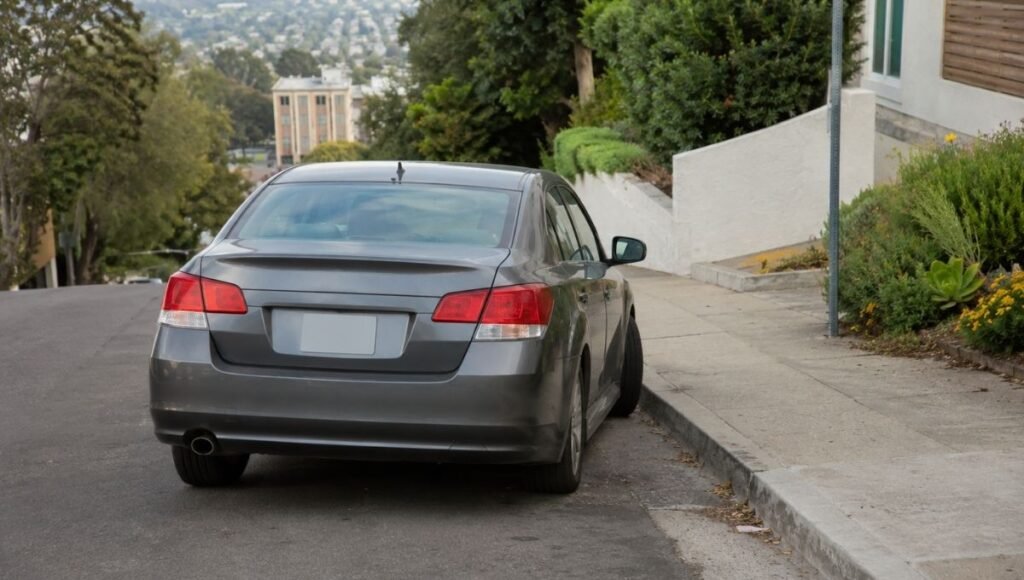
You’ve found a spot on a hill. You’ve parked. You’re sitting there with the car stopped, engine still running, and you suddenly remember you’re supposed to do something with the steering wheel before you get out. Something about turning the wheels. But which way? And does it matter which direction the hill is going? And wait — is there a curb here or not?
For a moment, you just stare at the steering wheel like it owes you an explanation.
This exact freeze happens to more drivers than anyone admits. A thread on r/coolguides sharing a diagram about hill parking got thousands of upvotes specifically because of the comments — experienced drivers confessing they’d been doing it wrong for years, new drivers realizing they’d passed their test without ever fully understanding the rule, and everyone collectively relieved that this was apparently a confusing thing for a lot of people.
The rule isn’t complicated once you understand why it exists. And once you understand why, you’ll never mix up the directions again — because the logic will tell you the answer even if you’ve forgotten the specific instruction.
This guide explains the why, then gives you the what, in a way that actually sticks.
Why the Wheel Direction Rule Exists at All
Here’s the honest version of why this matters.
Parking brakes fail. Not often — but occasionally, especially on older vehicles, in cold weather when cables can freeze, or when a brake component is worn. Transmissions fail. A car left in “Park” on a steep hill is relying on a small metal pin called the parking pawl to hold the entire weight of the vehicle. That pin was not designed to be the sole barrier between your parked car and the car behind it on a steep San Francisco street.
The wheel direction rule is a backup system. The idea is simple: if everything else fails and the car starts to roll, which direction does it go? You want it to roll into a curb (where it stops immediately with minimal damage) or off the edge of the road (where it rolls a few feet into grass or gravel) — not into traffic, not into a pedestrian, not downhill into six other parked cars.
That’s the entire logic. Every wheel direction decision is just asking: if this car rolls, where do I want it to go?
Once you see it that way, the four scenarios become almost intuitive.
The Four Scenarios — Explained With the Logic Behind Each
How to Park Uphill With a Curb
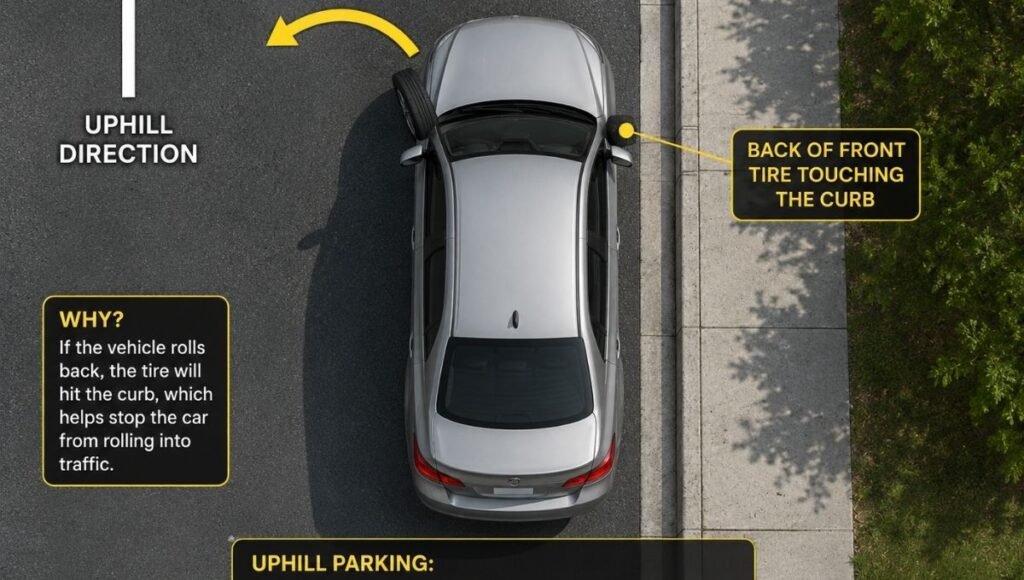
Wheel direction: Turn LEFT (away from the curb)
You’re facing uphill, there’s a curb to your right. You turn the steering wheel all the way to the left — away from the curb — and let the car roll back just a couple of inches until the back of the front tire rests gently against the curb.
Here’s the logic: if the parking brake releases and the car starts rolling downhill (backward, since you’re facing up), the back of the front wheel immediately hits the curb. The curb stops the car. You cannot roll into traffic because the curb is physically in the way.
Why turning right would be wrong here: If you turned the wheels right (toward the curb), the front of the wheel would push against the curb. If the car then rolled backward, the tire would ride up and over the curb, and the car would continue rolling downhill into the lane. Not good.
Memory hook: UCLA — Uphill Curb Left Away. This is the one scenario that breaks from the “turn right” pattern, so it’s the one worth memorizing specifically.
The full sequence:
- Pull alongside the curb (within 12–18 inches)
- Turn steering wheel all the way left
- Slowly ease off the brake and let the car drift back slightly until the back of the front tire touches the curb
- Engage the parking brake
- Shift into Park (automatic) or first gear (manual)
- Turn off the engine
How to Park Uphill Without a Curb
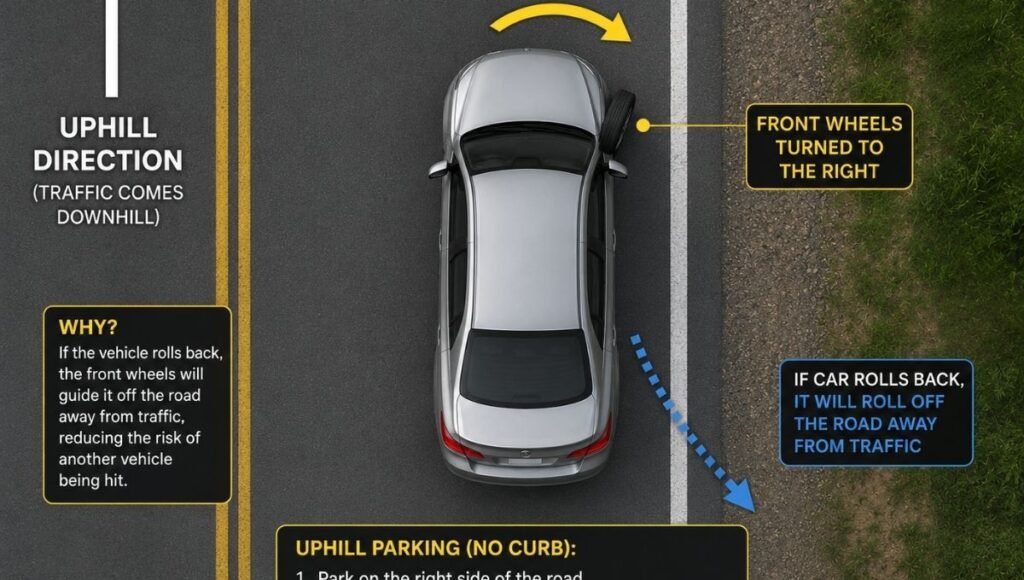
Wheel direction: Turn RIGHT (toward the edge of the road)
No curb present — you’re on an open road, a rural street, or a driveway edge. Turn the wheels right, toward the shoulder or edge of the road.
The logic: if the parking brake fails and the car rolls backward downhill, the turned wheels direct the car toward the edge and off the road — away from traffic. The car might roll into the grass, the gravel, or a gentle embankment, but it won’t cross the lane into oncoming traffic.
The full sequence:
- Position the car close to the road edge
- Turn steering wheel all the way right
- Engage the parking brake
- Shift into Park (automatic) or first gear (manual)
- Turn off the engine
How to Park Downhill With a Curb
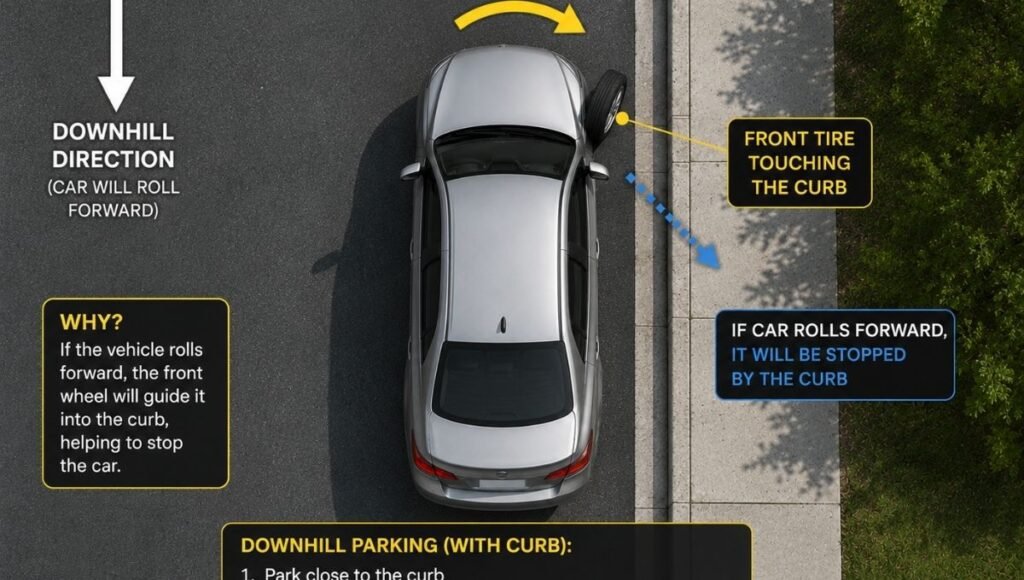
Wheel direction: Turn RIGHT (toward the curb)
You’re facing downhill, curb on your right. Turn the wheels right — toward the curb — and let the car ease forward a few inches until the front of the front tire rests against the curb.
The logic: if the parking brake fails and the car rolls forward downhill, the front of the wheel immediately hits the curb. The curb stops it. The car cannot continue rolling into traffic because the tire is physically blocked.
The full sequence:
- Pull alongside the curb (within 12–18 inches)
- Turn steering wheel all the way right
- Ease off the brake slightly and let the car roll forward until the front of the front tire gently touches the curb
- Engage the parking brake
- Shift into Park (automatic) or reverse gear (manual)
- Turn off the engine
How to Park Downhill Without a Curb
Wheel direction: Turn RIGHT (toward the edge of the road)
Same as uphill without a curb — turn right toward the shoulder. If the car rolls forward downhill, it rolls toward the edge and off the road, not into traffic.
This is the one that trips people up the least once they’ve understood the pattern, because it’s the same as uphill without a curb. Both no-curb situations: turn right.
The full sequence:
- Position the car close to the road edge
- Turn steering wheel all the way right
- Engage the parking brake
- Shift into Park (automatic) or reverse gear (manual)
- Turn off the engine
The Pattern That Makes This Permanent in Your Memory
Look at the four scenarios again:
- Uphill, curb: LEFT
- Uphill, no curb: RIGHT
- Downhill, curb: RIGHT
- Downhill, no curb: RIGHT
Three of the four scenarios are right. The only exception is uphill with a curb — and that’s where UCLA comes in.
Another way to think about it: you almost always turn right. The one exception is when you’re heading uphill and have a curb — because in that case, turning right would push the tire into the curb from the wrong side and allow the car to ride over it if it rolls.
If you only have time to memorize one thing: everything turns right, except uphill with curb turns left. That single exception covers all four scenarios.
The Parking Brake: The Step Most People Rush Through
Wheel direction is the backup. The parking brake is the actual protection.
A surprising number of drivers — especially those who learned on automatic transmissions — treat the parking brake as optional, something they use on very steep hills but skip everywhere else. This is a mistake for two reasons.
First, the parking pawl (the mechanism that keeps an automatic in “Park”) was not designed to hold the car on a slope indefinitely. It works fine, but it’s not engineered for the sustained load of a steep incline over hours or days. Repeated reliance on it without the parking brake accelerates wear on the transmission.
Second, on sloped surfaces, parking without the parking brake engaged means the car’s full weight is resting against the parking pawl the moment you shift into Park. If you engage the parking brake before shifting into Park, the brake cable holds the car’s weight and the pawl just serves as a secondary stop. This significantly reduces the force on the pawl.
The correct sequence for automatic transmission on any hill:
- Wheels positioned correctly
- Hold the foot brake
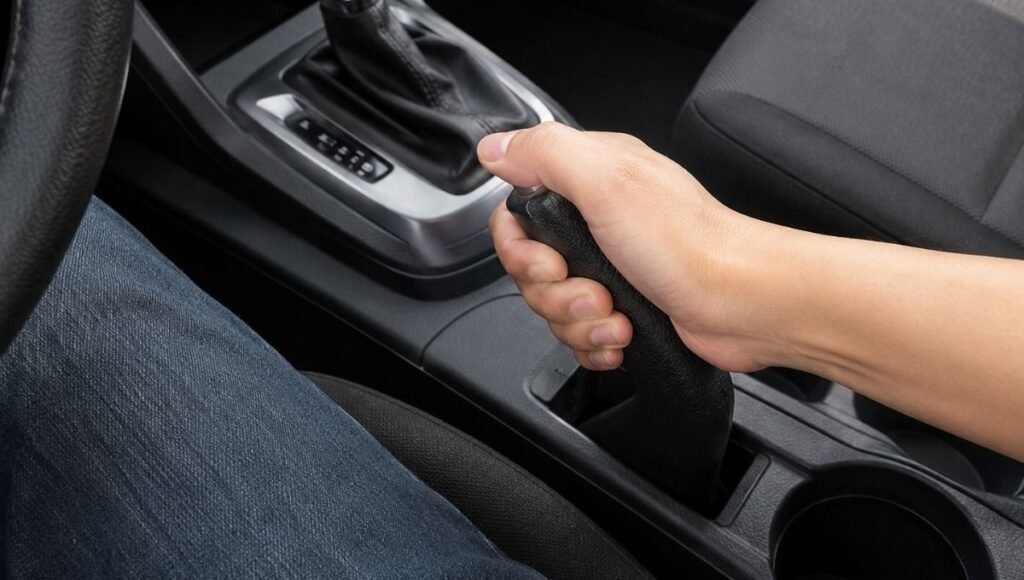
- Engage the parking brake (pull handle or press button)
- Shift into Park
- Release foot brake
In this order, the parking brake holds the car’s weight, not the transmission.
Manual Transmission: The Gear Logic
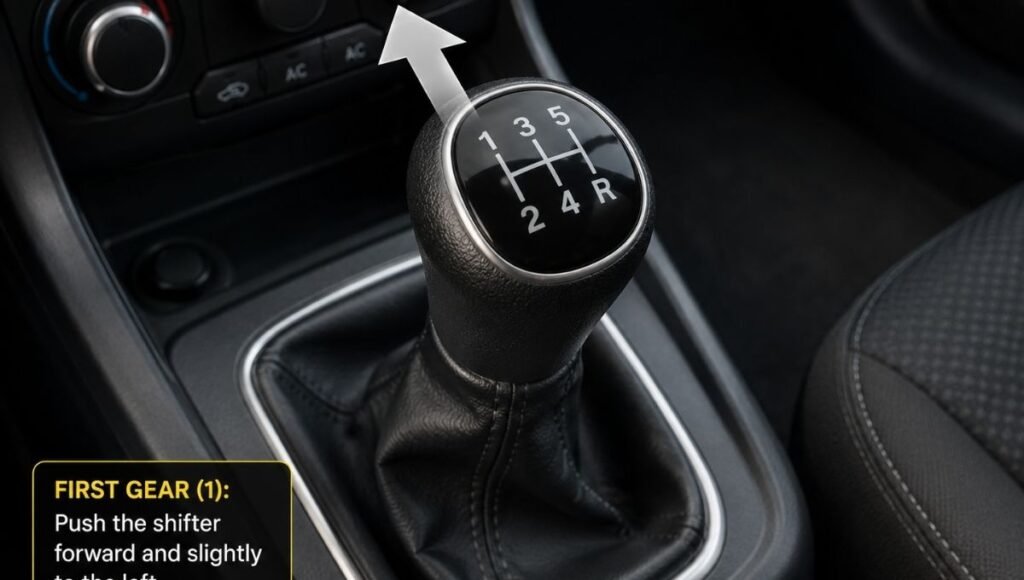
For manual drivers, the gear selection adds another layer of protection. The correct gears:
- Facing uphill: First gear
- Facing downhill: Reverse
The reason is intuitive once you picture it: if the car rolls backward when facing uphill, first gear creates mechanical resistance in that direction. If the car rolls forward when facing downhill, reverse gear creates mechanical resistance.
An easy mental shortcut: put the gear selector in the direction that points “up the slope.” If you’re facing uphill, first gear (forward) points up the hill. If you’re facing downhill, reverse points back up the hill. In both cases, you’re pointing the gear up.
The Scenarios New Drivers Actually Encounter
On a Sloping Residential Street
Most hill parking in daily life happens on residential streets with standard curbs. The most common version is probably parking on a downhill slope with a curb — turn right, let the front tire touch the curb, set the brake.
The mistake that happens most often here: people turn the wheel after turning off the car, losing power steering assistance. Turn the wheel first, while the engine is still running. Power steering makes the full-lock turn easy; without it, you’re muscling the wheel at a standstill against the car’s full weight, which is hard on the steering rack.
On a Steep Driveway
Sloping driveways require the same logic but with an added consideration: the wheels need to point so the car rolls away from the street if it moves. Usually this means turning right toward the garage or the side of the driveway. Check that the direction you’re pointing doesn’t send the car rolling into the street.
On a Hill in Winter
Ice and snow reduce the curb’s effectiveness significantly. A tire that’s spinning on ice can ride up and over a standard curb without the resistance that bare pavement provides. In winter conditions, the parking brake becomes even more critical, and on very steep slopes with ice, wheel chocks — small rubber wedges placed behind the tires — provide a physical block that ice can’t compromise.
On a One-Way Street
The directions above assume a standard two-way road with parking on the right side. On a one-way street where you might park on the left side, the same principle applies: turn the wheels to keep the car from rolling into the travel lane. The specific direction changes based on where the curb is and which way the hill goes. The logic doesn’t change, just apply it to your actual geography.
Getting Out Safely on a Hill
Parking correctly is half the job. Leaving correctly is the other half.
When you’re ready to leave a hill parking spot:
- Start the engine first
- Press and hold the foot brake firmly
- Disengage the parking brake
- Shift out of Park (or out of your gear if manual)
- Check mirrors and blind spots — other cars may have difficulty seeing you emerge from a parked position on a hill
- Gently accelerate and straighten the wheel as you pull out
The moment to be most careful is between releasing the parking brake and applying acceleration. This is the window where gravity is acting on the car and nothing is holding it. Keep foot brake firm until you’re actively pulling out.
A common mistake: releasing the parking brake and then reaching for the gear shift or mirrors before the car is moving under control. On a steep hill, the car can start rolling faster than expected in that window.
The 2-Minute Check Before You Walk Away
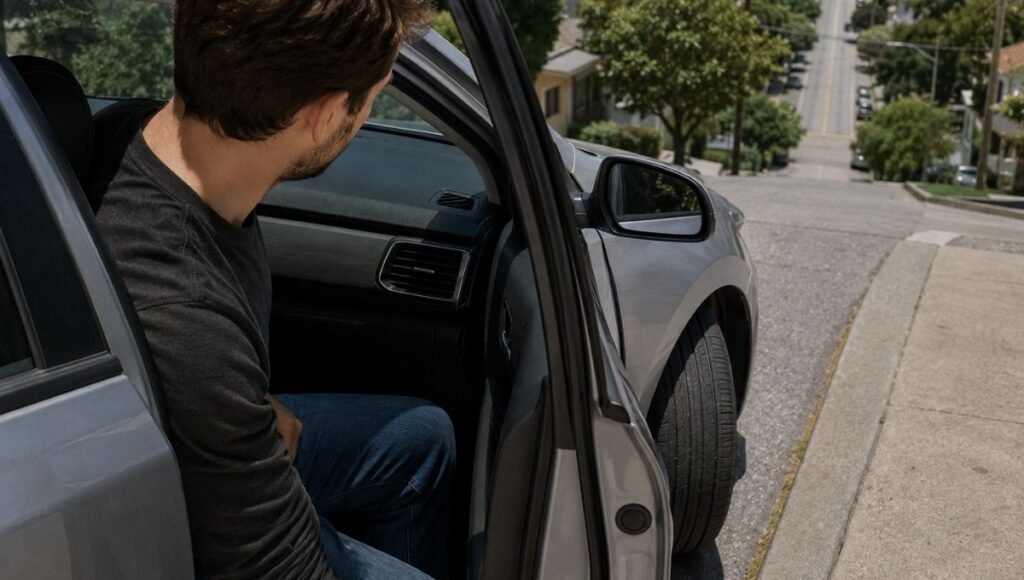
Before you shut the door, this takes 30 seconds and costs nothing:
- Look at the front tires. Are they turned the direction they should be? (You can see the top of the tires and which way they’re pointing.)
- Is the parking brake engaged? (Feel the handle or check the dashboard indicator.)
- Is the transmission in Park or the correct gear?
- Did you turn off the engine?
New drivers often skip the wheel check because they can’t easily see the bottom of the tires from the driver’s seat. Open the door and look at the top of the tire — the direction the tire is pointing is immediately visible. This 5-second check becomes a habit with practice.
FAQ
Which way do you turn your wheels when parking uphill? When parking uphill with a curb, turn the wheels left (away from the curb). When parking uphill without a curb, turn the wheels right (toward the edge of the road). The UCLA mnemonic helps: Uphill Curb Left Away.
Which way do you turn your wheels when parking downhill? Always turn right when parking downhill — whether there’s a curb or not. If there’s a curb, the right-turned wheels will stop the car against the curb if it rolls. If there’s no curb, the right-turned wheels direct the car away from the traffic lane.
Do you have to turn your wheels when parking on a hill? In many US states, yes — it’s a legal requirement. In California, parking on a grade without turning your wheels is a ticketable offense. Beyond the legal requirement, proper wheel positioning is a meaningful safety measure that can prevent a runaway vehicle from entering traffic.
What gear should you park in on a hill? Automatic transmission: always Park. Manual transmission: first gear when facing uphill, reverse when facing downhill. Think of it as putting the gear selector in the direction that points “up the slope.”
Should you always use the parking brake on a hill? Yes. Every time. On any slope. The parking brake protects the transmission from bearing the car’s weight alone, and provides a second independent braking system in case of failure. The sequence matters: engage the parking brake before shifting into Park.
What if I forget which way to turn my wheels? Remember UCLA (Uphill Curb Left Away) as your exception, and “everything else turns right” as the rule. If you’re parked and unsure, the test is simple: if the car rolls from where it’s parked, does the wheel direction send it toward the curb or away from traffic? If yes, you’re correct.
Can a car roll over a curb if the wheels are turned wrong? Yes — if the wheel is pressed against the curb from the wrong angle. When parked uphill with wheels turned right (toward the curb), a car rolling backward would push the front of the tire against the curb, which can cause the tire to ride up and over rather than stopping. This is exactly why uphill-with-curb requires wheels turned left.
What’s Next
Hill parking is one of the foundational skills that new drivers often learn for the test and then forget in practice. These guides cover the related skills and safety habits that make the whole picture clearer:
- Car maintenance checklist — keeping your parking brake in proper working condition is part of your regular vehicle maintenance; here’s the full schedule. (→ Car Maintenance Checklist)
- Car essentials every driver should have — including the emergency kit and the items that matter most if something goes wrong while parked. (→ Car Essentials Every Driver Actually Needs)
- Car dashboard symbols — if your parking brake indicator stays on after you’ve released it, that’s a warning light worth knowing about. (→ Car Dashboard Symbols Explained)
Parking on a hill correctly takes about 15 extra seconds. The wheel turn, the parking brake, the gear. Every time, without exception. That 15 seconds is the gap between a safely parked car and one that becomes a story on the local news.
References
- California Department of Motor Vehicles (California DMV) — California Driver Handbook, Section 6: Navigating the Roads, official hill parking procedures and wheel direction requirements; test performance data showing 49% correct response rate on uphill-with-curb question
- National Highway Traffic Safety Administration (NHTSA) — Parking Brake Systems and Runaway Vehicle Prevention, technical standards for parking brake performance and transmission pawl load specifications
- Insurance Institute for Highway Safety (IIHS) — Runaway Vehicle Incidents: Contributing Factors, data on parking brake failure and improper parking procedures in vehicle rollaway incidents
- AAA Foundation for Traffic Safety — Driver Education and New Driver Safety Research, hill parking skill retention data from post-licensing driver behavior studies
Have a hill parking question for your specific situation? Contact us — we read every message.