
Last updated: May 2026 | Reading time: 11 min | Category: Safety & Emergency
Key Takeaways
- Car batteries last 3–5 years on average — but extreme heat shortens life more than cold does; a battery in Phoenix may last 2 years while the same battery in Minnesota lasts 5
- AAA responds to more than 7 million battery-related calls per year — it’s the single most common cause of roadside emergencies, and most are preventable with a simple annual test
- You can check your battery’s health for free at any AutoZone, O’Reilly, or Advance Auto Parts — no appointment needed, takes 5 minutes
- A battery showing 12.4 volts or less at rest is significantly depleted; below 12.0 volts means immediate replacement
- Slow engine cranking is the most reliable early warning sign — if your engine sounds labored starting up, don’t ignore it; the battery is telling you something
The Morning It Decides Not to Start
You’re running slightly late. You get in the car, put your foot on the brake, press the start button — and nothing happens. Or worse: the engine turns over slowly, laboriously, like it’s trying very hard and not quite making it. Then it stops.
Or maybe it started fine that morning, but last week it cranked slowly once before catching. And the week before that, you noticed the interior lights dimmed briefly when you started the car. You told yourself it was probably fine.
This is how almost every battery failure announces itself — not with a dramatic sudden death, but with weeks of subtle signals that most drivers don’t recognize as battery warnings until they’re sitting in a parking lot waiting for roadside assistance.
The frustrating part is that this outcome is almost entirely preventable. A car battery gives you clear signals before it fails. A simple annual test tells you exactly where it stands. And the window between “this battery is getting weak” and “this battery is dead” is usually long enough to replace it proactively on your own schedule — rather than reactively, in a parking garage at 8 p.m.
This guide covers how to check your car battery yourself, what the numbers mean, how to handle a dead battery if it happens, and how to choose and replace a battery when the time comes.
How Long Do Car Batteries Actually Last?

The standard answer is 3–5 years, but the real answer depends heavily on where you live and how you drive.
Heat is the primary enemy of battery life — not cold, despite what most drivers believe. Cold weather makes batteries work harder to start an engine, which is why failures are more noticeable in winter. But the internal damage that shortens battery life — accelerated chemical degradation and water loss — happens primarily in summer heat. A battery in a hot climate like Arizona or Texas routinely lasts 2–3 years. The same battery in a cooler climate like Minnesota or Oregon may last 5–6 years.
Short trips accelerate wear significantly. Every time you start the engine, the battery delivers a large burst of current. The alternator recharges the battery during driving, but short trips — under 10–15 minutes — don’t allow full recharge. Drivers who make multiple short trips daily are effectively repeatedly partially discharging their battery without fully recovering it, which accelerates the sulfation process that kills batteries.
Parasitic drain from electronics is increasingly relevant in modern vehicles. Infotainment systems, remote start modules, security systems, and other accessories draw small amounts of current continuously even when the car is off. On a healthy battery this is manageable. On a battery that’s already aging, continuous small drain can tip it into failure faster.
When to proactively test: At 3 years, test annually. At 4 years, test every 6 months. At 5+ years, consider proactive replacement even if it’s passing tests — the failure rate increases sharply after year 5, and the consequences of waiting are worse than the cost of replacement.
The Warning Signs to Never Ignore
These are the signals a failing battery sends before it dies completely. Most drivers ignore them until the battery fails — which is exactly when you don’t want to deal with it.
Slow or Labored Engine Cranking
This is the clearest and most reliable early warning. When you start the car and the engine sounds slower than usual — like it’s working harder to turn over — the battery is struggling to deliver its rated current. The engine hasn’t changed; the battery has weakened. This symptom often disappears after the engine warms up and the alternator begins charging, which is why drivers dismiss it as temporary. It is not temporary. It’s progressive.
Dimming Interior or Dashboard Lights When Starting
When you turn the key or press the start button, electrical accessories throughout the car draw on battery power simultaneously with the starter motor. If the battery is weakening, the voltage drop during this high-demand moment is significant enough to visibly dim the interior lights or cause the infotainment screen to briefly go dark. This symptom typically appears 1–3 months before complete failure.
The Engine Clicks But Doesn’t Crank
A rapid clicking sound with no engine turnover indicates the battery has enough charge to engage the starter solenoid but not enough to turn the engine. This is a dead or nearly dead battery. A single loud click from the starter but no cranking suggests a different issue — possibly the starter motor itself.
Swollen or Misshapen Battery Case
A battery case that is visibly bulging or swollen has been exposed to extreme heat or has experienced an internal failure. The gases trapped inside have expanded the casing. A swollen battery can leak acid and in rare cases rupture. Replace immediately; don’t attempt to jump-start or recharge it.
Visible Corrosion on Terminals
A white, blue, or green fuzzy buildup on the battery terminal posts is corrosion — typically lead sulfate or copper sulfate compounds. Light corrosion is normal and manageable. Heavy corrosion that has built up on the cable connections causes resistance that mimics a weak battery: slow starts, electrical oddities, charging problems. Clean light corrosion with baking soda, water, and a wire brush. Recurring heavy corrosion often indicates the battery is overcharging or has an internal fault.
How to Check Your Car Battery — Three Methods

Method 1: Free Test at an Auto Parts Store (Recommended)
This is the easiest and most accurate option for most drivers. AutoZone, O’Reilly Auto Parts, and Advance Auto Parts all offer free battery testing — no appointment, no charge, results in 5 minutes.
The store uses a professional load tester that measures both voltage and Cold Cranking Amps (CCA) — the amount of current the battery can deliver in cold conditions. This is significantly more useful than a simple voltage reading because a battery can show acceptable voltage while being unable to deliver adequate current under real-world load.
The result will typically tell you: Good, Replace Soon, or Replace Now. Ask for a printout — it’s useful for tracking battery health over time and for negotiating warranty replacement if your battery is less than 2–3 years old.
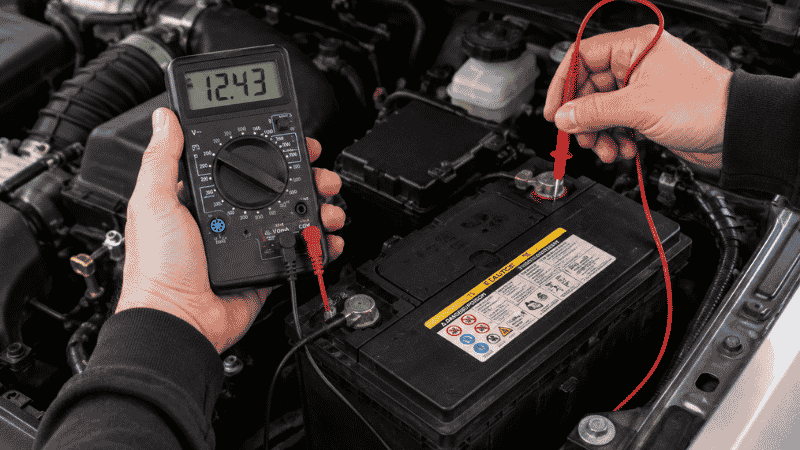
Method 2: Multimeter Test at Home
A basic digital multimeter costs $10–20 and gives you a quick voltage reading without leaving home.
How to do it:
- Make sure the car has been parked and not driven for at least 2 hours — the battery needs to be at “resting voltage” for an accurate reading
- Set the multimeter to DC voltage, 20-volt range (or select the 15V or 20V setting)
- Connect the red probe to the positive terminal (marked + or with a red cover) and the black probe to the negative terminal (marked -)
- Read the voltage
What the numbers mean:
| Voltage | Battery Condition |
|---|---|
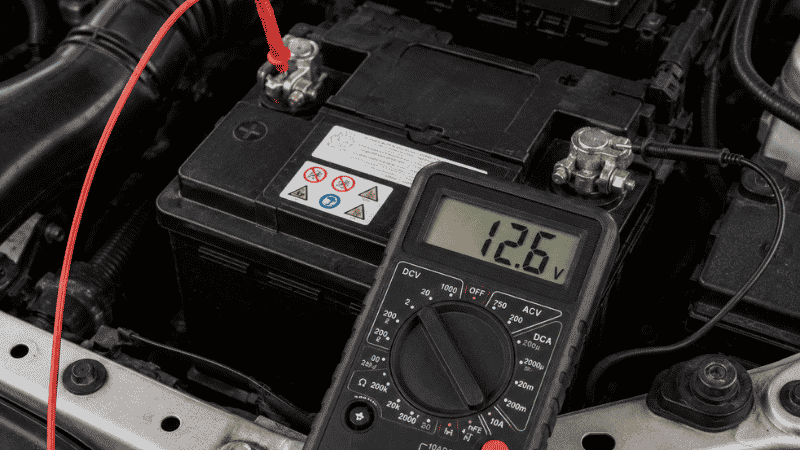
| 12.6V or higher | Fully charged, good condition |
| 12.4V–12.6V | 75–100% charged, acceptable |
| 12.2V–12.4V | 50–75% charged, needs attention |
| 12.0V–12.2V | 25–50% charged, weakening |
| Below 12.0V | Critically depleted — replace |
Important: These readings are resting voltage only. A battery can show 12.6V at rest but fail under load. The auto parts store load test catches this; the multimeter alone doesn’t. Use the multimeter for monitoring trends over time, and use the store test for a definitive condition assessment.
Method 3: Visual Inspection
Even without any tools, a visual inspection takes 2 minutes and catches obvious problems:
- Look at the terminal posts: heavy corrosion buildup requires cleaning or replacement
- Look at the battery case: bulging, swelling, or cracks mean immediate replacement
- Look for leaking fluid: battery acid leaks appear as dried crystalline deposits around the base of the battery
- Check the battery date code: most batteries have a date stamp on the case (a letter for the month, a number for the year — “B4” means February 2024). If you can’t find the code, ask the auto parts store to check when you bring the car in for testing
What to Do When Your Battery Is Dead Right Now
If you’re reading this because your car won’t start, here’s what to do.
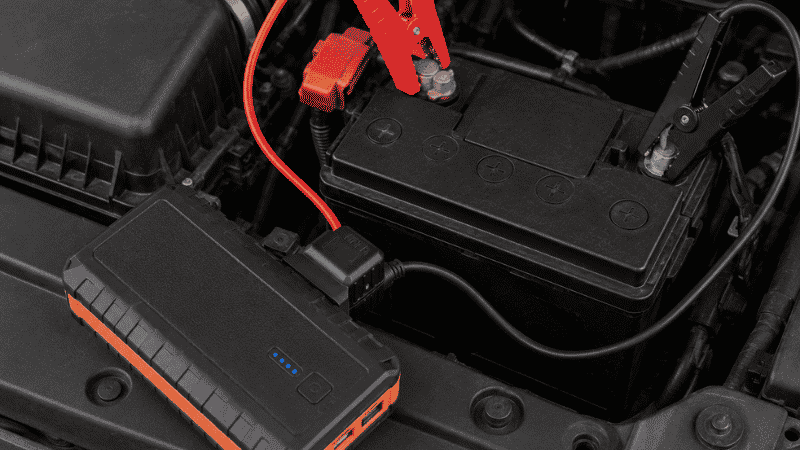
Option A: Portable Jump Starter (No Second Car Needed)
A portable lithium jump starter is a compact device — about the size of a thick paperback book — that contains enough stored energy to start most passenger vehicles without a second car. Connect the clamps (red to positive, black to negative), wait 30 seconds, then start the car. The whole process takes under 2 minutes.
This is the modern solution that most new car owners don’t know about until they need it. A quality portable jump starter costs $50–100 and fits in a glove box or under a seat. (→ See our Car Essentials guide for specific recommendations)
After jump-starting, drive the car at highway speed for at least 20–30 minutes to allow the alternator to fully recharge the battery. Then have the battery tested — a battery that has discharged completely has shortened its remaining life regardless of age.
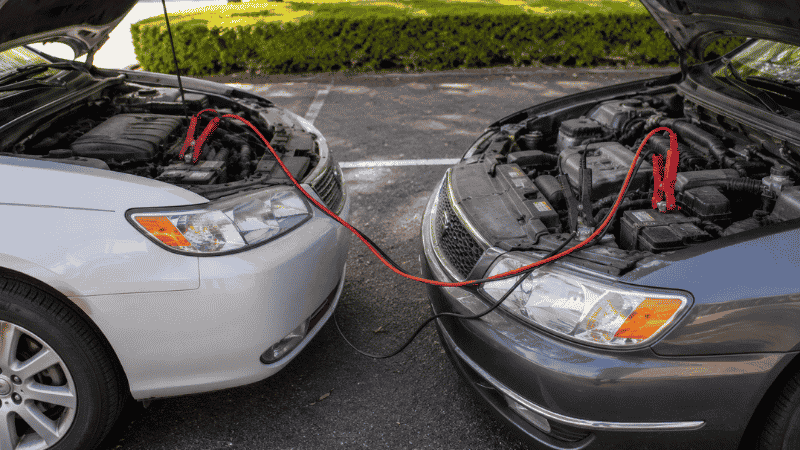
Option B: Traditional Jumper Cables (Second Car Required)
If you have jumper cables and a willing driver nearby:
The correct sequence — memorize it as: Dead positive → Live positive → Live negative → Ground:
- Park the live car close but not touching the dead car
- Connect red clamp to the positive terminal of the dead battery
- Connect the other red clamp to the positive terminal of the live battery
- Connect black clamp to the negative terminal of the live battery
- Connect the other black clamp to an unpainted metal surface on the dead car’s engine block or chassis — not to the dead battery’s negative terminal
The grounding step prevents a spark near the battery, which can emit hydrogen gas during charging. It’s a safety step, not optional.
Start the live car and let it run for 2–3 minutes. Then start the dead car. Once running, disconnect in reverse order: ground first, then live negative, live positive, dead positive.
How to Choose a Replacement Battery
Not all batteries fit all cars, and the wrong battery can cause electrical problems or simply not fit the battery tray.
Three Things to Match
1. Group Size: The physical dimensions of the battery and the terminal placement. Your owner’s manual specifies this (e.g., Group 35, Group 24F). Using the wrong group size means the battery may not fit or the cables won’t reach the terminals.
2. Cold Cranking Amps (CCA): The current the battery can deliver for 30 seconds at 0°F. Your owner’s manual specifies a minimum — don’t go lower. You can go higher for better cold-weather performance. If you live in a cold climate, prioritizing CCA is worth the slight extra cost.
3. Reserve Capacity (RC): How long the battery can power the car’s electrical systems without the engine running. Higher is better, especially if you ever leave electronics running with the engine off.
What “Maintenance-Free” Means
Most modern batteries are sealed, maintenance-free units — you can’t add water or check electrolyte levels. These are appropriate for almost all passenger vehicles. The older “maintenance-required” batteries with caps for adding distilled water still exist but are increasingly uncommon. Check your owner’s manual if you’re unsure which type you need.
Brand Considerations
Battery quality varies more than most drivers realize. Consumer-grade batteries at big-box retailers are typically adequate for moderate climates and average use. For hot climates, high-use vehicles, or vehicles with significant electronics, brands like Optima, Odyssey, or OEM-equivalent batteries from your dealer perform better and often carry longer warranties (3–5 years vs. 1–2 years for budget options).
The cost difference between budget and premium batteries is typically $30–70 — meaningful, but minor compared to the cost and inconvenience of a roadside failure.
How to Replace a Car Battery Yourself
Battery replacement is one of the most accessible DIY car tasks. Most vehicles require only basic tools and 20–30 minutes.
What you need:
- Adjustable wrench or socket set (typically 10mm)
- Gloves and eye protection
- Baking soda and water solution (for cleaning corrosion)
- Wire brush or battery terminal cleaner
- Memory keeper/OBD keep-alive device (optional but recommended — see below)
Before you start — the memory keeper note:
Modern cars store settings in their computers: radio presets, window positions, seat memory, power steering calibration, TPMS sensor locations. Disconnecting the battery resets some of these. A battery memory keeper ($10–20) is a small device that plugs into your OBD-II port and maintains a low-current connection to preserve these settings during battery swap. Optional, but worth knowing about.
Step 1: Locate the battery Most passenger car batteries are under the hood near the firewall. Some vehicles have them in the trunk (common in BMWs, some Audis) or under the rear seat (some Chrysler products). Check your owner’s manual if you can’t locate it.
Step 2: Disconnect negative first, always Loosen the nut on the negative terminal (marked – or with a black cover) and remove the cable. Tuck it aside so it can’t make contact with the positive terminal while you work. Then remove the positive cable the same way.
The negative-first rule prevents accidental short circuits. If you touch a wrench to the positive terminal with the negative still connected, completing a circuit to ground through the wrench can cause a dangerous spark or arc.
Step 3: Remove the battery hold-down A bracket or clamp at the base or side of the battery holds it in position. Remove the bolt(s) holding this bracket and set it aside.
Step 4: Lift out the old battery carefully Car batteries are heavier than they look — typically 30–50 lbs. Lift with both hands and keep it upright. Battery acid can leak from a battery tilted significantly. Have a place to set it immediately.
Step 5: Clean the battery tray and terminals Use baking soda solution and a wire brush to clean any corrosion from the tray, cable ends, and terminal clamps. Corrosion on the new battery’s terminals from the start will cause the same problems that just happened.
Step 6: Install the new battery Set the new battery in the tray in the correct orientation — positive terminal on the correct side (matches where the positive cable reaches). Reinstall and tighten the hold-down bracket.
Step 7: Connect positive first, then negative Opposite of removal. Connect positive first, tighten firmly, then connect negative. Check that both connections are snug — wiggling cable ends indicate loose connections that cause the same symptoms as a dead battery.
Step 8: Verify and clean up Start the car and verify all electrical systems function normally. If any warning lights are on that weren’t before, they may need to be reset — typically by driving the car for a few minutes so the vehicle’s computer re-learns settings.
Battery disposal: Car batteries contain lead and sulfuric acid and cannot go in regular trash. Every auto parts store that sells batteries accepts old batteries for free recycling. Most also apply a small core charge when you buy a new battery that’s refunded when you return the old one.
When to Stop DIY and Call a Professional
Most battery situations are manageable at home. These are the exceptions:
- Battery is in the trunk or under a rear seat — access often requires removing interior panels, which varies in difficulty by vehicle
- The battery keeps dying within days of replacement — the problem is likely the alternator (not charging the battery) or a parasitic drain from a faulty electrical component
- The charging system warning light stays on after battery replacement — the alternator needs inspection
- You see corrosion on the battery cables themselves (not just the terminals) — corroded cables need replacement, which requires accessing the full cable run
- The car has a start-stop system or AGM battery requirement — AGM (Absorbent Glass Mat) batteries require specific charging parameters; installing the wrong type or failing to register the new battery with the car’s ECU can cause issues on some European vehicles
FAQ
How do I know if my car battery needs replacing? The clearest sign is slow or labored engine cranking — the engine sounds like it’s working harder than usual to start. Other signs include interior lights dimming when starting, clicking but no cranking, and a battery older than 4 years. A free load test at any major auto parts store gives you a definitive answer in 5 minutes.
How long does a car battery last? Average is 3–5 years, but this varies significantly by climate. Hot climates (above 95°F regularly in summer) shorten battery life to 2–3 years. Cooler climates can extend life to 5–6 years. Short trips that don’t allow full recharging also accelerate wear.
Can a completely dead battery be recharged? Sometimes, but not always. A battery that discharged due to leaving a light on can typically be fully recharged with a battery charger and returned to normal service. A battery that died because it reached end-of-life cannot be restored by charging — the chemical capacity is gone. A load test after charging will tell you which situation you’re in.
Is it safe to drive with a weak battery? For a short distance to a repair shop, yes. For extended driving or another day’s commute, no — a weak battery can fail completely without warning, and a car that dies in traffic is significantly more dangerous than one that won’t start in a parking lot. If your battery is showing warning signs, get it tested within a day or two.
What happens to my car’s settings when I replace the battery? Radio presets, clock settings, and in some vehicles window/seat positions will reset. More significantly, the engine’s adaptive settings and TPMS sensor registration may reset, causing warning lights for a short period. These typically resolve after a few drive cycles. A memory keeper device can prevent most resets.
Can I use any battery for my car? No — you need the correct group size (physical dimensions) and at minimum the specified Cold Cranking Amps. Using a battery that’s too small physically may not fit the tray or allow the cables to reach. Using a battery with insufficient CCA can cause hard starting in cold weather. Going higher on CCA than specified is acceptable and often beneficial.
How much does a car battery cost? Budget batteries for common vehicles: $80–120. Mid-range: $120–180. Premium (AGM, Optima, Odyssey): $180–300. Installation at a shop: $20–50 labor if you bring the battery in, or often free if you buy from them. DIY installation costs nothing beyond your time and saves the labor charge.
What’s Next
A healthy battery is the foundation of your car’s entire electrical system. These guides cover the maintenance habits that work alongside battery health:
- Car maintenance checklist — where battery testing fits in your full annual maintenance schedule, and what else to check at the same time. (→ Car Maintenance Checklist)
- Car essentials every driver should have — including the portable jump starter that means a dead battery never strands you again. (→ Car Essentials Every Driver Actually Needs)
- How to check car fluids — the other monthly checks that, combined with battery monitoring, cover the vast majority of preventable breakdowns. (→ How to Check Car Fluids)
The drivers who are never stranded aren’t lucky. They’re the ones who pay attention to what their car is telling them — weeks before it becomes a problem.
References
- American Automobile Association (AAA) — 2023 Roadside Assistance Data Report; battery failure as primary cause of service calls
- Society of Automotive Engineers (SAE) International — Battery Cold Cranking Ampere Test Standards, SAE J537; Automotive Battery Specification Standards
- U.S. Department of Energy — Vehicle Technologies Office: Battery Performance and Temperature Effects, technical reference for lead-acid battery performance in extreme temperatures
- Consumer Reports — Car Battery Reliability Data 2023, battery brand reliability ratings and average lifespan by climate zone
Battery question we didn’t cover? Contact us — we read every message.