
Gas prices never seem to stay low for long. If you’ve found yourself filling up more often and wondering how to get better gas mileage, you’re not alone. The good news is that you don’t need to buy a new car or spend money on questionable fuel-saving gadgets. A few smarter driving habits, simple maintenance tasks, and small changes to the way you use your car can make a noticeable difference.
In this guide, you’ll learn how to get better gas mileage with practical tips you can start using today—many of them completely free. We’ll cover the driving habits that have the biggest impact, the maintenance that actually improves fuel economy, and the popular “fuel-saving” products that simply aren’t worth your money.
Overview: What Actually Improves Gas Mileage
The direct answer is this: driving habits and tire pressure have the biggest impact on fuel economy, followed by routine maintenance and reducing unnecessary weight or drag. Combined, these changes typically improve fuel economy by roughly 5–20%, depending on how the vehicle is currently being driven and maintained.
That range matters. If you’re already a smooth, attentive driver with a well-maintained car, you might only pick up a few percentage points. If you tend to accelerate hard, skip tire checks, and haul unnecessary gear, you have real room to improve. Either way, the fixes below are the same ones mechanics and fuel-efficiency testing consistently point to — not miracle products, just consistent habits.
Biggest Fuel Savers at a Glance
| Change | Estimated MPG Impact | Effort Required |
|---|---|---|
| Smoother acceleration and braking | Up to 10–15% | Low |
| Proper tire pressure | 1–3% (more if severely underinflated) | Very low |
| Reducing highway speed (75→65 mph) | Up to 8–10% | Low |
| Removing roof racks/boxes when not in use | 2–5% on highways | Low |
| Staying current on maintenance | Restores lost MPG, up to 10% if neglected | Medium |
| Reducing excess trunk weight | Small but adds up | Low |
| Fuel additives, cold air intakes, tunes | Little to none | N/A |
Start With the Habits That Save the Most Fuel
Before spending money on fuel additives or aftermarket parts, start with the one thing that makes the biggest difference: the way you drive. Two drivers can take the same car on the same route and still end up with very different MPG simply because of their driving habits. Smooth, consistent driving almost always beats expensive “fuel-saving” upgrades.
Accelerate Like You’re Carrying a Cup of Coffee
Hard acceleration burns noticeably more fuel than gradual, steady acceleration. A simple mental trick many driving instructors recommend: imagine there’s a full cup of coffee on your dashboard, and drive so it wouldn’t spill. This naturally smooths out your throttle input without requiring you to think about RPMs or fuel maps.
Coast Instead of Racing to Red Lights
It’s surprisingly common for new drivers to accelerate right up to a red light or stopped traffic, then brake hard at the last second. This wastes the energy you just spent speeding up. Looking further down the road and easing off the accelerator early lets momentum carry you forward, often meaning you barely need the brakes at all by the time you reach the light.
Why Driving 75 MPH Uses More Fuel Than 65 MPH
Aerodynamic drag increases sharply as speed increases — not in a straight line, but exponentially. That’s why dropping from 75 to 65 mph often saves more fuel than people expect, sometimes in the range of 8–10%. If your schedule allows a few extra minutes, moderate highway speeds are one of the easiest ways to stretch a tank of gas.
When Cruise Control Helps—and When It Doesn’t
On flat, consistent highway stretches, cruise control keeps your speed steady and avoids the small accelerations and decelerations that add up over a long drive. On hilly terrain, however, cruise control can sometimes work against you, gunning the throttle to maintain speed uphill. In hilly conditions, manual control with a light foot often gets better results.
Driving Habit vs. Fuel Savings
| Driving Habit | Fuel Impact | Difficulty | Estimated Savings |
|---|---|---|---|
| Smooth acceleration | High | Easy | 10–15% |
| Coasting to stops | Medium | Easy | 3–5% |
| Moderate highway speed | High | Easy | 8–10% |
| Cruise control (flat highways) | Medium | Easy | 3–7% |
| Avoiding aggressive lane changes | Low-Medium | Easy | 1–3% |
Key takeaway: Your right foot influences fuel economy more than almost any aftermarket modification you could buy.
Keep Your Tires Properly Inflated
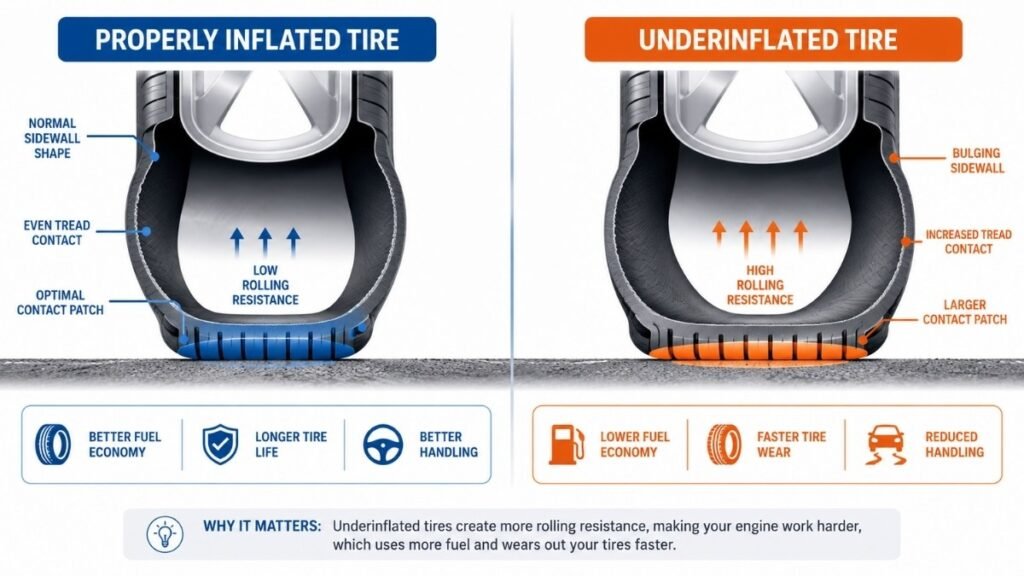
Underinflated tires increase rolling resistance, which means your engine has to work harder to maintain the same speed — burning more fuel in the process. This is one of the cheapest and most overlooked fixes available to any driver.
Find the Correct PSI for Your Vehicle
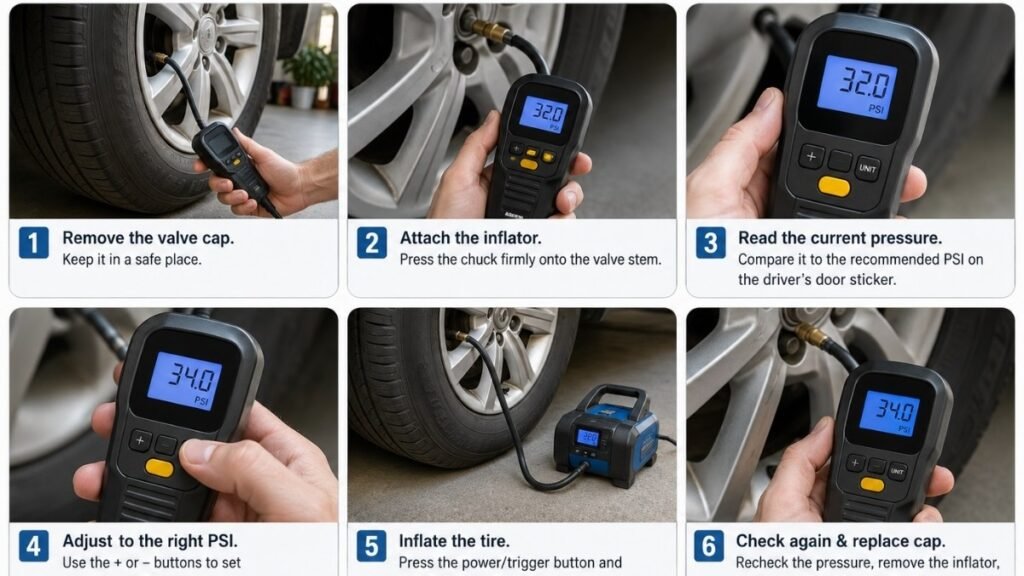
Your vehicle’s recommended PSI is listed on a sticker inside the driver’s door jamb, not on the tire itself (the number on the tire is the maximum, not the recommended pressure). Following the manufacturer’s number is the safest and most fuel-efficient choice.
How to Check Tire Pressure at Home
Check tire pressure when tires are “cold,” meaning the car has been parked for at least a few hours or driven less than a mile. Driving heats up the tires and raises the pressure reading, giving you an inaccurate number. Learning to check and maintain correct tire pressure at home takes just a few minutes and removes the guesswork that leads many drivers to only discover a problem when a warning light appears.
Common Tire Pressure Mistakes
- Checking pressure after driving, when tires are already warm
- Assuming the number on the tire’s sidewall is the recommended PSI
- Forgetting that pressure drops roughly 1 PSI for every 10°F temperature decrease
- Only checking tires when a warning light comes on, rather than proactively
Monthly Tire Pressure Checklist
- Check pressure in all four tires (plus spare, if applicable)
- Compare against the door jamb sticker, not the tire sidewall
- Check pressure cold, before driving
- Adjust for seasonal temperature swings
- Inspect for uneven wear that may indicate alignment issues
Many drivers only think about tire pressure when the TPMS light comes on — by which point the tires may already be significantly underinflated. Checking monthly, rather than reactively, is the more reliable habit.
Key takeaway: Proper tire pressure is one of the easiest, safest, and cheapest ways to improve MPG — and it also extends tire life.
Reduce Extra Weight and Wind Resistance
Every extra pound your car carries takes a small amount of extra fuel to move. On its own, weight isn’t usually the biggest factor — but wind resistance from roof-mounted accessories often is, especially at highway speeds.
How Much Extra Weight Really Matters
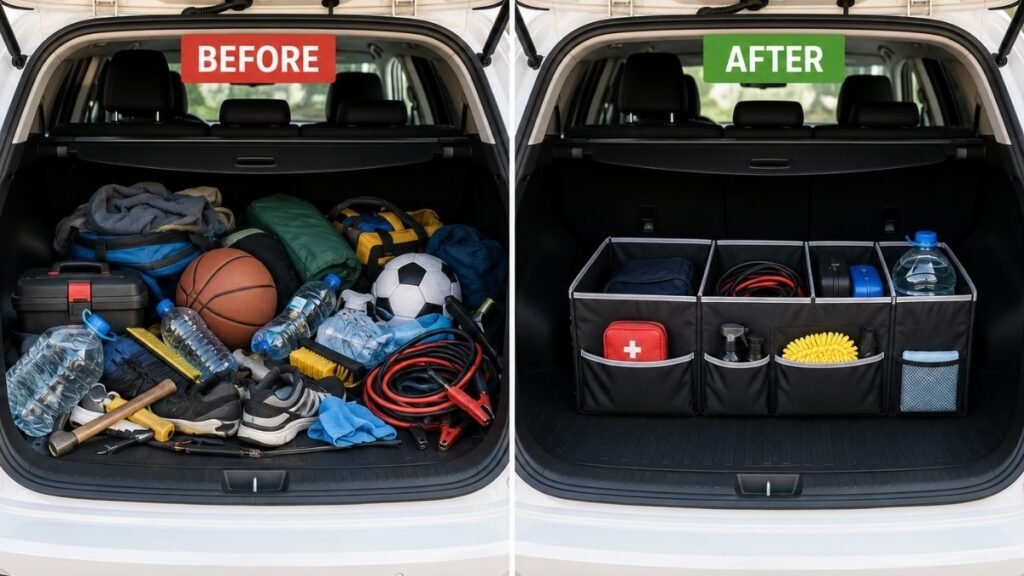
The rule of thumb is that fuel economy drops by roughly 1% for every 100 extra pounds carried, depending on the vehicle. That’s a modest number on its own, but it’s common for trunks to quietly accumulate camping gear, tools, sports equipment, or cases of water that sit there for months at a time without being used.
Roof Rack vs. Roof Box vs. Empty Roof
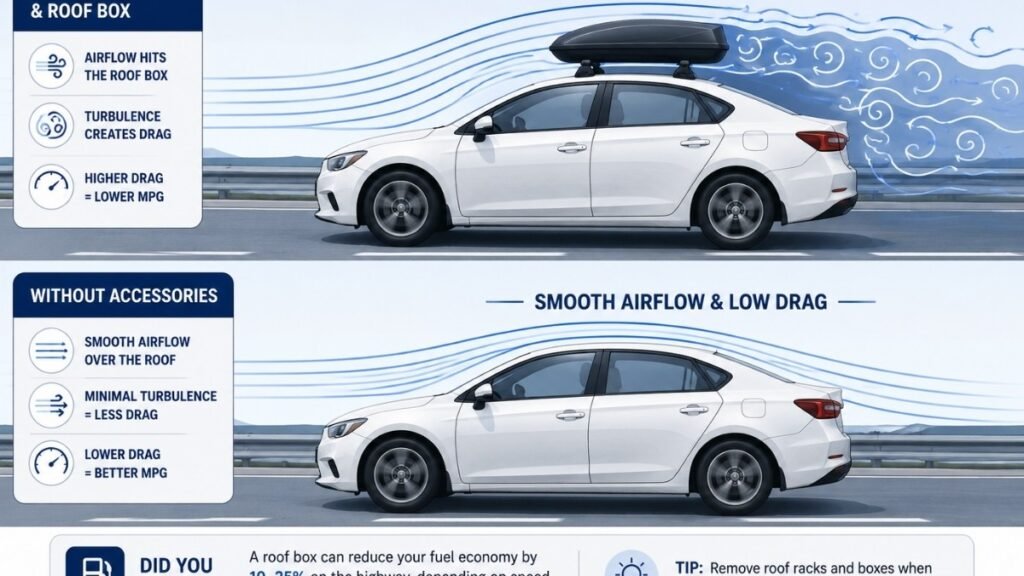
Roof-mounted cargo creates far more aerodynamic drag than the equivalent weight sitting in the trunk, because it disrupts airflow over the entire length of the vehicle. An empty roof rack left on “just in case” can measurably hurt highway MPG even without anything strapped to it.
Accessory vs. Aerodynamic Drag
| Accessory | Added Drag | Best Use | Remove When? |
|---|---|---|---|
| Roof box | High | Long trips, extra cargo | Not on trip |
| Roof rack (bare) | Medium | Occasional bike/kayak use | Not in regular use |
| Bike rack (rear) | Low-Medium | Weekend rides | Not needed |
| Trunk cargo | Low | Daily essentials only | Excess/unused items |
3-Minute Trunk Weight Audit
- Remove tools or equipment not used in the last month
- Take out extra water cases or bulk purchases
- Store seasonal gear (skis, camping equipment) at home when not needed
- Keep only an emergency kit and essential items
- Take roof racks/boxes off when not actively in use
Key takeaway: Removing unnecessary weight helps, but reducing aerodynamic drag — especially from roof accessories — often saves even more fuel on highway drives.
Stay on Top of Basic Maintenance
Neglected maintenance is one of the most common reasons fuel economy quietly drops over time. The tricky part is that the decline is gradual, so many drivers blame gas prices before ever suspecting an overdue maintenance item.
Maintenance Items That Affect MPG
- Engine oil: The wrong or degraded oil increases internal friction, making the engine work harder.
- Air filter: A clogged air filter restricts airflow to the engine, which can reduce efficiency, especially on older vehicles.
- Spark plugs: Worn spark plugs cause incomplete combustion, wasting fuel.
- Oxygen sensors: A failing sensor can cause the engine to run rich, burning more fuel than necessary.
- Wheel alignment: Poor alignment increases rolling resistance and uneven tire wear.
Problems That Cause Sudden Fuel Economy Drops
A sudden, noticeable drop in MPG (rather than a gradual one) is often a sign of something specific — a failing oxygen sensor, a stuck thermostat, or a dragging brake caliper. If your fuel economy drops sharply over a week or two rather than slowly over months, it’s worth having it checked rather than assuming it’s just “normal.”
Maintenance Item vs. MPG Impact
| Maintenance Item | MPG Impact | Typical Replacement Interval |
|---|---|---|
| Engine oil | Medium | Every 5,000–10,000 miles |
| Air filter | Low-Medium | Every 12,000–15,000 miles |
| Spark plugs | Medium | Every 30,000–100,000 miles (varies by type) |
| Oxygen sensor | High if failing | 60,000–100,000 miles |
| Wheel alignment | Low-Medium | Annually or after impact |
Keeping a habit of checking your engine oil level and condition between changes, and following a regular maintenance schedule, catches most of these issues before they cause a noticeable MPG drop.
Key takeaway: Routine maintenance restores lost fuel economy — it rarely creates dramatic gains beyond what the vehicle was designed to achieve, but it prevents unnecessary losses.
Drive Smarter in Stop-and-Go Traffic
City driving is inherently less fuel-efficient than highway driving because of constant acceleration and braking. But within that reality, there’s still a meaningful difference between reactive driving and anticipatory driving.
Why City Driving Hurts MPG
Every full stop means the car has to use energy to get back up to speed again. The more often you stop completely, the more fuel you burn simply restarting momentum — which is why traffic-heavy commutes often show noticeably worse MPG than the same distance driven on the highway.
The “Feather the Throttle” Technique
Rather than accelerating firmly then braking, easing on and off the throttle gently in traffic helps maintain a rolling pace without the sharp stops and starts that waste fuel. It takes some practice, but it becomes second nature after a few weeks.
Avoid Racing Between Traffic Lights
Tailgating is a common culprit here — following too closely often pressures drivers into repeated hard acceleration and braking just to keep pace with the car ahead. Leaving a larger following distance gives you room to coast and anticipate, rather than react.
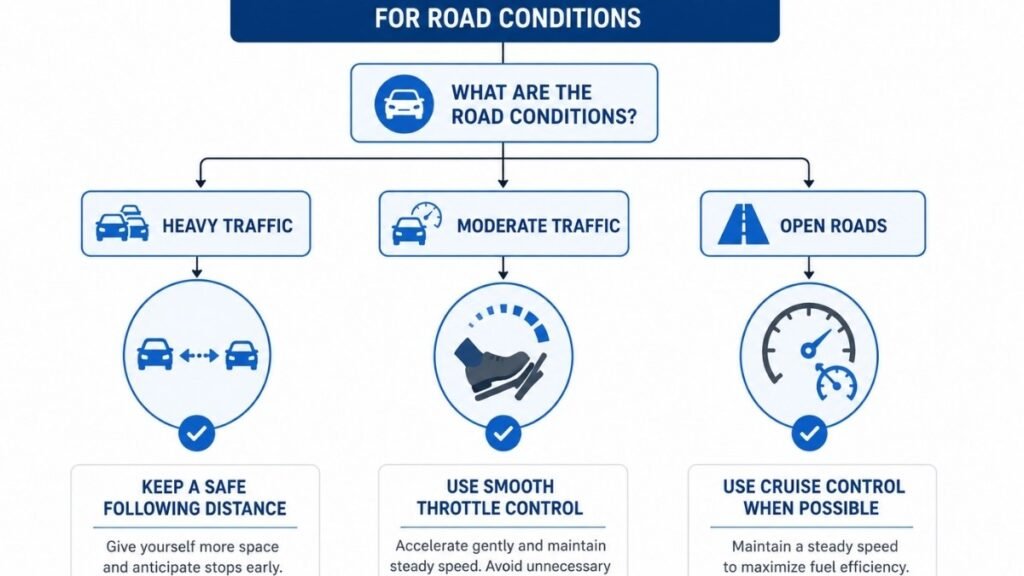
Traffic Driving Decision Guide
- Heavy traffic: Leave extra following distance, feather the throttle, avoid unnecessary lane changes.
- Moderate traffic: Anticipate lights and slowdowns early, coast when possible.
- Open roads: Maintain a steady, moderate speed; use cruise control on flat stretches.
Key takeaway: City fuel economy improves more from anticipation than from speed — seeing traffic patterns early beats reacting to them.
Use Air Conditioning, Windows, and Eco Mode the Right Way
This is one of the most debated fuel economy topics, and the honest answer is that there isn’t one universal rule — it depends on your speed.
When Windows Save Fuel
At lower, city-driving speeds, air conditioning draws more power from the engine than the drag created by open windows. In this range, windows down is typically the more fuel-efficient choice, assuming weather allows it.
When AC Is More Efficient
At highway speeds, open windows create enough aerodynamic drag to outweigh the fuel cost of running the AC. Many drivers assume rolling windows down always saves fuel, when in reality the crossover point is generally somewhere around 45–50 mph — above that, closed windows with AC running is usually more efficient.
What Eco Mode Actually Changes
Eco mode typically adjusts throttle response and shift points to encourage gentler acceleration — it doesn’t change the engine’s mechanical efficiency. In other words, eco mode nudges your driving style rather than working like a hidden performance boost.
Situation vs. Better Choice
| Situation | Better Choice |
|---|---|
| City driving | Windows down |
| Highway driving | AC with windows up |
| Hot weather, short trip | Windows down, precool briefly with AC |
| Mild weather | Windows down when comfortable |
Key takeaway: Speed determines whether AC or open windows use less fuel — there isn’t one universal answer.
Avoid Fuel Economy Myths That Waste Your Money
Walk through any auto parts store and you’ll find plenty of products claiming they’ll boost fuel economy. The reality is that most of them make little or no measurable difference in MPG, and some can even do more harm than good. If your goal is to spend less on gas, you’re almost always better off focusing on smarter driving habits and routine maintenance.
Modifications That Rarely Pay for Themselves
Fuel additives, cold air intakes, aftermarket exhaust systems, and performance tunes are marketed heavily around fuel savings, but independent testing has consistently found minimal to no real-world MPG improvement from most of these products. Even in cases where a small gain exists, the cost of the product usually exceeds what you’d save in fuel over its lifespan.
Upgrades That Actually Help Reliability
Some upgrades are worth doing — just not for the reason people assume. A quality air filter or OEM-spec spark plugs support reliability and consistent performance, but they should be thought of as maintenance, not a fuel-saving hack.
When Premium Fuel Is Required
Premium gasoline only matters if your vehicle’s manufacturer specifically requires it (usually higher-compression or turbocharged engines). If your manual says “regular unleaded recommended,” using premium provides no measurable MPG benefit — it’s simply a more expensive fuel with no added efficiency for that engine.
Product vs. Worth Buying
| Product | Cost | MPG Benefit | Worth Buying? |
|---|---|---|---|
| Fuel additives | Low-Medium | Minimal to none | Rarely |
| Cold air intake | Medium | Minimal | Rarely |
| Performance tune | High | Inconsistent, often none for MPG | Rarely |
| Exhaust upgrade | High | None for MPG | No (for fuel savings) |
| Premium fuel (if not required) | Ongoing | None | No |
Key takeaway: Most expensive MPG upgrades never recover their cost through fuel savings alone — the habits and maintenance covered earlier do far more for far less money.
Simple Car Tools That Make Fuel Saving Easier
None of the habits above require special tools, but a few affordable accessories make it much easier to stay consistent — which is often the real challenge.
Best Beginner-Friendly Fuel Saving Tools
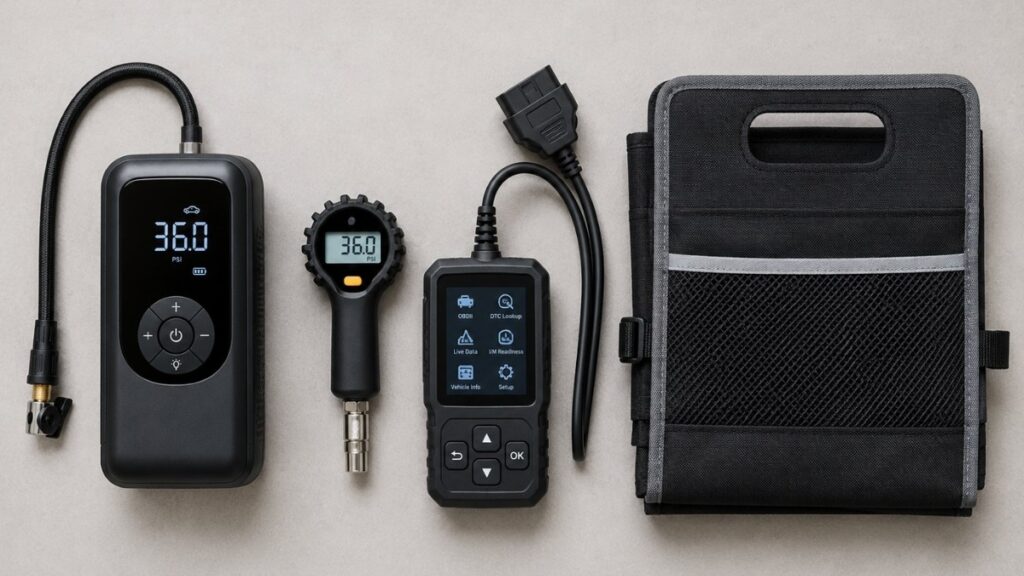
- Digital tire inflator with auto-stop: Makes it easy to top off tires at home without guessing, and takes the excuse out of “I’ll check it at the gas station later.”
- Digital tire pressure gauge: More accurate and easier to read than the analog gauges often found at gas stations.
- OBD2 scanner: Helps identify the cause of a check engine light — including sensors that quietly hurt fuel economy — before it becomes a bigger repair.
- Lightweight trunk organizer: Encourages keeping only what’s needed in the car, rather than letting weight accumulate over time.
Which Tools Are Worth Buying First
For most new car owners, a tire inflator and gauge offer the best return for the lowest cost, since tire pressure is checked most often. An OBD2 scanner is worth adding once you want to understand why a fuel economy drop is happening, rather than just guessing.
Fuel-Saving Tool Comparison
| Tool | Purpose | Approximate Cost | Best For Beginners |
|---|---|---|---|
| Digital tire inflator | Maintain correct PSI at home | $30–$60 | Yes |
| Digital tire gauge | Accurate pressure readings | $10–$20 | Yes |
| OBD2 scanner | Diagnose fuel-economy issues | $25–$80 | Yes, once comfortable |
| Trunk organizer | Reduce clutter and excess weight | $20–$40 | Yes |
Having these tools on hand tends to make good habits stick. It’s a lot easier to check tire pressure regularly when there’s an inflator in the garage, rather than needing to make a special trip to a gas station.
Key takeaway: Affordable tools don’t improve MPG by themselves — they make it easier to consistently follow the habits that do.
Frequently Asked Questions
What is the single most effective way to improve gas mileage without spending money?
Smoother acceleration and braking typically offer the biggest free improvement, often in the range of 10–15%. Combine that with moderate highway speeds and you’ll see the largest gains available without spending a dollar.
How does tire pressure affect fuel economy, and what PSI should I keep my tires at?
Underinflated tires increase rolling resistance, forcing the engine to work harder. Always follow the PSI listed on the driver’s door jamb sticker, not the number printed on the tire itself, and check it monthly when tires are cold.
How do I keep my MPG from dropping in stop-and-go city traffic?
Anticipate stops early, feather the throttle instead of braking hard, and leave extra following distance so you can coast rather than react. These habits reduce the repeated acceleration that makes city driving less efficient.
Do fuel additives, cold air intakes, or aftermarket tunes actually improve gas mileage?
Generally, no. Independent testing consistently shows minimal to no real MPG benefit from these products, and most never recover their cost through fuel savings.
Does carrying extra weight or keeping roof racks on your car reduce gas mileage?
Yes, though roof-mounted accessories usually matter more than weight alone, since they create aerodynamic drag at highway speeds. Removing a roof box or rack when it’s not in use is an easy win.
Is idling your car in the winter to warm it up bad for your gas mileage?
Extended idling burns fuel while producing zero miles traveled, and modern engines don’t need long warm-up periods to drive safely. Thirty seconds to a minute is generally enough before driving gently.
Is it worth swapping an engine or trading in an older truck/SUV just to get better MPG?
For most owners, no — the cost of an engine swap or a new vehicle far exceeds what you’d realistically save in fuel over several years. Habit changes and maintenance offer a far better return for the money.
Does replacing a dirty air filter or old spark plugs help recover lost gas mileage?
Yes, particularly if fuel economy has dropped gradually over time. These are maintenance items that restore lost efficiency rather than boost performance beyond factory levels — worth checking if a decline seems unexplained.
🏠 AutoIXPro Garage Notes: The Thinking Behind This Guide
Getting better gas mileage isn’t about finding a miracle product—it’s about building a few smart habits that make every tank of fuel go a little further.
That’s why this guide focuses on practical changes any driver can make, whether you’re commuting every day, planning a road trip, or simply trying to spend less at the pump.
This guide is built around three simple ideas:
- 🚗 Smarter Driving — Small changes behind the wheel that reduce unnecessary fuel use.
- 🔧 Routine Maintenance — Easy upkeep that helps your vehicle run efficiently.
- 💰 Real Value — Advice that saves money without relying on expensive gadgets or gimmicks.
Because improving fuel economy isn’t about chasing perfect MPG.
It’s about driving smarter, spending less, and getting more out of every mile.
Continue Building Smarter Driving Habits
Saving fuel is just one part of owning a car with confidence. These beginner-friendly guides can help you maintain your vehicle, solve common problems, and make everyday driving easier.
- Learn how to check your tire pressure correctly—one of the quickest ways to improve fuel economy, extend tire life, and stay safer on the road. (→ How to Check Tire Pressure)
- Check your engine oil in just a few minutes to help your engine run smoothly and avoid unnecessary wear. (→ How to Check Oil in Your Car)
- Follow a simple maintenance checklist to stay ahead of routine service and keep your vehicle performing at its best. (→ Car Maintenance Checklist)
- Want to save money on routine maintenance? Learn how to do an oil change yourself with this beginner-friendly step-by-step guide. (→ How to Do an Oil Change)
- Build a smarter emergency kit with the practical car essentials every driver should keep on hand for everyday driving and unexpected situations. (→ Car Essentials Every Driver Actually Needs)
❤️ A Final Note
Better driving isn’t about knowing every answer—it’s about building smart habits that make every trip safer, easier, and more enjoyable.
At AutoIXPro, we believe practical car advice should be easy to understand, affordable to follow, and useful in everyday life. That’s why every guide we publish focuses on real-world solutions instead of marketing hype.
Our goal is simple: helping everyday drivers become more confident car owners—one practical guide at a time.