
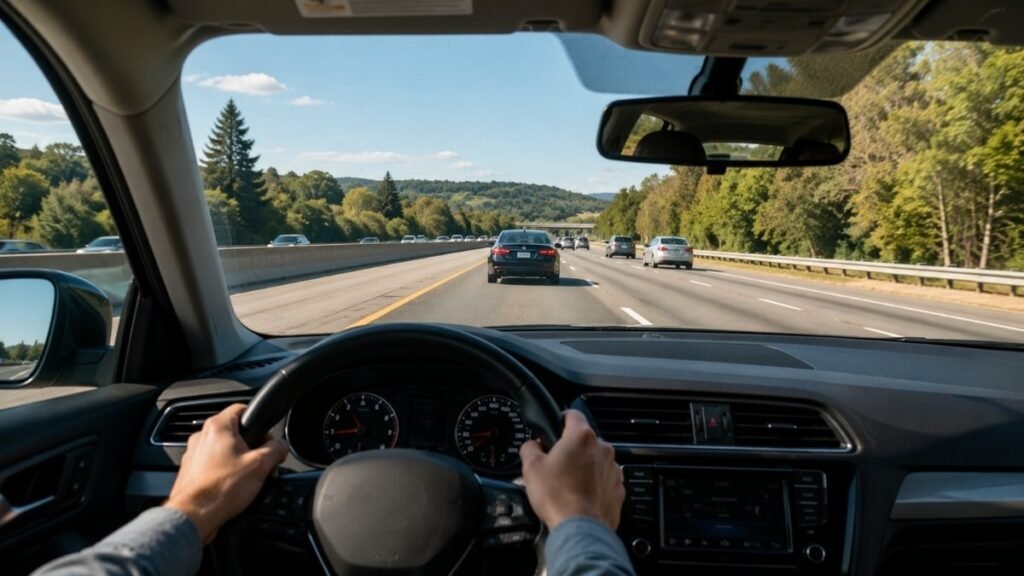
Most rear-end crashes don’t happen because drivers fail to brake—they happen because there wasn’t enough space to begin with. When the vehicle ahead stops suddenly, those extra few seconds are often the difference between braking safely and hitting the bumper in front of you.
The tricky part is that most people estimate following distance by eye. A gap that looks perfectly reasonable at 30 mph can be surprisingly unsafe at 65 mph, which is why so many drivers end up following closer than they realize.
This is exactly why the 3 second rule in driving exists. It replaces guesswork with a simple, repeatable method that works at any speed, in almost any car. In this guide, you’ll learn how to measure it correctly, when three seconds isn’t enough, how to handle traffic that keeps stealing your space, and which accessories actually help you keep a safer gap without turning your dashboard into a gadget shop.
Overview / Quick Answer
The 3-second rule gives you a useful reaction buffer under normal conditions, but it cannot guarantee that you will stop in time in every situation. It’s a minimum guideline for dry roads and normal visibility — not a fixed distance in feet or meters, since it automatically scales with your speed.
Here’s how it works in practice:
- Pick a fixed roadside reference point — a sign, pole, or pavement marking.
- Start counting the instant the rear of the vehicle ahead passes it.
- Count steadily: “one-one-thousand, two-one-thousand, three-one-thousand.”
- Your car should reach that same point only after you finish counting.
- If conditions are worse than normal — rain, darkness, poor traction, heavy vehicles — stretch the count longer.
- If another car merges into your gap, don’t fight it. Ease off the accelerator and let the space rebuild naturally.
Quick-Answer Card
| Driving Condition | Suggested Minimum Gap |
|---|---|
| Dry road and clear visibility | 3 seconds |
| Light rain or night driving | 4 seconds |
| Heavy rain or following a large vehicle | 4–5 seconds |
| Snow, fog, towing, or poor traction | 6 seconds or more |
| Ice or extreme conditions | 8 seconds or more |
What Is the 3-Second Rule in Driving?
At its core, the 3-second rule is a minimum time gap — not a distance — that you maintain between your vehicle and the one ahead under normal driving conditions. It’s a baseline, not a ceiling. Plenty of situations call for more.
Why Following Distance Is Measured in Seconds
Time-based following distance solves a problem that fixed distances can’t: speed. A gap of “two car lengths” might feel fine crawling through a parking lot, but at highway speed that same visual gap gives you almost no time to react. Measuring in seconds automatically fixes this, because the faster you go, the more physical road space three seconds covers. You don’t need to do any math — the count adjusts itself.
It’s also worth separating following distance from total stopping distance. Following distance is the buffer you choose to leave. Stopping distance is everything that happens once you decide to brake: recognizing the danger, reacting, and the car physically slowing down. The 3-second rule is designed to give you enough of a head start to cover both.
Many driver’s handbooks list the 3-second rule as a baseline, but some regions recommend longer intervals as standard practice, especially for new drivers or commercial vehicles. It’s worth checking your local guidance rather than assuming three seconds is universally the maximum recommendation.
Is Three Seconds Always Enough?
No — three seconds is a starting point for good conditions, not a fixed rule that applies everywhere. Rain, fog, darkness, a loaded vehicle, or a driver who’s tired all eat into your safety margin faster than most people expect. Treat three seconds as the floor, not the target.
One beginner habit worth breaking early: leaving the same number of “car lengths” in the city and on the highway. At city speeds, a tight-looking gap is often fine because everyone is moving slowly and stopping distances are short. On the highway, that same gap is a much bigger risk — and a proper 3-second highway gap will look and feel larger than most new drivers expect. That’s normal. It’s not overly cautious; it’s correct.
How to Use the 3-Second Rule While Driving
Knowing the rule is one thing—using it in real traffic is another.Once you’ve practiced it a few times, checking your following distance becomes something you can do almost automatically while driving.
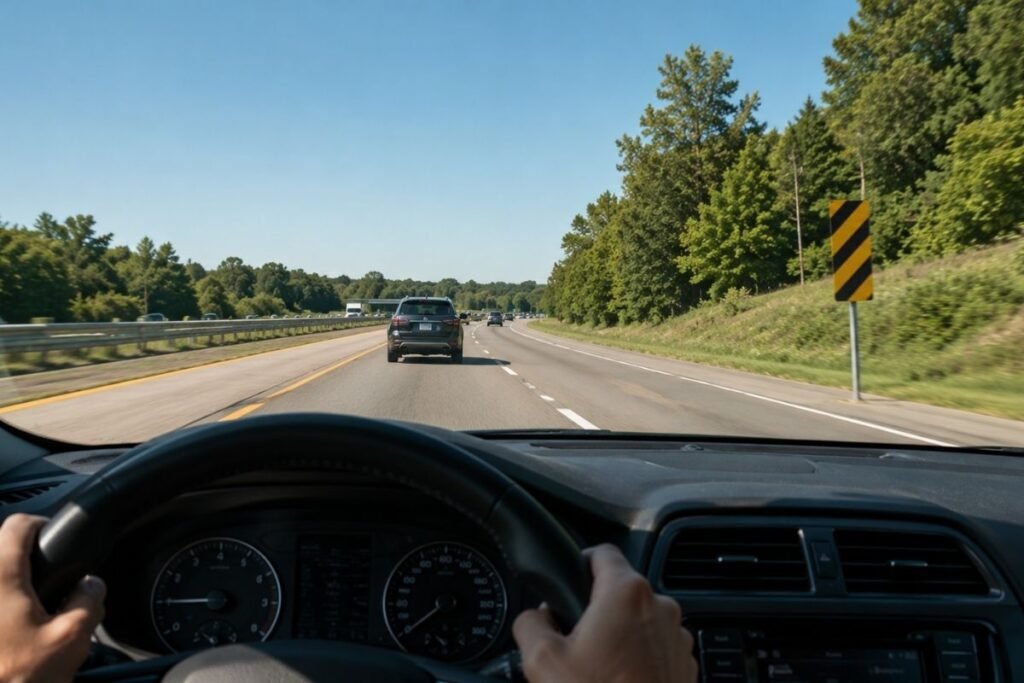
Step 1: Choose a Fixed Reference Point
Look ahead for something stationary: a road sign, a utility pole, a bridge support, a painted lane marking, or even a distinctive tree. Avoid anything that moves — another vehicle isn’t a valid marker, since its speed changes the whole calculation.
Step 2: Count as the Vehicle Ahead Passes It
The moment the rear bumper of the car in front passes your chosen marker, start counting: “one-one-thousand, two-one-thousand, three-one-thousand.” Say it at a natural, steady pace — not rushed.
Step 3: Check and Adjust Your Gap
Watch when the front of your own car reaches that same marker. If you get there before you finish counting, you’re following too closely — ease off the accelerator and let the gap open back up naturally. If you finish the count before you reach the marker, your spacing is good.
Repeat this check periodically, especially after a speed change, a lane change, or when traffic starts compressing. It only takes a few seconds, and it becomes automatic with practice.
3-Second Rule Practice Checklist
- Practice on a lightly traveled road first
- Maintain a steady, consistent speed
- Choose a clear, truly fixed marker
- Count naturally — don’t rush the numbers
- Keep scanning the road, not just the marker
- Adjust by easing off the accelerator, not braking hard
- Recheck your gap after any condition change
It’s surprisingly common for new drivers to count too fast without realizing it — adrenaline and unfamiliarity tend to speed up your internal clock. A useful habit is to practice this method away from rush-hour traffic a few times until the rhythm feels natural, so it’s second nature once you’re dealing with real congestion.
How Far Is a 3-Second Following Distance?
Three seconds isn’t a fixed distance — it’s a time interval that translates into very different physical gaps depending on your speed. Here’s roughly what that looks like:

| Speed | Approximate Distance in 3 Seconds | Approximate Distance in Meters |
|---|---|---|
| 30 mph | 132 feet | 40 meters |
| 45 mph | 198 feet | 60 meters |
| 60 mph | 264 feet | 80 meters |
| 70 mph | 308 feet | 94 meters |
These figures are useful for building intuition, but they’re illustrations, not a replacement for the roadside counting method — actual distance will vary slightly depending on your speedometer accuracy and road conditions. The real value here is understanding scale:At 70 mph, three seconds covers just over 300 feet—roughly the distance from one goal line to the other on an American football field.
This is also where counting car lengths falls apart completely. A “two car length” gap might be roughly accurate at low speed, but at 70 mph it would put you dangerously close to the vehicle ahead — nowhere near enough time to react.
People often find that once they get used to a correct highway gap, other drivers treat it as an invitation to merge in. That’s expected, and it’s not a flaw in the method — it just means you’ll be rebuilding your gap more often on busy highways. The temptation to close that “unnecessarily large-looking” space is one of the most common ways drivers slowly drift back into unsafe habits.
Why the 3-Second Rule Makes Driving Safer
Before your car starts slowing down, you need a moment to recognize the danger, move your foot to the brake, and let the brakes do their job. Most drivers don’t realize how quickly those seconds disappear until they’re forced to stop suddenly.
Perception and Reaction Time
Before you can brake, you first have to notice the hazard, then decide to act, then physically move your foot to the brake pedal. This entire sequence — perception plus reaction — typically eats up more time than people expect, and it gets longer with fatigue, distraction, darkness, or unfamiliarity with the road.
Braking Distance
Once your foot is on the brake, your vehicle still needs physical distance to slow down. This is affected heavily by speed, tire condition, road traction, and how much weight the vehicle is carrying. A worn tire or wet road can extend braking distance significantly compared to a well-maintained car on dry pavement.
| Stopping Stage | What Happens | Common Delays |
|---|---|---|
| Perception | Driver notices the hazard | Darkness, rain, distraction |
| Reaction | Driver decides and moves to brake | Fatigue, phone use, inexperience |
| Braking | Vehicle physically slows | Speed, poor traction, worn components |
Look Beyond the Vehicle Directly Ahead
A common mistake is watching only the brake lights of the car directly in front. Experienced drivers scan several vehicles ahead, which gives them a head start on slowing down before the immediate hazard even reaches them. It’s a small habit that meaningfully increases your effective reaction time.
Even a brief glance down at a navigation screen can consume the entire following-distance buffer you worked to build. A two-second glance at 60 mph covers over 175 feet with your eyes off the road — which is most of your 3-second cushion gone before you’ve even registered a problem.
When 3 Seconds Isn’t Enough
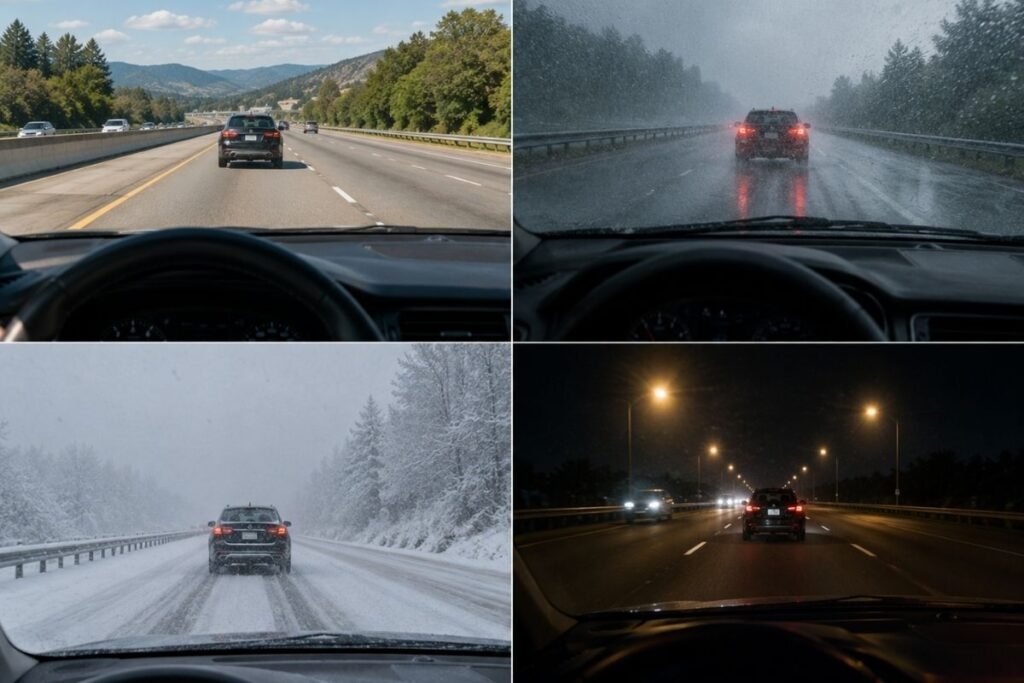
Three seconds is a good starting point, but it isn’t the right answer for every drive.Weather, visibility, road conditions, and even the type of vehicle you’re following can reduce the time you have to react.
| Condition | Suggested Minimum Gap | Main Risk |
|---|---|---|
| Normal dry conditions | 3 seconds | Standard baseline |
| Light rain or darkness | 4 seconds | Reduced visibility or traction |
| Heavy rain or blocked forward view | 4–5 seconds | Delayed hazard detection |
| Snow, fog, towing, or poor traction | 6 seconds or more | Longer stopping distance |
| Ice or extreme conditions | 8 seconds or more | Severely reduced control |
Rain, Snow, Ice, and Fog
Wet or icy roads reduce tire grip, which directly extends braking distance. Fog and heavy rain also delay how quickly you can perceive a hazard in the first place. Both problems compound, which is why the recommended gap grows so much under poor weather.
Night Driving and Glare
Reduced visibility at night, combined with headlight glare from oncoming traffic, slows down hazard recognition. A slightly longer gap gives you a buffer for the extra half-second or so it can take to register something in low light.
Following Large Vehicles
Trucks, buses, and vans block your view of the road ahead, meaning you often can’t see brake lights or road hazards until the vehicle in front of you reacts. Following one closely reduces both your visibility and your escape options if something goes wrong.
Towing, Heavy Loads, and Downhill Roads
Extra weight — whether from cargo or a trailer — extends braking distance substantially, and downhill grades add momentum that makes stopping even harder. These factors combine in a way that surprises a lot of drivers the first time they tow or haul something heavy.
Increase Your Gap When:
- The road is wet, snowy, icy, muddy, or loose
- Visibility is limited
- A large vehicle blocks the road ahead
- Your vehicle is heavily loaded
- You are towing
- You are traveling downhill
- Your tires or brakes may be compromised
- You feel tired or distracted
One mistake worth flagging directly: increasing the gap without also reducing speed doesn’t fully solve the problem. A bigger following distance helps, but if you’re still driving at normal speed on ice or in heavy fog, you’re only addressing part of the risk.
How to Handle Cut-Ins, Tailgaters, and Heavy Traffic
Busy roads rarely stay predictable for long. One driver cuts into your gap, another follows too closely, and traffic can slow without much warning.
When Three Seconds Feels Impossible
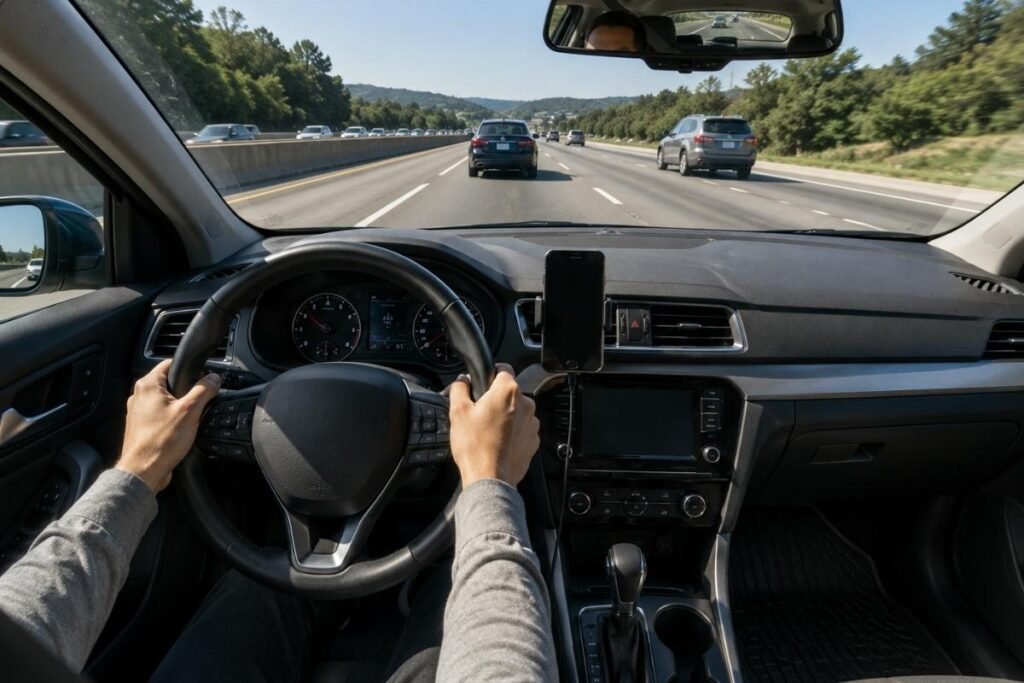
In dense, slow-moving traffic, maintaining a full 3-second interval often isn’t realistic — other drivers will fill the space almost immediately. In these situations, the priority shifts to reducing speed and preserving as much space as conditions reasonably allow, rather than rigidly chasing a specific number.
What to Do When a Vehicle Enters Your Gap
This is one of the most common frustrations drivers report — you build a proper gap, and someone merges right into it. The safe response is to ease off the accelerator and let the gap rebuild gradually. Accelerating to close the new gap or “punish” the merging driver defeats the entire purpose of leaving space in the first place.
It helps to reframe the gap mentally: it’s a reusable safety buffer, not territory you’re defending. Losing it to a merge isn’t a loss — rebuilding it is simply part of normal driving.
What to Do When Someone Is Tailgating You
If a driver is following you too closely, resist the urge to brake-check or speed up in response. Instead, increase your own front gap so you have more room to slow down gradually if needed, and when it’s safe, move over or use a legal pullout to let them pass. This isn’t “giving in” — it’s managing risk on both ends of your vehicle.
Does Leaving a Gap Slow Down Traffic?
Not meaningfully, and often the opposite is true. Larger, more consistent following gaps tend to reduce the accordion-style braking that causes phantom traffic jams — where one driver brakes hard, and that reaction ripples backward through dozens of cars. A steady buffer smooths traffic flow rather than disrupting it.
Defensive Response Checklist
- Stay predictable
- Scan several vehicles ahead
- Ease off the accelerator
- Avoid sudden steering or braking
- Rebuild the gap gradually
- Let aggressive drivers pass safely
- Never brake-check
- Avoid confrontation
| Situation | Safe Response | Avoid |
|---|---|---|
| Vehicle cuts into gap | Ease off and rebuild space | Accelerating to block it |
| Tailgater behind | Increase front gap and move over safely | Speeding or brake-checking |
| Dense traffic | Lower speed and preserve a usable buffer | Closing every available gap |
| Aggressive driver | Remain predictable and disengage | Gestures or confrontation |
If a tailgating situation escalates into something more serious, a front-and-rear dash camera provides useful documentation after the fact — though it’s worth being clear that a camera records an incident, it doesn’t prevent one.
Common Following-Distance Mistakes to Avoid
Knowing the 3-second rule doesn’t automatically mean you’ll use it consistently. Small habits, rushed decisions, and everyday distractions can gradually shorten your following distance without you even noticing.
Measurement Mistakes
Counting too quickly is one of the most common errors — under mild stress, most people’s internal counting speeds up without them noticing, effectively shrinking a “3-second” gap to something closer to two. Using car lengths instead of seconds, or picking a moving vehicle as a reference point, are two other habits worth breaking early.
Defensive-Driving Mistakes
Treating three seconds as sufficient in every condition, watching only the vehicle directly ahead instead of scanning further down the road, and assuming driver-assistance features like adaptive cruise control fully replace the need for a safe following distance are all mistakes that quietly erode your safety margin over time.
Cabin Distractions That Consume Reaction Time
A gap only protects you if you’re actually paying attention to it. Some of the most common culprits:
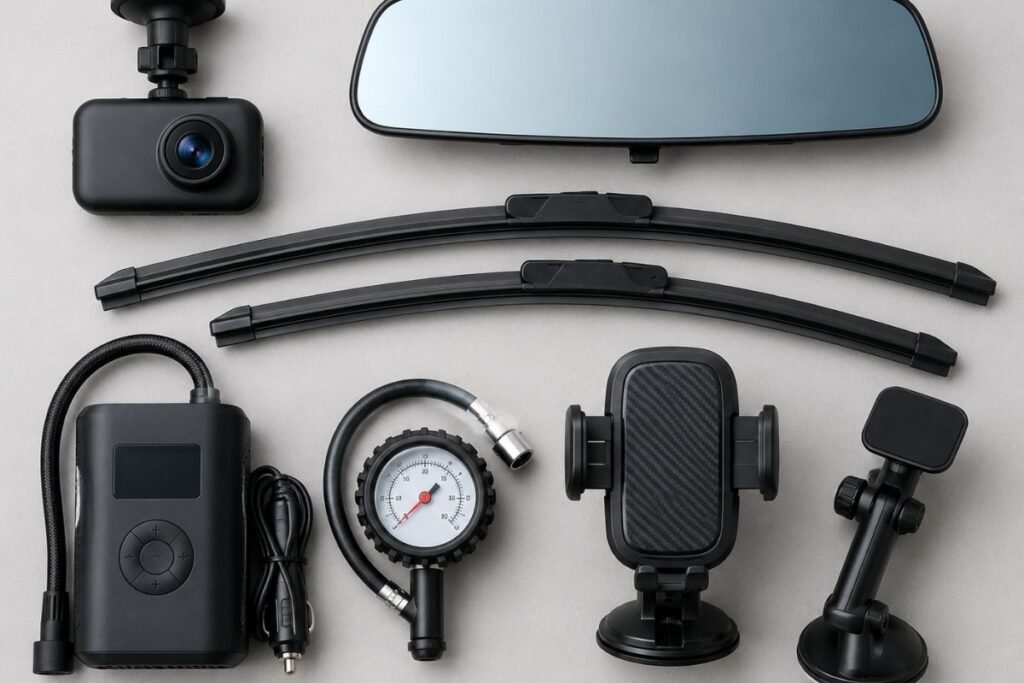
- A poorly positioned phone mount that requires looking down or away from the road
- Loose bottles, tools, or badly fitted floor mats that can interfere with pedals
- Streaking or worn wipers that delay recognizing brake lights in rain
- Fogged, dirty, or oily glass reducing visibility
10-Second Pre-Drive Focus Check
- Navigation set before moving
- Phone securely mounted
- Notifications silenced
- Mirrors adjusted
- Windshield and windows clear
- Wipers functioning
- Loose items secured
- Pedals unobstructed
- Seat and steering position adjusted
A securely positioned mount can reduce the need to look down toward a cupholder or center console, but it should never block the windshield or encourage frequent screen use.
Helpful Car Accessories for Safer Driving
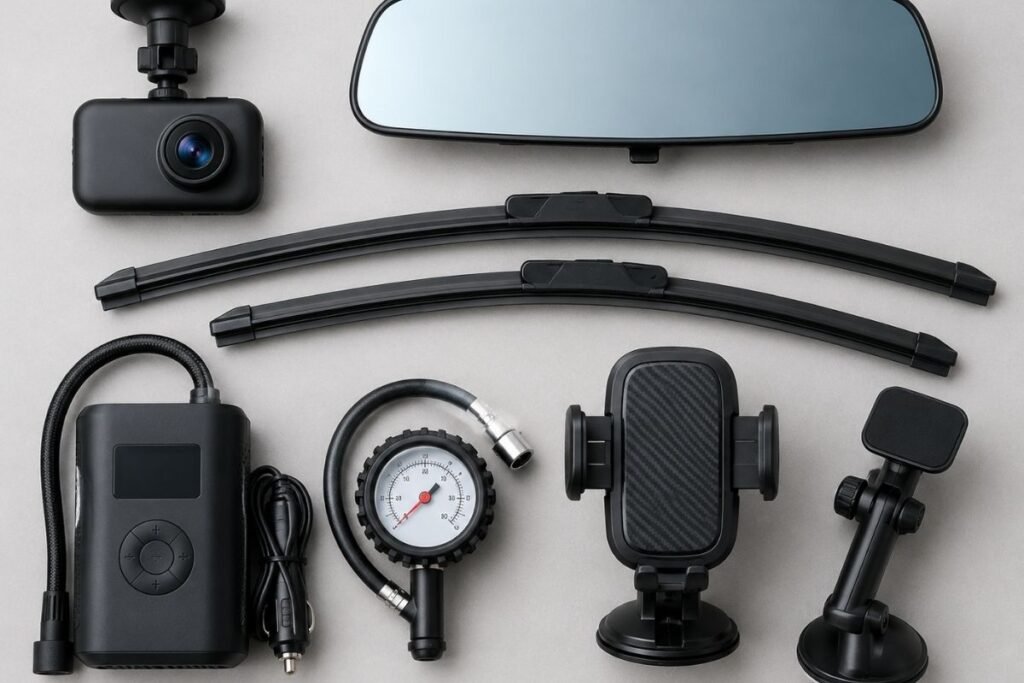
No accessory can replace a safe following distance, but a few well-chosen tools can make everyday driving easier. Better visibility, fewer distractions, and a vehicle that’s ready for changing road conditions all help you react more confidently when traffic changes unexpectedly.
Tools That Reduce Distraction
A stable, eye-level phone mount keeps navigation glances brief and close to your normal line of sight, instead of requiring a full look down at the console. Look for one with a secure, non-wobbling grip — a mount that vibrates or drifts is arguably worse than no mount at all, since it invites repeated adjustments while driving.
Tools That Improve Visibility
Quality windshield wipers and a good glass or oil-film cleaner directly affect how quickly you spot brake lights and road hazards in rain. Anti-glare or auto-dimming mirrors reduce the effect of headlight glare at night, which can meaningfully cut down perception delay after dark.
Tools That Support Vehicle Control
An accurate tire-pressure gauge or a portable inflator helps you keep tires at the correct pressure, which directly affects braking performance and handling. This is one of the cheapest, most overlooked ways to support the braking half of your stopping-distance equation.
Tools That Document Dangerous Driving
A front-and-rear dash cam won’t prevent a cut-in or a tailgater, but it does give you reliable documentation if a serious incident happens — useful for insurance claims or disputes over fault.
| Accessory | Primary Purpose | Important Buying Criteria |
|---|---|---|
| Eye-level phone mount | Reduce navigation distraction | Stability, legal placement, clear sightline |
| Front-and-rear dash cam | Document cut-ins and rear impacts | Night clarity, rear coverage, reliable storage |
| Wipers and glass-care tools | Maintain visibility in rain | Correct fit, streak-free performance |
| Anti-glare mirror | Reduce nighttime glare | Optical clarity, secure installation |
| Tire gauge or inflator | Support braking and handling | Accuracy, portability, auto-stop |
| HUD | Display limited information near eye level | Readability, compatibility, distraction risk |
| Vehicle-specific floor mats | Keep pedal area clear | Secure anchors, correct fit, non-slip backing |
Solve visibility and distraction problems first — mount, wipers, mirror — before adding anything purely cosmetic. Oversized phone cradles, dangling ornaments, or bulky mounts positioned in your direct sightline can undo the benefit of every other safety habit on this list by blocking part of your view.
FAQ
What is the 3-second rule in driving, and how do you calculate it properly on the road?
It’s a minimum following-distance guideline: pick a fixed roadside point, and make sure at least three seconds pass between the car ahead passing it and your own car reaching it. Count “one-one-thousand, two-one-thousand, three-one-thousand” as a steady pace, and ease off the accelerator if you arrive early.
Is it realistic to maintain a 3-second following distance in heavy or urban highway traffic?
Not always perfectly, and that’s expected. In dense traffic, focus on reducing speed and preserving as much space as conditions allow rather than forcing an exact three-second gap that other drivers will immediately fill.
How should you react when other drivers constantly cut into your 3-second safety gap?
Ease off the accelerator and let the gap rebuild gradually — don’t accelerate to close the new space. Treat it as a reusable buffer rather than territory to defend.
How many seconds of following distance should you leave during rain, snow, or night driving?
Generally 4 seconds for light rain or night driving, 4–5 seconds for heavy rain or when a large vehicle blocks your view, and 6 seconds or more for snow, fog, towing, or poor traction.
What should you do if someone is tailgating you closely from behind while you maintain your front gap?
Increase your own front gap for extra braking room, and when safe, move over or use a legal pullout to let them pass. Avoid brake-checking or speeding up in response.
Does maintaining a safe 3-second gap actually create traffic jams or slow down your commute?
No — consistent following gaps tend to reduce the hard-braking chain reactions that cause phantom traffic jams, so a steady buffer generally smooths traffic flow rather than disrupting it.
Why does the 3-second rule work better than counting vehicle lengths at high speeds?
Because time automatically scales with speed, while a fixed number of car lengths doesn’t. A gap that looks adequate at low speed becomes far too tight at highway speed, whereas a 3-second count stays proportionally accurate at any velocity.
What essential car accessories can help protect drivers from tailgating and aggressive cut-ins?
A front-and-rear dash camera is the most directly relevant tool, since it documents incidents for insurance or fault disputes. Beyond that, a stable phone mount and good wipers support the attention and visibility you need to respond safely in the first place.
🚗 AutoIXPro Garage Notes: Why We Put This Guide Together
Learning the 3-second rule is easy. Trusting yourself to use it when traffic suddenly slows, someone cuts into your lane, or rain starts pouring down is a different story. Most drivers have had at least one moment where they wished they had left just a little more space.
That’s why we created this guide. Instead of repeating the rule itself, we focus on the situations that make following distance harder to judge—busy highways, poor weather, tailgaters, and the small distractions that quietly steal your attention.
Every safe trip is built on small habits, repeated over time.
If this guide helps you feel a little calmer, a little more prepared, and a little more confident the next time you’re behind the wheel, then it has done exactly what we hoped.
🚗 Continue Building Safer Driving Habits
Keeping a safe following distance is only one part of becoming a more prepared driver. These practical guides can help you handle common roadside problems, maintain your tires and brakes, and feel more confident every time you get behind the wheel.
- How to Check Tire Pressure — Learn how to check and adjust tire pressure for safer braking, better handling, and more even tire wear.
- How to Change a Flat Tire — Follow a clear, beginner-friendly process for replacing a flat safely at the roadside.
- How Often to Rotate Tires — Find out when to rotate your tires and how this simple habit can help them last longer.
- How Long Do Car Brakes Last? — Understand typical brake lifespan, warning signs, and when it may be time for an inspection.
❤️ A Final Note
Cars are part of everyday life, but good driving isn’t about knowing every answer. It’s about building simple habits that make each trip a little safer, a little easier, and a little less stressful.
At AutoIXPro, we believe practical car advice should be clear, honest, and useful long after you’ve finished reading. That’s why we focus on real-world driving, straightforward maintenance tips, and everyday solutions that help you make confident decisions behind the wheel.
Whether you’re learning your first driving habit or improving one you’ve had for years, we’re glad to be part of the journey.
Drive safe, keep learning, and enjoy every mile ahead.